Sean Murray is the President and Chief Editor of deBanked and the founder of the Broker Fair Conference. Connect with me on LinkedIn or follow me on twitter. You can view all future deBanked events here.
Articles by Sean Murray

Is Online Lending the Next Credit Crisis?
August 7, 2015CIT CEO John Thain went on Bloomberg earlier to say that “some of the most leveraged lending is being pushed out of the bank space.” The comment was used to challenge Lending Club CEO Renaud Laplanche about whether or not online lending would be the next credit crisis. Laplanche answered that marketplace lending is the least levered model.”It’s a profit match between assets and liabilities, one to one,” he said.
Laplanche also said that life as a public company has been good because it’s made customers more likely to trust them and large companies more likely to partner with them.
You can listen to what he had to say in the video below:
Lending Club is one of six members that recently founded the Responsible Business Lending Coalition, which made headlines yesterday when it announced a borrowers bill of rights.
Is This OnDeck Class Action Lawsuit a Sham?
August 7, 2015Update: The lawsuit was withdrawn on September 28, 2016
 If you haven’t actually read the class action complaint filed against On Deck Capital on August 4th for an alleged violation of securities laws, you can download it here. Reactions throughout the industry are generally mixed, but the big surprise is that anyone would actually be surprised about who OnDeck is or what they are doing.
The company sourced 68.5% of its loans from commercial finance brokers in 2012 and 45.6% of its loans from them in 2013. By the second quarter of this year, that percentage had drifted down to 20.6%.
To OnDeck, this gradual shift has been part of an overall strategy to control their sales process, costs, and reputation. While it might impede origination growth in the short term, it would be a heck of a lot harder to explain to investors in the future that the company’s fate was in the hands of unknown salespeople who may or may not be swayed to work with their competitors at any moment.
Understandably, many brokers were not happy when OnDeck suddenly terminated them. Angry feelings spilled out on to DailyFunder, an online message board, and were eventually cited in a Seeking Alpha article, the very same article the lawsuit opens up with to make its case.
“THE TRUTH BEGINS TO EMERGE,” the complaint states. “On February 11, 2015, less than two months after the IPO, SeekingAlpha.com published an article entitled “On-Deck Capital: Bad Loans, Bad Interest Rates, Bad Business Plan.”
But the author of the article, TheStreetSweeper, which describes itself as as “a publisher of news and opinion,” placed a disclaimer that they held a short position in OnDeck’s stock. And notably, TheStreetSweeper website is run by Hunter Adams, a convicted felon who makes no effort to hide his past. His website bio says, “his career ended in 2001, when government investigators accused him of manipulating worthless penny stocks.” And continues, “he pled guilty to two conspiracy charges — for securities fraud and money laundering — and served time in prison for his crimes. Years later, he pled guilty to racketeering charges, fully cooperated with the government and accepted full responsibility for his actions.”
Today, his opinion on a stock for which he holds a short position in, has somehow become credible enough for lawyers to make the case that the “truth” had come out about OnDeck. But it’s no small oversight by the Pomerantz law firm, the attorneys that brought the suit on behalf of plaintiff Carl A. Stitt. A cursory glance at the law firm’s past press releases and filed complaints show that the firm regularly relies on TheStreetSweeper’s stories to solicit plaintiffs as well as to bolster class action complaints.
Notably, TheStreetSweeper’s analysis (overseen by convicted mob associate pumper dumper Hunter Adams), which Pomerantz accepts at face value and offers as evidence of misleading default rates, calculates a loan loss rate 24.8%. That formula is unfortunately incorrect. $26.7 million in charge offs divided by $107.6 million in gross revenue might return 24.8% but that’s not how one assesses a loan loss rate. $107.6 million is the interest income, not the aggregate loan principal.
OnDeck had an aggregate unpaid principal balance on loans outstanding of $422.1 million for the nine months ending September 30, 2014. $26.7 million was charged off during that time period.
Some quick math: $26.7 million/$422.1 million = 6.3% lost.
This is decent considering the company generated $107.6 million worth of interest income, not to mention consistent with what company management has both said and reported. TheStreetSweeper’s math and the plaintiff’s reliance on it is unsurprisingly wrong.
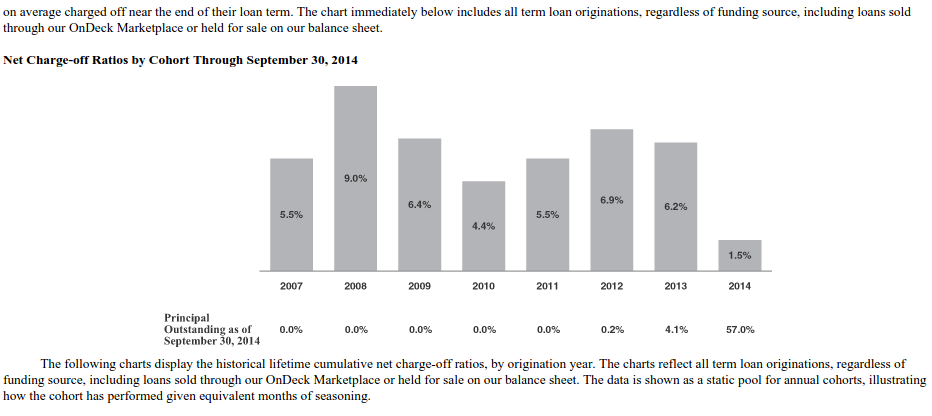
Reading through the rest of the suit, the plaintiff’s complaint hinges almost entirely on the phony calculation.
OnDeck might not be popular with the commercial finance brokers these days, and I myself have published several posts about their progress (good and bad), but if anything is garbage, it’s probably this lawsuit.
—-
Note: I do not and have never had a financial position in OnDeck.
Do Borrowers of a Feather Flock Together?
August 6, 2015Facebook believes that you might be the company you keep, at least according to a patent it has.
“When an individual applies for a loan, the lender examines the credit ratings of members of the individual’s social network who are connected to the individual through authorized nodes,” reads an explanation of the technology. “If the average credit rating of these members is at least a minimum credit score, the lender continues to process the loan application. Otherwise, the loan application is rejected.”
Diagram below:
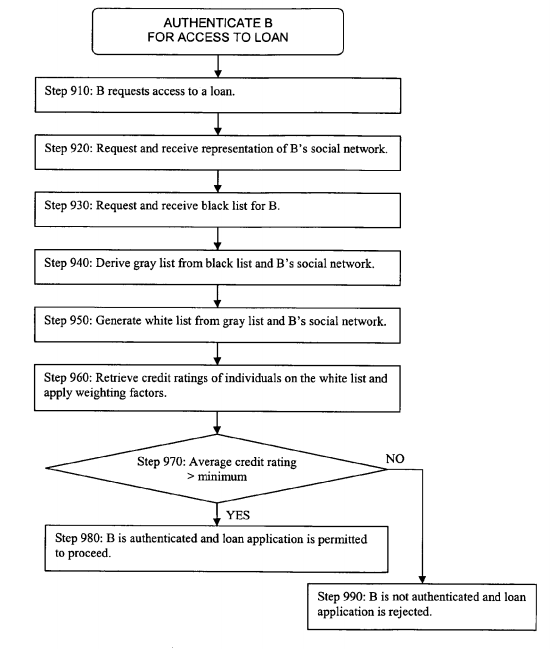
This is one of those concepts that if ever used, is likely to end up prohibited under an amendment to the Equal Credit Opportunity Act or similar.
What are your thoughts on this?
And also, you might want to check out similar patents that Kabbage has in its arsenal.
MCC and BizFi Founder Stephen Sheinbaum on Bloomberg
August 4, 2015Earlier today on Bloomberg TV:
“Automation doesn’t mean no underwriting,” said Stephen Sheinbaum, the founder of Merchant Cash and Capital and BizFi.
Sheinbaum also said that they have never raised an equity round from an institution.
“We do want to go public,” he added. If they can obtain an equity investor, he put their timeline to go public at 12 to 18 months.
Watch the video below:
Have Your Marketing Response Rates Changed?
August 4, 2015 Notice anything different with your marketing response rates lately? OnDeck has…
During the OnDeck Q2 earnings call yesterday, company CEO Noah Breslow said, “there are no two or three competitors dominating this trend (direct marketing), but we know the sheer number of marketing solicitations targeted to small businesses has grown meaningfully over the last six months which impacts our response rates.”
The comments were interesting because while they opposed any correlation between the increased competition and their continuously declining interesting rates, it was an acknowledgement that they are not alone in their marketing efforts, nor are their marketing methodologies proprietary.
The comment was focused mainly on direct mail campaigns and Breslow argued their strategy was to “break through the clutter” and “better communicate our value proposition.”
“Competition for customer response remains elevated,” he later added.
OnDeck still managed to fund $419 million for the quarter, up only $3 million from the previous quarter, but a 69% increase over the same time period a year ago.
During the Q&A which was unfortunately not part of the recorded transcript so I will paraphrase as best I can from memory, a few analysts inquired deeper about the competition.
One wondered if their competitors’ marketing efforts were sustainable or if they were simply on a market share binge and would eventually go away. Breslow said there would probably be a combination of both, that some would continue to stick around long term and others might fall off. It was a safe answer because while some of their competitors may indeed have high acquisition costs, there are still profits being made and nobody should expect the competition to subside any time soon, if ever.
Breslow also shared that the competition was bidding up the price online, talking at least in part about Pay-Per-Click marketing.
OnDeck shed more Funding Advisors (brokers) in Q2 than they expected to because of their “re-certification program.” Brokers either didn’t make the cut or would not go through the program. Only 20.6% of their loans were originated by brokers in Q2 of this year as opposed to 30.8% during this time last year. Brokers brought in bigger loans though on average because they made up 28.4% of the dollar volume of loans originated this year. Last year at this time they made up 42.9% of the volume.
OnDeck has managed to grow despite their dwindling reliance on brokers and a marked increase in competition.
Have your direct mail and online advertising response rates changed recently? If OnDeck has taken notice, surely you must have too…
Update: You can read the full transcript of the call here, including the Q&A
deBanked’s Next Issue Shipping Soon
August 3, 2015Are you ready for another issue of deBanked Magazine?!
In this edition, we explore the Australian market, the commission chargeback debate here at home, the quest for national bank charters, a deeper look at the Midden v. Midland case and MORE!
Haven’t been receiving the print edition in the mail? You need to SUBSCRIBE for that. It’s free.

We distribute thousands of copies to ISOs, brokers, lenders, funders, and other players in the alternative business lending ecosystem. Want to be included in future issues? Drop me a line at sean@debanked.com
New Funding Brokers Struggle As Industry Grows
August 3, 2015 Here’s a few things that will have you scratching your head.
1. A new sales agent recently took to an industry forum to ask for help with ACH processing. According to him, he charged a closing fee on a loan that closed and then realized that he had no idea how to collect the fee. His problem was perplexing because he had the merchant sign an agreement that authorized him to debit the funds out despite not having an ACH processing account.
Some sympathetic veterans advised him to have the merchant write him a check, but others were too dumbfounded by his use of an ACH agreement when he did not know anything about ACH. The agreed fee was probably too large to write off as a mistake so hopefully the merchant will understand and write him a check for services rendered.
The lesson: If you don’t know how to do something, don’t guess. The agent would’ve been in a much better situation if he had asked how to collect fees prior to drawing up an agreement that referred to a methodology he had no familiarity with.
2. A semi-seasoned sales agent griped about a recent experience on an online message board about a business lender that stole his deals and turned out to be a repeat felon. The broker community was not sympathetic when they learned that the “lender” used a gmail address to communicate. What’s worse is that a perfunctory Google search revealed a record of violent crime.
The lesson: At the very least, do not send deals to anyone using a free email address. This was item #3 on my Advice to New Brokers list, published back in February. This also violated item #4 on my list, which says, don’t send your deal to some random company just because they went around posting on the web. A simple Google search for this broker would’ve showed that the “lender” was a serial criminal.
3. One broker e-mailed me to say that a lender had stolen his syndication money and disappeared. Another told me that they had stopped receiving their syndication deposits for their entire portfolio and wasn’t sure what was going on. This situation often doesn’t make the public forums because the aggrieved parties are sometimes too embarrassed to tell others that they got hustled. I recommended a lawyer to one of them.
The lesson: Refer to #4 on my Advice to New Brokers list. Even if others claim to be having a positive experience, there are a few red flags to look out for when it comes to syndication:
- Were they too eager to accept your money?
- Did they have an Anti-Money Laundering process in place?
- Would your funds be co-mingled with their operating funds or isolated in a separate account?
- How is their system structured? Will you get paid even if they declare bankruptcy?
- Was the owner of the company ever charged or convicted with fraud? This is probably the most important and for some reason the most overlooked. If the owner was previously charged with fraud and your money eventually gets stolen, you can only blame yourself. And if you don’t know if someone has a past criminal history, you should probably ask around in addition to conducting a formal background check.
Syndicating brings me to item #1 on my Advice list, hire a lawyer. If you can’t afford a lawyer, you definitely can’t afford to syndicate.
OnDeck to Announce to Q2 Earnings
August 3, 2015 OnDeck will announce their second quarter earnings today at 5:00 PM EST. Anyone can dial in by calling (877) 201-0168 and using conference ID 80861672.
The company’s executives may have to endure more questions than in previous calls because of the low stock price and the curious guidance reversal issued two weeks ago. After Q1, OnDeck projected Adjusted EBITDA for Q2 to be a loss of $3 million to $4 million. But on July 15th, they revised that to a GAAP net income of between $4 million and $5 million.
The sudden change was attributed to a one-time sale of loans in which the proceeds were booked as revenue.
Compass Point analysts Michael Tarkan and Andrew Eskelsen wrote in a note to clients, “if we exclude the one-time gains, core revenues came in well below our expectations, suggesting a meaningful deceleration in loan origination growth and/or another decline in yields.”
OnDeck closed Friday at $13.37, down 33% from its IPO price, though it’s higher than its all time low of $11.15.
The depressed value has invited a slew of ominous sounding press releases from law firms that questioned whether or not previous statements about the company’s prospects were false or misleading.
The distractions may have been compounded by the false rumor picked up by most of the web that claimed OnDeck was scheduled to release earnings last month on July 6th.
Notably, most analysts have issued Buy recommendations for the stock. Deutsche Bank analyst Ross Sandler set a price target of $18 and Stifel Nicolaus has it at $22. For now, Wall Street is still bullish about OnDeck.