Sean Murray is the President and Chief Editor of deBanked and the founder of the Broker Fair Conference. Connect with me on LinkedIn or follow me on twitter. You can view all future deBanked events here.
Articles by Sean Murray

Invest in Marketplace Lending in 2016 (New Year’s Resolution)
January 4, 2016 The story of 2015, at least according to CNN, was that 70% of investors lost money. The big winners were apparently people that didn’t invest at all or those that took humongous risks. Millennials are notorious for being perpetually pessimistic about the stock market and headlines like these probably don’t raise their spirits. And while there’s nothing wrong with caution and skepticism, there’s really no reason that 2015 should’ve been a losing year, especially for such a large percentage of people.
Peer-to-peer lending evangelist Peter Renton is earning more than 10% a year through his Lending Club and Prosper investments. And he’s not an anomaly. The majority of Lending Club investors are earning above 5%, including myself as shown below as the dot compared to everyone else:
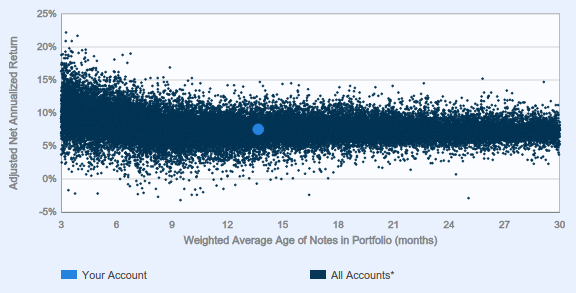
After splurging on very high risk notes in 2014, I’ve since settled on a strategy of only A & B-rated notes for individuals making more than $85,000 a year. Since July of 2015, my notes have been purchased automatically by LendingRobot based upon the filters I’ve programmed in. Thus, marketplace lending has become a rather passive investment for me that runs in the background and it should for you too, especially if you work in the alternative lending industry.
In May and June of last year, we told you to break out of your bubble. If you didn’t heed those words, maybe the new year will give you the excuse you need to give marketplace lending some consideration.
Over the last two years, I’ve personally invested nearly $75,000 in consumer debt through Lending Club and Prosper, entirely in $25 increments. Suffice to say, I didn’t lose money on these in 2015. The monthly principal and interest payments from them are constantly reinvested into new loans on a daily basis, compounding my earnings. It definitely beats not investing at all, which is apparently what a lot of people did last year.
Even if marketplace lending isn’t for you, you can earn a few hundred basis points less per year with an FDIC guaranty. 5-year CDs are paying up to 2.42% right now. Back in June I wondered whether or not the risk undertaken with consumer debt was worth a few extra percent a year, especially considering how these notes are taxed (you may only be able to deduct up to $3,000 in losses per year).
I guess you could say that I decided it was worth it. My new investing strategy takes the $3,000 loss cap in stride because the number of A and B-rated notes (which are all I buy now) that default are very low. In fact, I’ve never even had an A-rated note default in the two years I’ve been investing.
The one disclaimer I will add is that I did indeed invest more money in mutual funds (stocks) in 2015 than I did in marketplace lending. While I enjoy the reprieve from daily volatility that Lending Club and Prosper notes bring, it’s important to never lose sight of the fact that those investments are ultimately in Lending Club and Prosper themselves. Originally envisioned as peer-to-peer, both companies actually just issue bonds to investors that are backed by nothing other than the performance of chosen loans. So if Lending Club and Prosper blew up tomorrow (or worse), it might not matter how all those loans were performing. If the secret to investing is to diversify, then you should treat your total investment on a marketplace lending platform as if it were a single stock. That’s precisely why I won’t open an IRA with Lending Club or Prosper, even if the tax advantages would be better.
Nevertheless, as my mutual funds were flat for the year, my marketplace lending portfolio pushed me forward. At the very least I plan to reinvest all the payments from my portfolio this year into new notes on a daily basis. If you were discouraged by the headlines that 70% of investors lost money last year, you should consider complementing your stock portfolio with marketplace lending this year.
Consumer debt might seem like an odd choice for an individual to invest in, but once you get the hang of it, you’ll eventually consider it to be an integral part of diversification.
deBank the World: See the Times Square Ad Campaign LIVE
January 1, 2016If you didn’t make it to Times Square for the New Year’s Eve celebration, you’re probably a lot better off. But if you’re not going to be in that neighborhood any time soon either, you can still catch a LIVE glimpse of three very important company logos that are broadcasting on a video billboard above 43rd and Broadway. (hint: look at the top left)

The deBanked ad in particular, which only makes a handful of appearances every hour in the rotation, can be viewed in the continuous live stream hosted by Nasdaq. (Update: The ad was retired in early 2016)
What isn’t visible is the half of the screen that wraps around the building. On that side is the story produced by BizBloom, the company behind the campaign. In the video above, you will occasionally see the logos for deBanked, BizBloom, and Quick Bridge Funding in the top left hand corner. The live stream has the ability to rewind up to the previous 3 hours. So if you don’t want to wait, rewind to different parts until you spot them.
Below is the video footage you can’t see that wraps around the other side of the building:
The purpose of the campaign, according to BizBloom’s Thomas Costa, is to tell the story of the American Dream, particularly the struggles and accomplishments of entrepreneurs.
Happy New Year.

Letter From the Editor – Jan/Feb 2016
January 1, 2016 2016 is here and the world of alternative finance isn’t slowing down. If you’re a commercial finance broker, the environment has gotten a little bit more competitive. Sorry folks, the Ferrari might have to wait, at least that’s what some of the sources we interviewed are saying.
But it’s not all bad, the path to success is just changing. Cold calling and direct mail are giving way to new ideas such as Times Square billboards, referral relationships, and diversified product lines. Along the way, regulatory compliance is permeating thought processes more than ever before. The SBFA (formerly NAMAA) is evolving and other groups are trying to make their presences felt as well.
Certain models may be tested by rising interest rates in 2016. Investors in marketplace lending may be wooed by safer investments that pay out a smaller, yet acceptable yield. Or perhaps a volatile or declining stock market will encourage more investors than ever before to flock to marketplace lending. Several predictions made by the “experts” in 2015 will be tested. It’s amazing to think that we really haven’t had economic or market conditions change in a long time.
The fact that it’s a presidential election year could also stir things up. Democratic contender Bernie Sanders for example, has pledged to wage war on lenders by instituting nationwide interest rate caps to levels that would likely cripple both marketplace lenders and credit card companies.
With all of these things to consider, perhaps the two guys that lost God and found $40 million (as told in Bloomberg this past October) are better off retired on a beach in Puerto Rico. Then again, we’ve got a more compelling story in this issue with two guys from somewhat similar circumstances. Jared Feldman and Dan Smith, co-founders of Fora Financial, sold a part of their company to Palladium Equity Partners LLC late last year. Fora fittingly means marketplace in Latin and the pair still run the company from New York City. The two entrepreneurs are featured on this issue’s cover and should serve as a reminder to anyone reading, that the industry has so much more room to grow.
–Sean Murray
Year of The Broker Concludes – 2015 Recap
December 31, 2015 It was the Year of the Broker, a phrase that often conjured up images of easy money and inexperience. Lenders like OnDeck reacted by reducing their dependence on them. Responsible for 68.5% of their deal flow in 2012, OnDeck only sourced 18.6% of their deals from brokers in the third quarter of 2015.
But there’s money being made. One broker is on pace to do more than $100 million worth of deals annually after working as a plumber eight years ago. Another went from sleeping in his car to driving a Ferrari. Meanwhile, brokers like John Tucker are basically saying just the opposite. Tucker has repeatedly taken to deBanked to preach things like “minimalism,” a practice of living below your means to a point where you can survive, and telling everyone it’s okay to embrace the satisfaction of a middle class life.
So is it the end of days or just the beginning?
In October, initial survey results of top industry CEOs revealed a confidence index of 83.7 out of 100, but out there on the street for the little guy, it’s been a tumultuous year. Things like commission chargebacks have hit brokers at unexpected times, with several funders privately telling us over the year that rogue brokers have closed their bank accounts or frozen the ACH debits in order to avoid giving the commissions back.
In 2015, brokers sued their sales agents and sales agents sued their employing brokers. Deals got backdoored, deals got co-brokered, and soliciting deals anonymously got banned from industry forums. Stacking continued mostly unfettered but is being pursued in the court system by funders allegedly injured by it. Brokers took over Wall Street and are supposedly being watched by regulators. Oh, and robo-dialing? Brokers should probably steer clear of that, just as underwriters should ditch paper bank statements.
It’s a lot to manage. Sometimes for a broker, just losing a deal can make them so sick that they have to go home. That’s apparently what happens when you don’t answer the phone fast enough. At least one said there’s no room left for more competitors so if you were thinking of starting a brokerage now, $2,000 won’t be enough.
But things could be worse. In 2015, IOU Financial was under attack by Russian nuclear scientists, a story that was more truth than exaggeration. In the end, Qwave Capital acquired a 15% stake in IOU.
An OnDeck class action lawsuit that looked bad at first turned out to be mostly based on the words of a convicted stock manipulator with a short position in the stock. The case is still ongoing and OnDeck’s stock price is down 50% from their IPO.
In 2015, two guys lost God but found $40 million (although numerous sources say that number is off).
“Madden” no longer means the football video game and Section 1071 is not a seating area in a stadium.
An RFI turned out to be something not to LOL about. Despite an overwhelming response from lenders and funders, the Treasury isn’t completely sold.
 Things weren’t so automated in 2015 despite the cries of technological disruption. Maybe that’s why it feels like 1997. Manual underwriting still dominated and bank statements still matter as much as they ever did. God declined loan applications, Google rigged the search results, and a mayor declared war on merchant cash advance (and then never spoke about it ever again after being re-elected).
Lobbying coalitions formed. NAMAA became the SBFA. The CFPB lied and community bankers testified.
But things are looking up. Brokers can obtain outside investments, get acquired, or make millions through syndication.
Bad Merchants are now ending up in more than one bad database, though a deal for the ages slipped through the cracks. Other merchants went to jail. Square went public and brought merchant cash advances along with them. The industry beamed its message through Times Square and one Democratic congressman has asked God to bless it all.
It was a crazy year. Marketplace lending became an acknowledged term (and the name of a conference) and already companies under that umbrella have been linked to presidential candidate (and desperate loser) Jeb Bush and the San Bernardino Terrorists. The FDIC had a few things to say and SoFi went triple-A. Marketplace lending is making a lot of people money, but when looking at the tax implications is there something funny?
In 2015, the big boys shared their wisdom and their figures. Turns out, it was beyond hyperbole. Brokers experienced an incredible rise or they pawned their ferrari to the other guys. Some focused on a specific crop, while others are trying it over the top. California sucked, John Tucker tucked, and one lender got totally F*****. In 2015 some funders got tanked, so in 2016 we’ll all be deBanked.
Happy New Year!
Details Emerge About the OnDeck – JPMorgan Chase Deal
December 30, 2015 The Wall Street Journal recently published many details about the recent OnDeck/JPMorgan Chase deal that everyone has been wondering about. Here are the cliff notes:
- OnDeck will get fees to originate and service loans for Chase up to $250,000
- Chase’s small business loans will have terms of 6, 9, and 12 months
- Chase customers won’t know OnDeck is involved at all
- OnDeck will not get Chase’s declines
- OnDeck will process Chase’s business loan applications in a matter of hours instead of weeks
Perhaps most interesting of all is that Chase will be doing 6-12 month small business loans. 2016 should be a unique year. With a Chase loan approved in hours, the days of banks taking weeks or months to underwrite an application will be a thing of the past.
The First Ever Comprehensive Industry Report is Now Available
December 29, 2015 Months ago, investment bank Bryant Park Capital teamed up with us to conduct the first ever industry CEO survey of its kind. A sample of the initial findings were distributed at Money2020 in Las Vegas. Eligible participants that disclosed their identities to the surveyors have already received a complementary copy of the full anonymized report.
Today, those that either weren’t eligible to take the survey or missed the deadline to participate, can buy a copy of it.
With a sample size of small business funding companies that originate more than $2 billion annually, the final report reveals the industry’s Compound Annual Growth Rate, Average Annual Revenues, Average Annual EBITDA, Portfolio Loss Rates, Approval Rates, M&A Expectations, Valuation Expectations, Syndication Data, and much more.
This report is highly recommended for all funders and ISOs seeking to raise capital or for those that want to eventually sell their company. It’s also a must-have for any company that seeks to set short-term or long-term goals, that wants to compare themselves against the industry, or is creating a realistic business plan.
Investors in the industry also stand to benefit from this data.
If you are interested in buying the full report, e-mail sean@debanked.com.
The original report sample for public distribution
Mentioned in Forbes
Bryant Park Capital’s professionals have completed approximately 400 assignments representing an aggregate transaction value of over $80 billion.
Lending Club Gets More Aggressive With Direct Pay
December 28, 2015 Lending Club’s maximum debt-to-income ratio eligibility level until now had been 30%. But under a new pilot program called Direct Pay Loans, borrowers whose DTI is as high as 50% can now get approved. But there’s a catch…
The Direct Pay Loan program “requires a borrower to use up to 80% of their loan proceeds to pay off outstanding debt,” according to a notice published by the company. They’re not trusting the borrower in these cases to do that on their own either. Lending Club will actually be the ones making the payments on the borrower’s behalf.
The move is reminiscent of a fairly common practice in the commercial financing industry where liabilities such as past due rent and tax liens are payed by the funding company directly.
It’s unclear if the ultimate goal is to be able to lend to more risky borrowers or if this is an experiment to determine if paying directly reduces the odds that a borrower will lie about how they intend to use the proceeds.
As of September 30th, 2015, Lending Club reported that 67.7% of their borrowers used their loans to refinance existing loans or pay off their credit cards. Since that’s based entirely on what box applicants select on the online application and isn’t actually verified, it’s possible that no borrowers actually refinance or pay off anything. With this being the case, Direct Pay may help Lending Club force their borrowers to hold up their end of the bargain.
Bernie Sanders Poses Bad Lending Question
December 27, 2015Two loans: one with collateral, the other without any. All else being the same, which one do you think would have the higher interest rate?
Given his tweet, Socialist (Democrat) candidate Bernie Sanders might not understand the question.
You have families out there paying 6, 8, 10 percent on student debt but you can refinance your homes at 3 percent. What sense is that?
— Bernie Sanders (@SenSanders) December 26, 2015
The twitterverse was quick to pounce on him for it:
@SenSanders I like you but you have to understand collateralized debt
— Greg Wissinger (@gwiss) December 26, 2015
@SenSanders
A bank can repossess a house. They can't repossess your brain if you quit paying student loans. Though, you make me wonder.
— Smittie (@smittie61984) December 26, 2015
@SenSanders Collateralized vs non collateralized loan. But you knew that already.
— enargins (Neil) (@enargins) December 26, 2015
@SenSanders it makes perfect sense. A 'home' is collateral which the bank can take possession of in case of default. m/t @KurtSchlichter
— All-American Male (@chrisbraly) December 26, 2015
@SenSanders astonishing how you can run president and not understand this basic understanding of collateral.
— Wittorical (@Wittorical) December 26, 2015
@SenSanders I'm generally on your side, but mortgages are secured debt whereas student loans are unsecured and don't always increase income.
— Don Edwards (@DMEdwards) December 26, 2015
@SenSanders wow, big display of stupidity here. The house has resale value. Can we sell people now if they don't pay?
— Ms. Parker (@CaseyParksIt) December 26, 2015
To be fair, student loans might be unsecured debt but they can’t be discharged in bankruptcy. There’s also ways for debt collectors to garnish a paycheck to pay them back. That’s entirely dependent on the borrower generating income though and likely means a substantially longer repayment period. In a famous op-ed by Lee Siegel in the NY Times titled, Why I Defaulted on My Student Loans however, it is apparently possible to just avoid the debt altogether (and apparently feel okay about it).
With stories like that it’s easy to understand why a loan secured by a home would cost less than a loan secured by someone’s willingness and ability to pay. And in the case of Bernie Sanders, a candidate who believes college should be free for everyone, it’s tough to say if his question was really just rhetoric meant to stir up his base or a serious one in which he really doesn’t understand how the underwriting of loans work.
Either way, many people are worried:
.@SenSanders doesn't understand why having collateral would account for a lower interest rate. And people want to make him president?
— Caleb Cassel (@CalebCassel) December 27, 2015