
Articles by deBanked Staff

Online Consumer Lender Argon Credit Files Chapter 11
December 20, 2016“Decisioning as a Service (DaaS), specifically the commercialization of Argon’s machine learning algorithms, is being developed to revolutionize the way credit is evaluated for the entire industry.” That’s according to a press release put out by Chicago-based Argon Credit 19 months ago. The company filed for bankruptcy on Friday, December 16th.
Argon offered loans from $2,000 to $35,000 with APRs ranging from 4.99% to 149% to consumers with at least a 540 FICO score.
Listing more than $42 million in outstanding debt, the largest creditor by far is the Princeton Alternative Fund, which provides credit facilities to select, consumer-facing lenders in the alternative lending marketplace, according to a fact sheet. Argon owes Princeton and a related entity $39 million, the bankruptcy petition states.
The company filed for Chapter 11 after “experiencing financial difficulty.”
A Q4 To Remember – A Timeline
December 18, 2016In case you haven’t noticed, it’s been an interesting few months for alternative finance. The below timeline is an expanded version of what appears in the print version of our Nov/Dec magazine issue.
9/27 Able Lending secured $100 million in debt financing
9/30 The FTC won a judgement of $1.3 billion against payday loan kingpin Scott Tucker, its largest ever award through litigation
10/11 The United States Court of Appeals for The District of Columbia ruled the CFPB’s organizational structure unconstitutional. To remedy, the agency will either have to convert its one-person directorship to a multi-member commission or the director will have to report to the President of the United States. The CFPB is appealing the decision.
10/13 Affirm secured $100 million in debt financing
10/14
- CircleBack Lending was reported to have ceased lending operations
- Goldman Sachs unveiled its new online consumer lending division, Marcus
10/20 CommonBond secured a $168 million securitization deal
10/24 Bizfi announced that John Donovan had joined the company as CEO. Donovan was the COO of Lending Club from 2007 to 2012.
10/25
- Expansion Capital Group announced new management team. Vincent Ney, the company’s majority shareholder became the CEO
- Lendio raised $20 million through a new equity round led by Comcast Ventures and Stereo Capital
- Lending Club announced its foray into the $1 trillion auto refinancing market
11/1
- Cross River Bank raised $28 million in equity led by Boston-based investment firm Battery Ventures along with Silicon Valley venture capital firms Andreessen Horowitz and Ribbit Capital
- Square beat earnings estimates and extended $208 million through 35,000 loans in Q3
11/3
- OnDeck announced earnings, continued use of balance sheet to fund loans and extended $613 million in Q3
- Independent merchant cash advance training course goes live, allowing brokers and underwriters to earn a certificate
11/4 SEC concluded its investigation into Lending Club
11/7 Lending Club announced earnings and a deal to sell $1.3 billion worth of loans to a National Bank of Canada subsidiary
11/8 CFG Merchant Solutions secured a $4 million revolving line of credit
11/9 Donald Trump became the President-Elect
11/11
- Fintech leader Peter Thiel joins the executive committee of Trump’s transition team
- Kabbage appointed Amala Duggirala as Chief Technology Officer and Rama Rao as Chief Data Officer
11/14 Prosper’s CEO Aaron Vermut, stepped down
11/16
- UK-based p2p lender Zopa applied for a banking license
- Small business lender Dealstruck reportedly ceases lending operations
- Former Lending Club CEO revealed to be launching a new rival, Credify
11/17
- LiftForward secured a $100 million credit facility
- Prosper filed their Q3 10-Q, revealing that they only originated $311.8 million in loans for the quarter compared to $445 million in Q2
- The IRS sent a broad request to Coinbase, the nation’s largest bitcoin exchange, as part of a hunt for tax evaders
- PeerStreet raised a $15 million Series A funding round led by Andreessen Horowitz
11/18 P2Bi raised $7.7 million in venture financing
11/22 LendIt announced the first ever industry awards event
11/29 Three C-level executives at CAN Capital are placed on a leave of absence after the company identified assets that were not performing as expected
12/2
- Total Merchant Resources secures $20 million in private equity, launches wholesale funding division
- Bitcoin-based P2P lending platform BitLendingClub shuts down
- OCC announces they are moving forward with a special purpose national charter for fintech companies
12/8 Former CEO and co-founder of World Wrestling Entertainment tapped to run Small Business Administration
12/9 OnDeck announced new $200 million revolving credit facility with Credit Suisse
12/12 Knight Capital Funding announced new Chief Data Scientist
12/13 Fifth Third Bank is reported to buy a stake in franchise marketplace lender ApplePie Capital
12/14 BlueVine raised $49 million in Series D funding
12/15
- Swift Capital named Tim Naughton as Chief Legal Officer
- John MacIlwaine, Lending Club’s Chief Technology officer, submitted his resignation to the company to pursue another opportunity
12/16 CAN Capital is reported to have laid off more than 100 employees
+1 for Swift Capital, -1 for Lending Club
December 15, 2016Swift Capital has named Tim Naughton as Chief Legal Officer, according to a company announcement on Thursday. “Prior to joining Swift Capital, Naughton advised Bank of America’s small business lending and deposit services as assistant general counsel and senior vice president,” it says. “He served as external counsel for American Express and Sallie Mae, and was a partner at Hudson Cook specializing in financial and regulatory compliance.”
Hudson Cook law firm coincidentally produced the merchant cash advance industry’s training course.
Meanwhile, Lending Club disclosed in an 8-K Thursday that CTO John MacIlwaine had tendered his resignation “to pursue another opportunity.” MacIlwaine had been with the company for more than 4 years. He is the latest of several C-level execs to depart in 2016. Former CEO Renaud Laplanche resigned in a scandal earlier this year and CFO Carrie Dolan, like MacIlwaine, also resigned “to pursue another opportunity” back in August. Other executives including Jeff Bogan and Adelina Grozdanova, Lending Club’s Head of Investor Group and Vice President, Head of Institutional Investors respectively, also both resigned in May. Lending Club’s stock is down more than 50% since the beginning of the year.
AI Sales Assistant Penetrating Alternative Finance Raises $34 Million in Series B Round
December 15, 2016 Wondering how your competition always seems to be so on top of their game? They might be using an artificially intelligent sales assistant. Such technology was reported on last month when deBanked learned that it had penetrated the alternative business financing industry through at least one company named AI Assist. AI Assist is powered by Conversica, a Foster City, CA-based technology firm that announced it had raised $34 million in a Series B round on Wednesday led by Providence Strategic Growth Capital Partners L.L.C. More than 1,000 companies across technology, automotive, higher education, finance, insurance, real estate and hospitality are using Conversica.
“Conversica’s AI technology has helped IBM be smarter about engaging our prospective customers and maximizing their value as they move through our sales funnel,” Kevin Pollack, head of IBM’s Global Email Marketing Practice, is quoted as saying in a press release. “Not only have we freed up resources within the marketing team and gained immediate value in the form of qualified sales opportunities, we are also seeing how AI can help transform our entire business moving forward.”
For Roman Vinfield, who launched a merchant cash advance ISO in 2015, it changed his life. “I hadn’t heard anything like an artificial-intelligence sales assistant,” said Vinfield. “The results we got within a month of using it were unbelievable.” Within the first month, Vinfield made $35,000 in revenues by spending just $4,000 and he eventually reduced his staff of 24 to 4 people. He’s since launched AI Assist, the exclusive reseller of Conversica to the alternative finance industry.
“We’ve gone way beyond the theoretical,” Conversica CEO Alex Terry told Fortune. A demo given by Vinfield of AI Assist, demonstrated that its artificial intelligence can communicate with merchants over emails in a way that is indistinguishable from a human. According to Fortune, Terry said the sales assistant software has proven so effective for some customers that recruiters have even mistaken the software for a human and tried to make a hire. Other contacts have sent in thank-you notes and flowers, he added.
Conversica has raised more than $56 million since inception. Providence, who led the Series B round, also owns stakes in Hulu and the Yankees Entertainment & Sports Network (YES Network). Conversica’s technology is only available to this industry via AI Assist.
RapidAdvance’s Mark Cerminaro is deBanked’s November/December Cover
December 14, 2016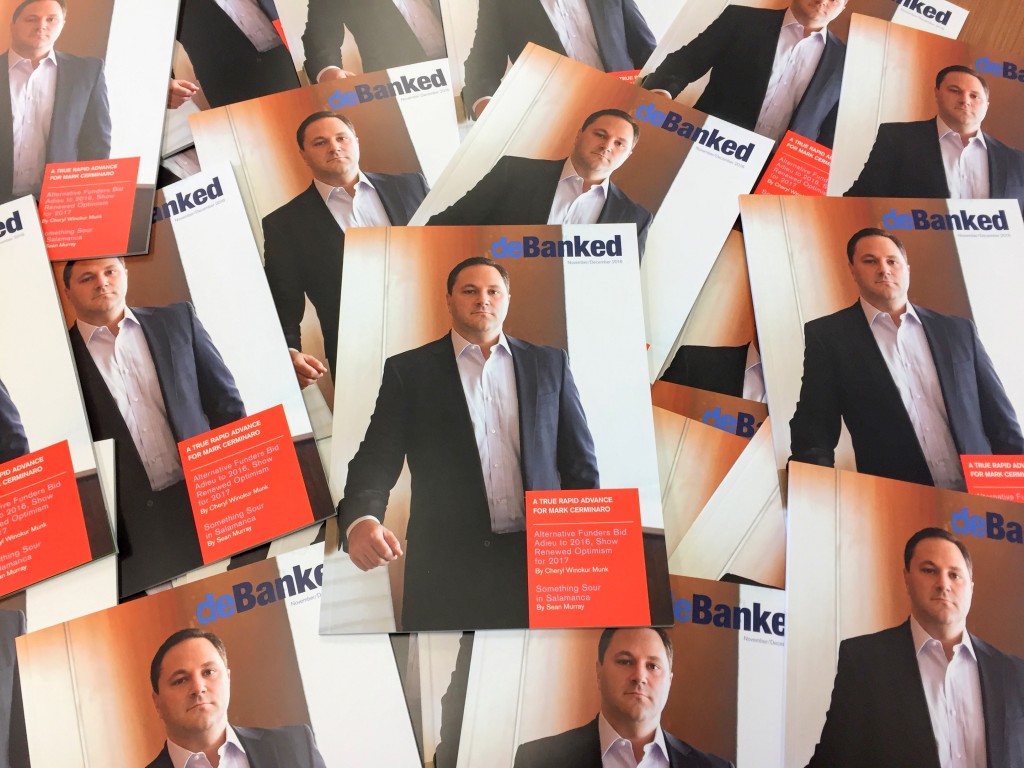
It’s been a quick rise for Mark Cerminaro, who won the 2016 Commercial Finance Association’s 40 Under 40 Award and is the Chief Revenue Officer of RapidAdvance based in Bethesda, MD. He is featured in the November/December issue of deBanked magazine that is currently being delivered to subscribers nationwide. If you haven’t already subscribed, you can SIGN UP HERE FREE.
An excerpt from the story:
Early in Cerminaro’s tenure at Morgan Stanley, the company sent him for training with about 300 other new employees at 2 World Trade Center in Manhattan. The date was Sept. 10, 2001. When the trainees reported to the office the next day, they were in a 64th-floor conference room when they heard an explosion and saw shreds of paper floating past the windows. They didn’t realize yet that a terrorist controlled jetliner had hit next door at 1 World Trade Center.
deBanked interviewed Mark and several folks who know him professionally. He joined RapidAdvance in 2007, which gave him a front row seat to the financial crisis that forever shaped the company. “We went from a single-product company, to now being more of a solutions-based company,” he said.
If you want to know how the big players are succeeding, you’ll certainly want to hear what a day in the life of a chief revenue officer is like, and how Mark is making the sales hum at Rapid.
The digital version will be online next week, but you don’t want to miss deBanked magazines in print. Sign up FREE!


Update: Stitt v OnDeck Class Action Dismissed
December 12, 2016
In case you missed it, the class action lawsuit filed in August 2015 by small retail investor Carl Stitt against OnDeck, its officers and underwriting banks for violating securities laws, was dismissed in late September of this year. Stitt withdrew his suit without prejudice as to all parties, including another investor, Isaac Malafsky, whose own class action suit was eventually consolidated into Stitt’s.
The case never gained any traction. Once the two suits were consolidated, OnDeck filed a motion to dismiss on multiple grounds, while pointing out that part of the complaint’s argument for a supposedly undisclosed negative trend came from a blog post on SeekingAlpha whose author had a short position in OnDeck’s stock. deBanked reported this on August 7th, 2015, when it was determined that the author was not just any short seller, but a company owned by Hunter Adams, who notoriously served time in prison for his role in a previous stock manipulation scheme.
Once the judge asked the parties to present oral arguments on the motion, the plaintiffs withdrew instead.
OnDeck traded at $10.47 on the day Stitt’s case was filed last year. It closed at $4.30 on December 9th, 2016, down by more than 50% since then.
Barbara Corcoran, OnDeck Contest Final Aired on Rachael Ray Show
December 6, 2016The OnDeck “Seal of Approval” contest led by company spokesperson Barbara Corcoran recently came down to one final challenge and the results were aired on the Rachael Ray Show on Tuesday.
Three small businesses were featured and each won $10,000 paid for by OnDeck. Corcoran couldn’t mention the company enough times. This kind of collaboration and publicity is probably the best kind of marketing an alternative lender can get, not to mention a great opportunity for small businesses. Watch the TV segment of it below:
Not loading? Click here
The OCC Wants Online Lenders to Become Limited Purpose Banks
December 2, 2016 Earlier today, Comptroller of the Currency Thomas J. Curry announced that the OCC will move forward with chartering financial technology companies that offer bank products and services that meet their high standards and chartering requirements.
“We have decided to move forward and to make available special purpose national charters to fintech companies for a few basic reasons,” he began saying during a speech at the Georgetown University Law Center. “First and foremost, we believe doing so is in the public interest. Fintech companies hold great potential to expand financial inclusion, empower consumers, and help families and businesses take more control of their financial matters.”
Curry also responded to critics who argued that a limited charter would put fully regulated banks at a disadvantage competitively. “The reality today is that the 4,000 fintech companies out there are already competing with national and state banks, without regard to any of the national bank responsibilities and under a patchwork of supervision,” he said. “Granting national charters to the companies who desire and warrant one doesn’t weaken the competitive position of existing banks or the dual banking system. In some ways, it levels the playing field because statutes that by their terms apply to national banks would apply to all special purpose national banks, even uninsured ones.”
Applying for this charter would be optional, not a requirement.
Like the Treasury RFI last year, the OCC has put up an official 13-question Request For Comment that is open until January 15th.
Those questions are:
1. What are the public policy benefits of approving fintech companies to operate under a national bank charter? What are the risks?
2. What elements should the OCC consider in establishing the capital and liquidity requirements for an uninsured special purpose national bank that limits the type of assets it holds?
3. What information should a special purpose national bank provide to the OCC to demonstrate its commitment to financial inclusion to individuals, businesses and communities? For instance, what new or alternative means (e.g., products, services) might a special purpose national bank establish in furtherance of its support for financial inclusion? How could an uninsured special purpose bank that uses innovative methods to develop or deliver financial products or services in a virtual or physical community demonstrate its commitment to financial inclusion?
4. Should the OCC seek a financial inclusion commitment from an uninsured special purpose national bank that would not engage in lending, and if so, how could such a bank demonstrate a commitment to financial inclusion?
5. How could a special purpose national bank that is not engaged in providing banking services to the public support financial inclusion?
6. Should the OCC use its chartering authority as an opportunity to address the gaps in protections afforded individuals versus small business borrowers, and if so, how?
7. What are potential challenges in executing or adapting a fintech business model to meet regulatory expectations, and what specific conditions governing the activities of special purpose national banks should the OCC consider?
8. What actions should the OCC take to ensure special purpose national banks operate in a safe and sound manner and in the public interest?
9. Would a fintech special purpose national bank have any competitive advantages over full service banks the OCC should address? Are there risks to full-service banks from fintech companies that do not have bank charters?
10. Are there particular products or services offered by fintech companies, such as digital currencies, that may require different approaches to supervision to mitigate risk for both the institution and the broader financial system?
11. How can the OCC enhance its coordination and communication with other regulators that have jurisdiction over a proposed special purpose national bank, its parent company, or its activities?
12. Certain risks may be increased in a special purpose national bank because of its concentration in a limited number of business activities. How can the OCC ensure that a special purpose national bank sufficiently mitigates these risks?
13. What additional information, materials, and technical assistance from the OCC would a
prospective fintech applicant find useful in the application process?
Read the OCC’s 17 page report on the matter. The Request For Comment and submission instructions are at the end of it.