

MCC and BizFi Founder Stephen Sheinbaum on Bloomberg
August 4, 2015Earlier today on Bloomberg TV:
“Automation doesn’t mean no underwriting,” said Stephen Sheinbaum, the founder of Merchant Cash and Capital and BizFi.
Sheinbaum also said that they have never raised an equity round from an institution.
“We do want to go public,” he added. If they can obtain an equity investor, he put their timeline to go public at 12 to 18 months.
Watch the video below:
Have Your Marketing Response Rates Changed?
August 4, 2015 Notice anything different with your marketing response rates lately? OnDeck has…
During the OnDeck Q2 earnings call yesterday, company CEO Noah Breslow said, “there are no two or three competitors dominating this trend (direct marketing), but we know the sheer number of marketing solicitations targeted to small businesses has grown meaningfully over the last six months which impacts our response rates.”
The comments were interesting because while they opposed any correlation between the increased competition and their continuously declining interesting rates, it was an acknowledgement that they are not alone in their marketing efforts, nor are their marketing methodologies proprietary.
The comment was focused mainly on direct mail campaigns and Breslow argued their strategy was to “break through the clutter” and “better communicate our value proposition.”
“Competition for customer response remains elevated,” he later added.
OnDeck still managed to fund $419 million for the quarter, up only $3 million from the previous quarter, but a 69% increase over the same time period a year ago.
During the Q&A which was unfortunately not part of the recorded transcript so I will paraphrase as best I can from memory, a few analysts inquired deeper about the competition.
One wondered if their competitors’ marketing efforts were sustainable or if they were simply on a market share binge and would eventually go away. Breslow said there would probably be a combination of both, that some would continue to stick around long term and others might fall off. It was a safe answer because while some of their competitors may indeed have high acquisition costs, there are still profits being made and nobody should expect the competition to subside any time soon, if ever.
Breslow also shared that the competition was bidding up the price online, talking at least in part about Pay-Per-Click marketing.
OnDeck shed more Funding Advisors (brokers) in Q2 than they expected to because of their “re-certification program.” Brokers either didn’t make the cut or would not go through the program. Only 20.6% of their loans were originated by brokers in Q2 of this year as opposed to 30.8% during this time last year. Brokers brought in bigger loans though on average because they made up 28.4% of the dollar volume of loans originated this year. Last year at this time they made up 42.9% of the volume.
OnDeck has managed to grow despite their dwindling reliance on brokers and a marked increase in competition.
Have your direct mail and online advertising response rates changed recently? If OnDeck has taken notice, surely you must have too…
Update: You can read the full transcript of the call here, including the Q&A
deBanked’s Next Issue Shipping Soon
August 3, 2015Are you ready for another issue of deBanked Magazine?!
In this edition, we explore the Australian market, the commission chargeback debate here at home, the quest for national bank charters, a deeper look at the Midden v. Midland case and MORE!
Haven’t been receiving the print edition in the mail? You need to SUBSCRIBE for that. It’s free.
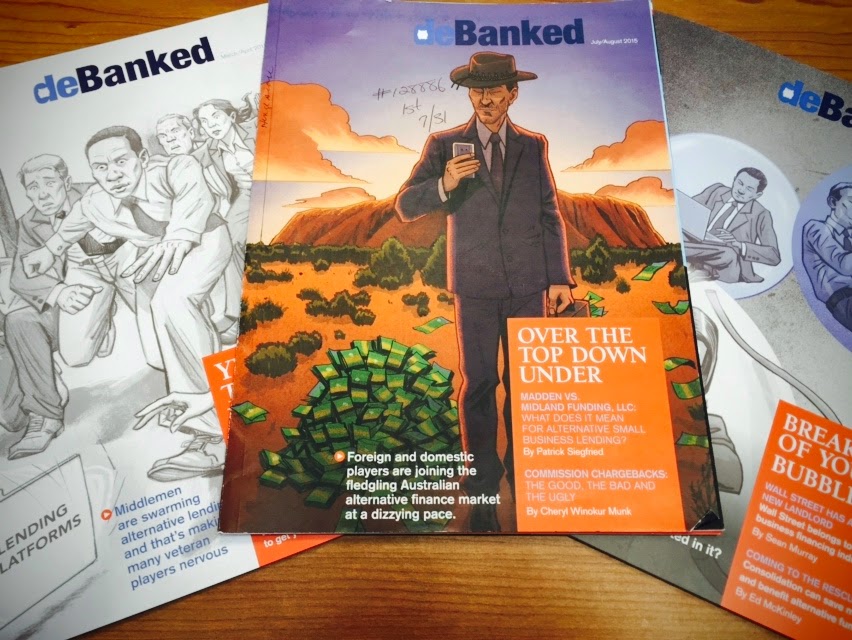
We distribute thousands of copies to ISOs, brokers, lenders, funders, and other players in the alternative business lending ecosystem. Want to be included in future issues? Drop me a line at sean@debanked.com
New Funding Brokers Struggle As Industry Grows
August 3, 2015 Here’s a few things that will have you scratching your head.
1. A new sales agent recently took to an industry forum to ask for help with ACH processing. According to him, he charged a closing fee on a loan that closed and then realized that he had no idea how to collect the fee. His problem was perplexing because he had the merchant sign an agreement that authorized him to debit the funds out despite not having an ACH processing account.
Some sympathetic veterans advised him to have the merchant write him a check, but others were too dumbfounded by his use of an ACH agreement when he did not know anything about ACH. The agreed fee was probably too large to write off as a mistake so hopefully the merchant will understand and write him a check for services rendered.
The lesson: If you don’t know how to do something, don’t guess. The agent would’ve been in a much better situation if he had asked how to collect fees prior to drawing up an agreement that referred to a methodology he had no familiarity with.
2. A semi-seasoned sales agent griped about a recent experience on an online message board about a business lender that stole his deals and turned out to be a repeat felon. The broker community was not sympathetic when they learned that the “lender” used a gmail address to communicate. What’s worse is that a perfunctory Google search revealed a record of violent crime.
The lesson: At the very least, do not send deals to anyone using a free email address. This was item #3 on my Advice to New Brokers list, published back in February. This also violated item #4 on my list, which says, don’t send your deal to some random company just because they went around posting on the web. A simple Google search for this broker would’ve showed that the “lender” was a serial criminal.
3. One broker e-mailed me to say that a lender had stolen his syndication money and disappeared. Another told me that they had stopped receiving their syndication deposits for their entire portfolio and wasn’t sure what was going on. This situation often doesn’t make the public forums because the aggrieved parties are sometimes too embarrassed to tell others that they got hustled. I recommended a lawyer to one of them.
The lesson: Refer to #4 on my Advice to New Brokers list. Even if others claim to be having a positive experience, there are a few red flags to look out for when it comes to syndication:
- Were they too eager to accept your money?
- Did they have an Anti-Money Laundering process in place?
- Would your funds be co-mingled with their operating funds or isolated in a separate account?
- How is their system structured? Will you get paid even if they declare bankruptcy?
- Was the owner of the company ever charged or convicted with fraud? This is probably the most important and for some reason the most overlooked. If the owner was previously charged with fraud and your money eventually gets stolen, you can only blame yourself. And if you don’t know if someone has a past criminal history, you should probably ask around in addition to conducting a formal background check.
Syndicating brings me to item #1 on my Advice list, hire a lawyer. If you can’t afford a lawyer, you definitely can’t afford to syndicate.
Yellowstone Capital Continues to Reach New Heights
August 2, 2015 An anonymous source inside NYC-based Yellowstone Capital revealed the company had recently reached two milestones. One was that they had funded more than 50,000 deals since inception. The other was that they had funded just a hair shy of $40 million in the month of July, a new internal record.
The monthly figure puts them on pace with their competitor Merchant Cash and Capital, who announced having funded $115 million across the second quarter of this year.
Yellowstone’s $1.1 billion+ funded since inception raised eyebrows at the recent AltLend conference in NYC when Lendio’s Brock Blake put deBanked’s industry leaderboard up on the big screen during the event’s opening presentation.
Since then, other funders have shared their figures through public announcements. Coral Springs, FL-based Business Financial Services officially joined the billion dollar club just a few days ago.
Yellowstone’s continued rise can likely be attributed to the expansion of their risk box from high risk to moderate risk. Back in March, company CEO Isaac Stern led a management buyout backed by a private family office that brought on a new executive team. Private equity turnaround expert Jeff Reece came on as the company’s President. Reece is a former Director of Cogent Partners, a boutique, private equity-focused investment bank and advisory firm.
The company is also reportedly on a massive hiring spree after having leased another floor at 160 Pearl Street in Manhattan.
Yellowstone has a strategically diverse business model that allows them to either fund small businesses in-house (on their own balance sheet) or broker them out to other funders. My source says that the 50,000 lifetime deals funded figure includes both.
Addressing Stress and Depression Over Declined Deals
July 29, 2015 I wanted to add to my series discussion by touching on a topic that isn’t often discussed in our space, and it pertains to dealing with depression, stress and other mental health related conditions over the loss of a deal.
Let’s Be Honest
Let’s face it, most of us (as brokers) work on a 100% commission structure, or derive a significant portion of our income from commission, this means that our compensation is based on performance. This performance is directly correlated to the amount of new/renewal business that we fund. The word fund is the keyword here, as your performance in terms of selling might be excellent with the continued production of new leads, new applicants and new interested parties to our industry’s working capital selections. However, if those new leads and applicants don’t fund, then in terms of your performance, they don’t count. An applicant can be declined for a variety of reasons and all of them are usually totally out of your control. However, your compensation is dependent upon your merchant’s approval as well as the offering of terms/conditions that they deem acceptable. This high level of stress can lead to mild bouts of depression, and that depression could lead to a variety of other issues such as overeating, not eating, over sleeping, not sleeping enough, emotional breakdowns, paranoia, personal relationship issues, along with a variety of other inefficiencies.
The Loss Of Hope
Google says that the definition of depression is related to “the feelings of severe despondency and dejection.” Despondency and dejection refers to a state of low spirits caused by the loss of hope, and hope is sometimes all we have as Brokers. All we have going for us is an internal “hope” that our sales abilities will produce the commissions needed to not just cover our business/tax expenses, but cover our personal expenses, insurance, etc., and leave some left-overs to allow us to save for retirement. If you put your soul into this (like I do), then with every funded deal you will rejoice internally, and with every deal declined or approved with terms that are unacceptable to your client, you might feel sudden emotions of panic, fear and uncertainty. As a one man show, I have funded hundreds of deals while also building up a side merchant processing portfolio that processes tens of millions in volume every year. But I have also lost a ton of potential deals on both the funding side and the merchant processing side through declines or approvals that were unacceptable to my client. If left unchecked, still to this day I feel emotions of sickness and depression over declined and lost deals, so much so that sometimes I just have to go home and lay down in the bed for a minute.
Tackling The Stress Through Other Means Of Management
So how do I handle depression and stress over declined and lost deals for the most part? Here are some tips on how I handle the stress and depression of this industry, and perhaps they too can provide some assistance for you in those critical, nerve-racking situations of receiving emails from your Funder with “Declined” or “Application Ineligible” typed out in the Subject Line:
Diversify, Diversify, Diversify
This isn’t just true in Stocks, but it’s also true in being an Independent Agent/Broker. You are a 1099 Independent Sales Office and there’s just no reason why you ought to only be selling one product. Remember as I touched on in prior deBanked articles, as a Broker your job is to be as Jeff Thull from Prime Resource Group explains, which is to be a valued source of business advantage for your prospective and current clientele. You should have access to knowledge, resources, networks, products and platforms that your prospective and current clientele lacks access to, allowing them to see you as a “valued extension” of their organization in terms of the value of your expertise and network.
So there’s no reason that you should just be selling Merchant Cash Advances or Alternative Business Loans, you should be selling a variety of other products in various different segments such as POS Systems, Merchant Processing, Equipment Leasing, Insurance, Big Data, Marketing Programs, Cost Reduction Programs, etc., just to name a few.
Do This Because It’s Your Purpose, Not Just For The Money
Listen, I’m not here to convert anybody to any particular Religion, but I believe that if you are going to be an entrepreneur (which is what you are as a 1099 Broker/Agent) then you need to have a very strong internal spirit or soulful foundation. Your motivation, joy, peace and confidence should extend beyond your earthly circumstances. You should see this industry as something you do as a Purpose that aligns with your spirit or soulful foundation, rather than just seeing it solely as a means to make an income.
Continued Learning and Development
The Merchant Services related industry continues to evolve and you should be following all of the trends and updates. The best places to do this for the Merchant Services related industry, is to make sure to follow deBanked as well as other sources such as The Green Sheet, Payment Source’s ISO/Agent, The ETA, The SBFA, as well as various industry trade conferences such as LendIt and The AltLend Summit.
 Focus On Total Financial Management
Financial management is not just about bringing in decent income, it’s about managing the six pillars of finance which are Income, Investments, Insurance, Credit, Expenses and Taxes.
For example, you might be bringing in $100,000 a year in commissions from your Home Office, but you might be living in a high cost of living area, have horrible spending habits, have inefficient tax reduction strategies, and you have four children from four different women paying very high child support claims. This means that your expenses are too high and your financial efficiency is going to be off.
On the other hand, you might be making $50,000 a year in commissions from your Home Office, with no children, living in a low cost of living area, with efficient budgeting and tax reduction strategies, putting away let’s say $7,500 a year into your retirement accounts. If you do this for 40 years from 25 – 65 for example, with just a conservative 5% per year return, you will have over $1 million at age 65. You will have made yourself a self-made millionaire and you didn’t need a six figure annual commission compensation to do it. All you needed was Total Financial Management.
To Wrap
So in a nutshell, I manage the stress and depression of our industry through having a totally efficiently managed financial system in place, not selling just one product, always learning, and making sure that everything I do is grounded in Purpose. I believe that if you too were to adapt some of these techniques, the loss of that deal you worked so hard on, might not “sting” as bad after all.
Business Financial Services Joins The Billion Dollar Club
July 29, 2015 Yet another small business financing company has surpassed a historic milestone. Representatives for Coral Springs, FL-based Business Financial Services, Inc. confirmed that they have funded $1 Billion since inception. BFS, as they’re known in the industry, was founded in 2002, though nearly half of their volume was funded in just the past two years.
deBanked had recently speculated that BFS had funded somewhere between $700 million and $1.2 billion in their lifetime. They are now one of seven companies confirmed to have reached the billion dollar threshold.
New York City-based Merchant Cash and Capital announced hitting the billion dollar mark only four months ago.
“This milestone is indicative of how much demand there is for working capital among small businesses, the backbone of the U.S. economy,” said Marc Glazer, CEO and co-founder of BFS.
BFS/Boost Capital CEO Marc Glazer on Bloomberg London in 2013Much like Capify, a newly-formed lending conglomerate with operations in multiple countries, BFS has a presence in Canada and the United Kingdom. In the U.K., where they operate as Boost Capital, they’ve got an active relationship with the press.
Norman Carson, director of business development for Boost Capital, recently told The Telegraph, “Smaller companies in Britain have been told for too long that they’re inadequate in some way, operating in too risky a field, lacking in assets, or trading in the wrong way.”
Several commercial finance brokers put BFS in the same league as OnDeck and CAN Capital competitively. Referring to BFS, Arty Bujan of New York City-based Cardinal Equity told deBanked, “I think they’re great and serve a specific sector of our industry for merchants that need more money and are willing to prove they’re worthy of it.” He added that the documentation requirements at least in his experience can be a little bit more stringent than for competing companies that promise to fund almost immediately.
And Chad Otar, a Managing Partner of Excel Capital Management, also of New York City, said, “Business Financial Services is a great addition to have in your pocket for the longer deals.”
 In April of this year, BFS extended its credit line with its bank group led by Wells Fargo Bank, N.A. “We are excited to reach this milestone, as it is fueled by our ability to meet the financing needs of so many businesses of different sizes across more than 400 industries,” said Glazer.
BFS is the only billion-dollar-plus funder on the deBanked leaderboard to be based outside of New York City or Silicon Valley. South Florida is widely considered to be one of the top three hubs for tech-based lending. This milestone for BFS is a validation of that.
“With a high percentage of our customers renewing with us, and doing so at higher amounts, we are well-positioned for continued growth,” Glazer said.
A Square IPO Would Be Alternative Lending’s Third
July 26, 2015 First Lending Club, then OnDeck, and now… Square? The news media was flooded with stories late last week that payments company Square had filed their S-1 in secret. The move can be done under a JOBS Act provision that allows companies that grossed less than $1 Billion in revenue in the most recent fiscal year.
Square’s merchant cash advance arm, Square Capital, reportedly funded $100 million to small businesses in 2014, a figure large enough to earn them a spot on the deBanked leaderboard.
While often reported as a lending program, Square’s own website describes their working capital transactions as sales of future credit card receivables. At face value, and aside from what their contracts might actually say, it’s a textbook merchant cash advance.
While some publicly traded companies have dabbled in merchant cash advances, the financial product is one of Square’s two major products, the first obviously being payments.
And while OnDeck offers loans that are very similar to merchant cash advances, Square could potentially be the first true merchant cash advance IPO.
Also on the IPO watch list is CAN Capital, a company that offers both loans and merchant cash advances. In November of last year, Bloomberg and WSJ claimed the company was already working on it. While it has been eight months since that news came out, word on the street is that a CAN Capital IPO is still very much a possibility.
Unfortunately, because of the same JOBS Act provision that allowed Square to file an S-1 (if they actually did) also applies to CAN Capital. There is no way to know what’s going on behind the scenes until the filing is made public or leaked to the media.
Either way, the end of 2015 will likely end in at least one more IPO for the commercial side of alternative lending.
Could Jack Dorsey and his wacky beard be the future face of the merchant cash advance industry?
BREAKING: JACK DORSEY’S BEARD pic.twitter.com/Quv8nVG9PZ
— Nicholas Carlson (@nichcarlson) June 12, 2015