MCA in Conversation: Where do we go from here?
July 27, 2020 DeBanked Magazine recently posted the “Underwriter’s Song” to highlight an entire industry’s yearning for simpler times, claiming it was the MCA soundtrack for 2020. But I disagree and nominate a different song. You see, growing up in the south with a close-knit family gave way to a childhood filled with generations worth of entertainment. Many of my summers and holiday vacations were spent with the Turner Classic Movie channel playing in the background, and songs from the Oldies Country station on the radio. I tell you this to explain how I am reminded of a song I’ve heard countless times before, and is more applicable today than ever before. That song is “If We Make It Through to December” by the venerable Merle Haggard, a tune whose message resonates with not only the merchant cash advance industry, but our entire country.
The Expectations and Reality
Way back in March and April, the consensus appeared to be an expected return to “normal” by June, while areas hit hardest by COVID-19 would return by July. Yet here we are, teeter-tottering on the fence of moving forward. Now, our country is faced with the possibility of a second wave of shutdowns, rising crime, riots, a fourth stimulus, and funders whose workforce remains remote or have yet to resume funding. The proverbial “goal post” has moved yet again, and with it the expectations of many of us in the industry. Over the past few weeks, I had the opportunity to speak with a number of our referral partners to gauge their thoughts on the current state of our industry. A common theme in our discussions was the desire for validation. Not just as a business owner, but as an employer. They wanted to be reassured that they were taking the best steps forward and not alone in their decision making. To help those seeking the same validation, here is what the majority had to say:
- Yes, all had to terminate or furlough staff on various levels.
- Yes, all adjusted marketing budgets.
- Yes, all are struggling with managing remote employees.
- Yes, all are finding it harder to place files.
- Yes, all are seeing interruptions in relationships with funders and merchants alike.
- Yes, all are competing against the Government’s low-cost products.
- Yes, all are having files killed in late stages of funding or having offers adjusted.
- Yes, all are struggling to predict what comes next.
- Yes, all are managing unrealistic expectations from clients.
- Yes, all are having merchants walk away from fair and just offers.
- Yes, all are struggling to remain motivated.
- And yes, all of you are doing the best you can!
The New Normal
The Word Cloud below describes the state of the MCA industry using our partners’ own words. I find that the overall thoughts are best visualized by taking a step back to see which stand out the most. Our conversation was focused on the industry as a whole, then a discussion specific to Elevate Funding and how we’ve pivoted during these unprecedented times. As you can see, some of the keywords that stand out the most are; merchants, PPP, offers, funders, and marketing.
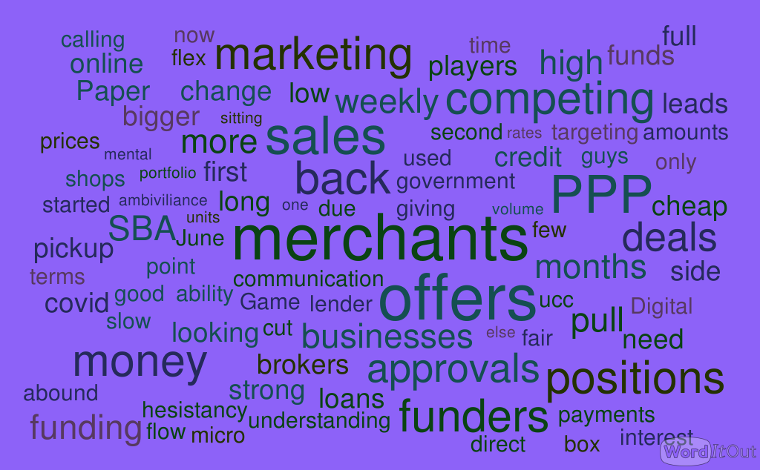
Much of the conversations focused around merchants and their new funding expectations. Each partner I spoke with agreed the demand for money is there, but the willingness to move forward on offers was very low. This reluctance is driven in part by low cost expectations based on PPP and SBA product rates, as well as uncertainty over increased debt in an unstable market. We’re also seeing a change in merchant demographics, where the mid-sized small businesses who previously did not qualify for SBA loans, now have access to these products. As a result, the remaining merchants whose best option is an MCA are now located on the opposite extreme ends of the spectrum; either those who did not qualify for PPP or SBA EIDL, and the large-scale businesses whose lines were revoked by their bank. Our response as a company has been to adjust our offers to better suit merchant’s expectations, and to shift from underwriting a business owner’s activity to underwriting the consumers’ activity. Monitoring government restrictions down to a county level countrywide and understanding consumer trends has enabled us to further mitigate risk during a time of uncertainty, and not only fund deals, but fund deals that will perform.
Meanwhile, our industry is seeing credit profiles and business profiles that have never applied in our space before, as a decreasing number of providers are available to service current merchants. During our conversations, some expressed a concern over lack of A-paper funders. Many of whom have either paused funding or entirely moved over to servicing PPP products. Another concern was the mental toll of having deals fall apart at the eleventh hour due to fast changing qualifications, variations in merchant revenue, or funders deciding to pause funding at inopportune times. These factors combined with the increasingly common “bait-and-switch” technique of funders providing a large offer, only to change to a much lower offer in the final stages of funding, has left many broker shops and ISOs feeling very discouraged.
The Path Upward and Onward
The conversations were not entirely negative, as new marketing opportunities have opened up with the goliaths of the industry such as Kabbage, OnDeck, Lendio, and Square shifting their marketing dollars towards PPP and SBA products. Many folks are finding their advertising dollars across marketing platforms are stretching further, particularly with search engine optimization. While this opens up an increased likelihood of fraud and in applicants who fall below qualifications, it has enabled many shops to operate on an even playing field with inbound marketing. Many small funders, including Elevate Funding, have already created new products to cater to lower revenue merchants and those directly affected by COVID-19. We’ve already received tremendous response on this change from partners and merchants alike. As merchants slowly shift back towards alternative financing solutions once the government runs out of money for its loan products, we remain optimistic there will be increased opportunities in terms of both volume and quality.
While the Word Cloud highlighted a number of topics, it also highlighted important topics that were not discussed; Expectations, Renewals, Commission, Aggression, and Repositioning.
Expectations in particular, is of note as it is different from opinions. Everyone has an opinion, but there is a tremendous sense of uncertainty going forward and it’s very difficult to create expectations or goals when forecasting is not possible. Many companies are doing away with forecasting models altogether, and switching to a dashboard for production goals and expectations based on real time data.
The drastic change we’re seeing now should demonstrate the importance of renewals and customer retention. Neither of which were brought up during all of my partner discussions. Over time, the industry has moved away from a “residual mindset” to seeking instant gratification of new fundings in the quest for market share supremacy. As funders, we have to ask ourselves; Are we inadvertently throwing out the baby with the bathwater with new deal bonus structures and monthly promotional campaigns to drive new deal growth? Or perhaps, renewals were scarce in discussions because when funders said when funding stopped, they meant all funding? While I can’t speak to each funder’s operations, Elevate has continued to fund throughout the pandemic with established merchants and renewals being a saving grace to drive our momentum forward. In my opinion, client retention has never been more important during an ever-changing landscape.
I was shocked to see commission taking a backseat to approvals and banks during our discussion. But the focus has seemingly move towards approvals and conversions, which will in turn lead to commissions returning. Which brings me to Aggression and Repositioning. The state of our industry is a timid one, and it’s neither the fault of the funders or the merchants. Many experts will tell you that our space was overdue for a market correction of sorts, because many were far too aggressive for far too long. This aggression gave way to bad habits such as lowered underwriting standards and lack of consideration for merchant ability to repay. More and more funders are shifting back to “normal” guidelines, providing fair and just offers. This is an encouraging sign that we are finding our way back to sustainable positive growth. But it will take time for the industry to fully reposition itself. Something that is being delayed by products from the PPP, SBA, and the hope for a third round of stimulus.
But hope is on the horizon. While the pessimists will look at that word as a form of denial, I challenge all of you to take a glass half-full approach. Hope is the confident expectation of good. The change and adjustments we’re experiencing now are what life is all about, and will ultimately lend way to better things. If you’re in need of a little dose of hope, or want a sounding board to know you’re not alone through this, feel free to drop me a line at heather@elevatefunding.com.
Stay safe, be well, and do not lose hope.
New York State Legislature Passes Law That Requires APR Disclosure On Small Business Finance Contracts (Even If They’re Not Loans)
July 24, 2020 Factoring companies and merchant cash advance providers may be in for a rude awakening in New York. The legislature there, in a matter of days, has rammed through a new law that requires APRs and other uniform disclosures be presented on commercial finance contracts… even if the agreements are not loans and even if one cannot be mathematically ascertained.
The law also makes New York’s Department of Financial Services (DFS) the overseer and regulatory authority of all such finance agreements. DFS can impose penalties for violations of the law, the language says.
The bill was passed through so quickly that unusual jargon remained in the final version, increasing the likelihood that there will be confusion during the roll-out. One such issue raised is the requirement that a capital provider disclose whether or not there is any “double dipping” going on in the transaction. The term led to a rather interesting debate on the Senate Floor where Senator George Borrello expounded that double dipping might be well understood at a party where potato chips are available but that it did not formally exist in finance and made little sense to have it written into law.
Senator Kevin Thomas, the senate sponsor of the bill, admitted that there was opposition to the “technicalities” of it by some industry groups like the Small Business Finance Association and that PayPal was one such particular company that had opposed it on that basis. Senator Borrello raised the concern that a similar law had already been passed in California and that even with all of their best minds, the state regulatory authorities had been unable to come up with a mutually agreed upon way to calculate APR for products in which there is no absolute time-frame. Thomas, acknowledging that, hoped that DFS would be able to come up with their own math.
APR as defined under Federal “Regulation Z”, which the New York law points to for its definition, does not permit any room for imprecision. The issue calls to mind a consent order that an online consumer lender (LendUp) entered into with the Consumer Financial Protection Bureau in 2016 after the agency accused the lender of understating its APR by only 1/10th of 1%. The penalty to LendUp was $1.8 million.
Providers of small business loans, MCAs, factoring and other types of commercial financing in New York would probably be well advised to consult an attorney for a legal analysis and plan of action for compliance with this law. The governor still needs to sign the bill and New York’s DFS still has to prepare for its new oversight role.
Passage of the law was celebrated by Funding Circle on social media and retweeted by Assemblyman Ken Zebrowski who sponsored the bill. The Responsible Business Lending Coalition simultaneously published a statement.
Bitty Advance Has Been Acquired By Industry Veteran Craig Hecker
July 23, 2020 There’s new management over at Bitty Advance. The Fort Lauderdale-based funding company has been acquired by long-time industry veteran Craig Hecker. Hecker, who years ago founded, grew, and sold Rapid Capital Funding had originally acquired a stake in Bitty earlier this year, but in the following months purchased the remainder of the business from founders Eddie Siegel and Lenny Duvdivani.
Hecker told deBanked that under his management Bitty has committed capital that will allow the business to fund up to $10 million per month.
“I’m very excited to take my industry experience and knowledge and apply it to this segment of the MCA space,” he says.
As part of the takeover, Hecker says that he has “re-assembled his dream team of technologists and ops” that have been part of his inner-circle for nearly a decade and “were critical in building out the platform” that had made Rapid Capital Funding successful.
Bitty has historically focused on micro-advances and the company plans to really scale up its efforts in the $2,500 – $12,500 small merchant market segment with the aid of automated technology. In addition to this, Bitty has launched a new sales partner portal for ISOs. “That way [ISOs] will always know what’s going on with merchant applications,” hecker said.
“People are Starting to Come Out of Their Caves”: How 2M7 got through the lockdown
July 13, 2020 For 2M7, the Toronto-based alternative funding company, the concept of a global economic shutdown was far-fetched. January and February of 2020 had been some of their best months in business yet. But, like every company, 2M7 was forced to reckon with the unreckonable and feel the effects of an economic lockdown.
“In terms of client onboarding and funding volume, in terms of collecting volume, and in terms of any metric you would look at, [January and February] were two very strong months,” CEO Avi Bernstein explained in a call. “And then in March, I don’t want to say we slammed on the brakes, but in the first or second week of March we basically just said, ‘you know what, we just need to really change the focus of what we’re doing.”
Saying that they were a week or two ahead of the curve, Bernstein notes that in the leadup to the shutdown their customers had already been asking for deferred or reduced payments. And with anxiety and concern in the air, 2M7 changed course and moved from focusing on bringing in new customers and increasing collections, they “hunkered down” and worked exclusively on the needs of existing clients.
“We funded throughout very minimally … and really our main effort was to get in touch with all our existing merchants and see how they were being affected, if they needed a payment plan, or if they needed a little bit more capital to tide them over. And we adjusted each one on an ongoing basis as we kind of floated through the panic of the lockdown to the waiting time to when we really started to reopen. … And you know, the ones that were still operating in the kind of environment that they were operating, if they had any additional expenses, they had additional requirements for capital.”
This approach lasted up until mid-June, around the time that the Canadian economy began to reopen. Lasting all of three months, this halting was not without victims as 2M7 had to furlough a number of staff members, many of whom were on the sales team that had reduced responsibilities during this time. Since then though, these employees have been brought back in, new customers have been brought on, and 2M7 has returned to its offices.
“As the Canadian economy started reopening and wrapping up even a little bit earlier than we were, we worked with provinces that were already more advanced in the opening stages. Saskatchewan, Nova Scotia, New Brunswick, Newfoundland, they were doing better in terms of reopening and they were ahead of us. … We were able to work with them in terms of ramping up. Now as the economy’s kicking into gear, we’re seeing more and more demand from businesses and we’ve started feeling our how much of their client base is still in existence, how much of their market is still in existence; whether it be manufacturing or transportation, or whatever it is.”
Looking ahead, Bernstein is cautiously optimistic, believing the worst is behind them but that there is still a ways to go for the Canadian market that has shown resilience in that last four months. Explaining that he think the shutdown won’t lead to any great reset of the Canadian market, the CEO thinks that it will instead act as a catalyst for events that were already in motion: debt-laden companies will struggle and possibly perish.
But beyond that, Bernstein is feeling positive about the future, saying that “people are starting to come out of their caves, and slowly but surely businesses are starting to reopen and invest. A lot of businesses are hiring back their employees. So that’s good news for Canada and good news for small businesses in the Canadian marketplace. … I feel like we’re going to come out okay.”
Discussion: The State of The Industry With Matthew Washington at PIRS Capital
July 9, 2020I recently connected with Matthew Washington, the Chief Revenue Officer of PIRS Capital to get his take on the state of the industry right now and whether or not there are opportunities in the market. Video below:
The State of Securitizations in Alternative Lending
July 6, 2020Over the last few months, “securitizations” were frequently cited as a reference point for the health of a small business lender or alternative finance provider. Given the vague information and inferences that circulated, I decided to schedule a chat with Methodical Management co-founder Gunes Kulaligil to get his perspective. Our discussion on the state of securitizations in alternative lending below:
How Should A Merchant Cash Advance Be Structured, What is Syndication, and More?
June 29, 2020A recent roundtable hosted by Pepper Hamilton partner Gregory J. Nowak examined some broad questions about merchant cash advances including:
- What is a merchant cash advance?
- How should a merchant cash advance transaction be structured?
- What are the key features for enforceability?
- Could a merchant cash advance transaction be a security?
- What is participation? is it a security? If yes, what does that mean?
- What is syndication?
- What’s the role of FINRA?
They published the presentation on jdsupra.com and it can be viewed here:
Good Internet Connection: A Recap of Broker Fair Virtual’s Debut
June 17, 2020 Last week’s Broker Fair Virtual was the first of its kind for the industry. The day-long event offered talks and networking, just like the in-person event, albeit without the catering service and open bar. Offering a digital space that included a virtual auditorium, networking lounge, expo hall, and individual company booths, the event attempted to recreate the experience of connecting and mingling with the rest of the industry, as much as was possible.
Kicking off with a Matrix-inspired introduction to the virtual space led by alternative finance’s version of Neo’s mentor, Mur-pheus (Murray as Morpheus), the show then went in numerous directions, with panels and talks covering a variety of topics and sectors.
Funding Metrics’ David Frascella took to the virtual stage to talk about how his company and the industry at large have been getting through the pandemic; what’s to come for America was up for discussion with Scott Rasmussen, the veteran pollster, who elaborated on how business could be effected by the upcoming presidential election; the future of combining people with data was debated by figures from Become, Elevate Funding, and Ocrolus; Canada’s lending situation and prospects were talked through in Covid and Canadian Credit;The new normal was discussed by NYC’s Fintech Women; and John Henry, an entrepreneur and star of VICELAND’s ‘Hustle,’ spoke of his experience running businesses and what made his story a success.
As well as this selection of talks, another standout was the cannabis panel. Led by a number of industry veterans, which broke down the difference in funding marijuana-based companies compared to other deals, and what could be down the road for the industry as more states consider legalization.
National Funding’s CRO, Justin Thompson, held an extended Q&A session, fielding queries about how National has been faring through these times and what its approaches are as the economy begins to open back up.
How long-term is long-term for the coronavirus’s impact? Are SBA deals the way to go? Does the industry need to go further with its adaption to this new normal? All these questions were asked and answered in The Great Debate, a panel made up of industry figures from various backgrounds.
And brokers’ futures were considered by Lendio’s Brock Blake, United Capital Source’s Jared Weitz, National Business Capital & Service’s James Webster, and The Watson Group’s Gerald Watson. Here, the idea of a recovery, how each struggled through March and April, and PPP were all debated by the panelists, with perspectives of what’s to come leaning both ways.
There’ll be an evolution of new industries and how we do business,” Gerald Watson noted in his closing words, “just look at this conference for example.”
There was no lobby to find brokers and funders hashing out deals in relative privacy away from the expo hall, instead this was replaced by private messages exchanged. Rather than line up for some chicken wings, people chowed down to whatever was in their home on that day. And instead of gathering around a bar and finishing the day after the final talk, attendees cracked something at their desk and chatted it up in the networking lounge, recalling previous events and what was once taken for granted: the ability to connect effortlessly.
The coronavirus continues to physically keep people apart, but for one day last week the industry was able to come together and network, make deals, and gain insight; albeit in a different way, internet connections providing.