
Industry News
Update: Stitt v OnDeck Class Action Dismissed
December 12, 2016
In case you missed it, the class action lawsuit filed in August 2015 by small retail investor Carl Stitt against OnDeck, its officers and underwriting banks for violating securities laws, was dismissed in late September of this year. Stitt withdrew his suit without prejudice as to all parties, including another investor, Isaac Malafsky, whose own class action suit was eventually consolidated into Stitt’s.
The case never gained any traction. Once the two suits were consolidated, OnDeck filed a motion to dismiss on multiple grounds, while pointing out that part of the complaint’s argument for a supposedly undisclosed negative trend came from a blog post on SeekingAlpha whose author had a short position in OnDeck’s stock. deBanked reported this on August 7th, 2015, when it was determined that the author was not just any short seller, but a company owned by Hunter Adams, who notoriously served time in prison for his role in a previous stock manipulation scheme.
Once the judge asked the parties to present oral arguments on the motion, the plaintiffs withdrew instead.
OnDeck traded at $10.47 on the day Stitt’s case was filed last year. It closed at $4.30 on December 9th, 2016, down by more than 50% since then.
Knight Capital Funding Announces New Chief Data Scientist, Alex Kondratyev
December 11, 2016MIAMI, Dec. 9, 2016 /PRNewswire/ — Knight Capital Funding, a financial services company dedicated to delivering working capital to small and medium sized businesses in an efficient and transparent manner, announced the hiring of Alex Kondratyev as its Chief Data Scientist.
Kondratyev had been providing financial consulting to Knight Capital prior to accepting the role of Chief Data Scientist. He will be working out of Knight Capital’s new Silicon Valley office. Prior to joining Knight Capital, Kondratyev worked at Cadence Design Systems, a multinational electronic design automation software and engineering services company, as a senior software Architect. At Cadence he led and managed the scheduling group, which was responsible for a kernel of C-to-Silicon synthesis that involves about 20 man-years of development with more than 100,000 lines of C++ code.
“Alex will be integral to our data modeling in all aspects of our business. His expertise will play a critical role in our underwriting models, giving us the enhanced capabilities to mitigate potential fraud, while also increasing our approval ability to get working capital in the hands of small and medium sized businesses,” said Rich Ferrante, CFO at Knight Capital.
“I was intrigued by the rapid growth and unique technology platform at Knight Capital,” said Kondratyev. “I am very happy to have joined and to be a part of the largest funding and revenue months in the Company’s history, which gives us many data points to enhance the prediction power of our models.”
 Kondratyev has been in software design his whole career with a specialization in complex algorithms. He began his career as a professor in Logic Design and Foundations of programming. He then joined Cadence Design Systems where he was a founder of C-to-Silicon synthesis group. Later he moved to Xilinx Inc. and worked as Principal engineer before joining Knight Capital. Kondratyev has a Master’s in Computer Science as well as a Ph.D. in Computer Science from the esteemed Saint Petersburg Electrotechnical University in Russia. He holds seven U.S. patents, more than 50 Russian patents, and is co-author of two monographs on asynchronous synthesis with more than 120 conference and journal publications.
About Knight Capital, LLC
Founded in 2013 and with offices in New York, Silicon Valley, Florida, India and Dominican Republic, Knight is a leading financial technology company that provides customized financing solutions to small and medium size businesses in the United States. Knight leverages its leading technology platform to provide solutions to small and medium sized business owners with greater speed and flexibility than in the marketplace. Visit www.knightcapitalfunding.com to learn more.
SOURCE Knight Capital Funding
OnDeck Announces New $200 Million Revolving Credit Facility with Credit Suisse
December 9, 2016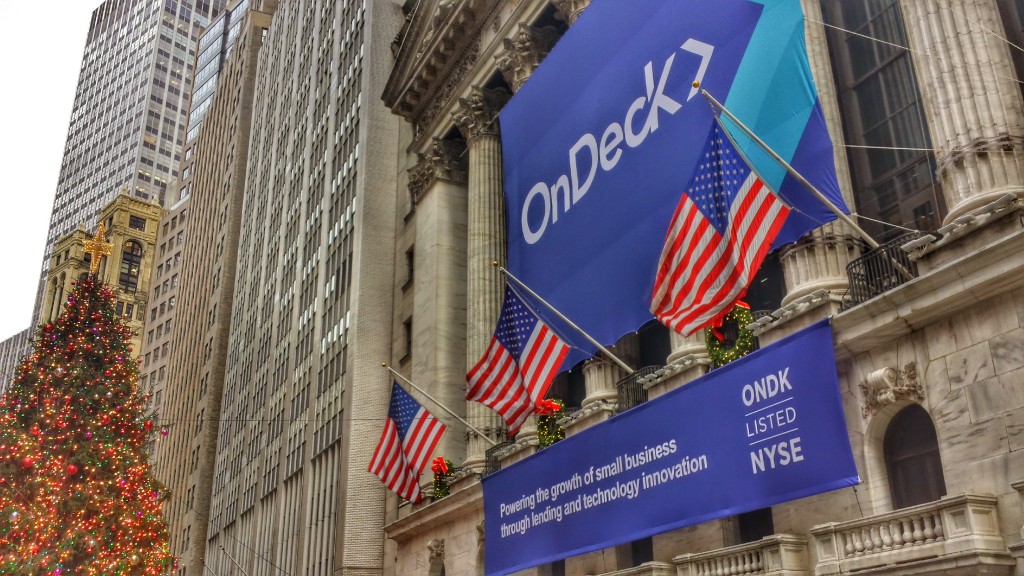
NEW YORK, Dec. 9, 2016 /PRNewswire/ — OnDeck® (NYSE: ONDK), the leader in online lending for small business, announced today the closing of a $200 million asset-backed revolving debt facility with Credit Suisse.
In addition to its other funding sources, OnDeck may now obtain funding under the new credit facility with Credit Suisse, subject to customary borrowing conditions, by accessing $125 million of committed capacity and an additional $75 million of capacity available at the discretion of the lenders.
“OnDeck has emerged as a leading provider of growth capital to small businesses around the country,” said Jon-Claude Zucconi, Managing Director, Credit Suisse. “The team’s innovative vision and commitment to financing is vital to expansion and growth in the small business community.”
Under the facility, loans will be made to Prime OnDeck Receivable Trust II, LLC, or PORT II, a wholly-owned subsidiary of OnDeck, to finance PORT II’s purchase of small business loans from OnDeck. The revolving pool of small business loans purchased by PORT II serves as collateral under the facility. OnDeck is acting as the servicer for such small business loans. The Class A Loans under the facility were rated by DBRS, Inc.
 OnDeck intends to initially use a portion of this facility, together with other available funds, to optionally prepay in full without penalty or premium, the existing $100 million Prime OnDeck Receivable Trust, LLC facility which was scheduled to expire in June 2017. As a result, OnDeck will benefit from obtaining additional funding capacity through December 2018.
“This transaction marks a continuation of our financing strategy to diversify funding sources, extend debt maturities, and create additional funding capacity to pave the way for future loan growth,” said Howard Katzenberg, Chief Financial Officer, OnDeck. “We are pleased to have Credit Suisse, a leading global financial institution, support OnDeck in our mission to power the growth of small business through lending technology and innovation.”
About OnDeck
OnDeck (NYSE: ONDK) is the leader in online small business lending. Since 2007, the company has powered Main Street’s growth through advanced lending technology and a constant dedication to customer service. OnDeck’s proprietary credit scoring system – the OnDeck Score® – leverages advanced analytics, enabling OnDeck to make real-time lending decisions and deliver capital to small businesses in as little as 24 hours. OnDeck offers business owners a complete financing solution, including the online lending industry’s widest range of term loans and lines of credit. To date, the company has deployed over $5 billion to more than 60,000 customers in 700 different industries across the United States, Canada, and Australia. OnDeck has an A+ rating with the Better Business Bureau and operates the educational small business financing website BusinessLoans.com.
For more information, please visit www.ondeck.com.
About Credit Ratings
Credit ratings are opinions of the relevant rating agency. They are not facts and are not opinions of OnDeck. They are not recommendations to purchase, sell or hold any securities and can be changed or withdrawn at any time.
Safe Harbor Statement
This press release contains “forward-looking statements” within the meaning of the private Securities Litigation Reform Act of 1995 and other legal authority. Forward-looking statements include statements about the intended use of proceeds from the new facility and expected optional repayment in full of the existing facility, the extension of debt maturities and the availability of additional funding capacity, all of which are dependent upon compliance with the borrowing and other conditions of the new facility, as well as information concerning OnDeck’s business plans and objectives and financing plans including future loan growth. Forward-looking statements can also be identified by words such as “will,” “enables,” “expects”, “may,” “allows,” “continues,” “believes,” “intends,” “anticipates,” “estimates” or similar expressions. Forward-looking statements are neither historical facts nor assurances of future performance. They are based only on OnDeck’s current beliefs, expectations and assumptions regarding the future of its business, anticipated events and trends, the economy and other future conditions. Moreover, OnDeck does not assume responsibility for the accuracy and completeness of forward-looking statements. As such, they are subject to inherent uncertainties, changes in circumstances, known and unknown risks and other factors that are difficult to predict and in many cases outside OnDeck’s control.
As a result, you should not rely on any forward-looking statements. OnDeck’s expected results may not be achieved, and actual results may differ materially from OnDeck’s expectations. Important factors that could cause actual results to differ from OnDeck’s forward-looking statements are the risks that OnDeck may not be able to manage its anticipated or actual growth effectively, that its credit models do not adequately identify potential risks, and other risks, including those under the heading “Risk Factors” in OnDeck’s Annual Report on Form 10-K for the year ended December 31, 2015, Quarterly Report on Form 10-Q for the quarter ended September 30, 2016 and in other documents that OnDeck files with the Securities and Exchange Commission, or SEC, from time to time which are available on the SEC website at www.sec.gov. OnDeck undertakes no obligation to publicly update any forward-looking statements for any reason after the date of this press release to conform these statements to actual results or to changes in OnDeck’s expectations, except as required by law.
OnDeck, the OnDeck logo and OnDeck Score are trademarks of On Deck Capital, Inc.
Logo – http://photos.prnewswire.com/prnh/20150812/257781LOGO
SOURCE On Deck Capital, Inc.
Barbara Corcoran, OnDeck Contest Final Aired on Rachael Ray Show
December 6, 2016The OnDeck “Seal of Approval” contest led by company spokesperson Barbara Corcoran recently came down to one final challenge and the results were aired on the Rachael Ray Show on Tuesday.
Three small businesses were featured and each won $10,000 paid for by OnDeck. Corcoran couldn’t mention the company enough times. This kind of collaboration and publicity is probably the best kind of marketing an alternative lender can get, not to mention a great opportunity for small businesses. Watch the TV segment of it below:
Not loading? Click here
SmartBiz Loans Ranked Number One Provider of Traditional SBA 7(a) Loans Under $350,000
December 5, 2016SAN FRANCISCO, CA – December 5, 2016 – SmartBiz Loans, the first SBA marketplace and bank-enabling technology platform, has ranked as the number one provider of non-Express, SBA 7(a) loans under $350,000 for the 2016 government fiscal year. SmartBiz also ranked number five among providers of under $350,000 traditional SBA 7(a) and Express 7(a) loans combined.
“SmartBiz’s success in this year’s SBA 7(a) ranking demonstrates how technology can support banks in meeting the needs of small businesses,” said Evan Singer, CEO of SmartBiz Loans. “SmartBiz is committed to creating the leading marketplace for both banks and small business owners, by matching small business owners with the bank best suited to their needs and enabling a higher percentage of SBA loans to be approved.”
SmartBiz generated $200 million in funded SBA 7(a) loans through its bank lending partners, which helped them earn the top spot. The data used is based on SBA lending data released in November, reflecting its 2016 fiscal year which ended on Sept. 30. Wells Fargo Bank, which was ranked just below SmartBiz, generated $155 million in funded non-Express SBA 7(a) loans under $350,000. This is the first time a technology platform and marketplace has achieved the number one position in SBA’s ranking of 7(a) loans.
“Small businesses are the driving force of the economy,” said Ann Marie Mehlum, retired Associate Administrator, Office of Capital Access, U.S. Small Business Administration. “By supporting them, the SBA and lending partners like SmartBiz are investing in the economy as a whole.”
SmartBiz is revolutionizing SBA lending. Its marketplace helps increase approval rates by automatically directing businesses to the right lender, while its advanced software streamlines the SBA loan application, underwriting and origination process. In this way, SmartBiz fills a critical gap in the small business loan market and enables small businesses nationwide to grow without settling for the sky-high rates of alternative online lenders or undergoing the typically slow and tedious traditional bank process.
About SmartBiz Loans
SmartBiz Loans is a unique combination of an online SBA loan marketplace and a bank enabling technology platform. The company’s online software provides SBA preferred lenders customized and automated origination, underwriting and documentation, making approval and funding fast and easy. Sophisticated algorithmic sorting in the SmartBiz marketplace also enables higher approval rates for small businesses because the right applications are automatically directed to the right bank. SmartBiz is based in San Francisco and was founded in 2009 by a team of experienced financial services entrepreneurs with backing from leading venture capital firms including Investor Growth Capital, Venrock, First Round Capital, Baseline Ventures, and SoftTech VC. Learn more at www.smartbizloans.com.
The OCC Wants Online Lenders to Become Limited Purpose Banks
December 2, 2016 Earlier today, Comptroller of the Currency Thomas J. Curry announced that the OCC will move forward with chartering financial technology companies that offer bank products and services that meet their high standards and chartering requirements.
“We have decided to move forward and to make available special purpose national charters to fintech companies for a few basic reasons,” he began saying during a speech at the Georgetown University Law Center. “First and foremost, we believe doing so is in the public interest. Fintech companies hold great potential to expand financial inclusion, empower consumers, and help families and businesses take more control of their financial matters.”
Curry also responded to critics who argued that a limited charter would put fully regulated banks at a disadvantage competitively. “The reality today is that the 4,000 fintech companies out there are already competing with national and state banks, without regard to any of the national bank responsibilities and under a patchwork of supervision,” he said. “Granting national charters to the companies who desire and warrant one doesn’t weaken the competitive position of existing banks or the dual banking system. In some ways, it levels the playing field because statutes that by their terms apply to national banks would apply to all special purpose national banks, even uninsured ones.”
Applying for this charter would be optional, not a requirement.
Like the Treasury RFI last year, the OCC has put up an official 13-question Request For Comment that is open until January 15th.
Those questions are:
1. What are the public policy benefits of approving fintech companies to operate under a national bank charter? What are the risks?
2. What elements should the OCC consider in establishing the capital and liquidity requirements for an uninsured special purpose national bank that limits the type of assets it holds?
3. What information should a special purpose national bank provide to the OCC to demonstrate its commitment to financial inclusion to individuals, businesses and communities? For instance, what new or alternative means (e.g., products, services) might a special purpose national bank establish in furtherance of its support for financial inclusion? How could an uninsured special purpose bank that uses innovative methods to develop or deliver financial products or services in a virtual or physical community demonstrate its commitment to financial inclusion?
4. Should the OCC seek a financial inclusion commitment from an uninsured special purpose national bank that would not engage in lending, and if so, how could such a bank demonstrate a commitment to financial inclusion?
5. How could a special purpose national bank that is not engaged in providing banking services to the public support financial inclusion?
6. Should the OCC use its chartering authority as an opportunity to address the gaps in protections afforded individuals versus small business borrowers, and if so, how?
7. What are potential challenges in executing or adapting a fintech business model to meet regulatory expectations, and what specific conditions governing the activities of special purpose national banks should the OCC consider?
8. What actions should the OCC take to ensure special purpose national banks operate in a safe and sound manner and in the public interest?
9. Would a fintech special purpose national bank have any competitive advantages over full service banks the OCC should address? Are there risks to full-service banks from fintech companies that do not have bank charters?
10. Are there particular products or services offered by fintech companies, such as digital currencies, that may require different approaches to supervision to mitigate risk for both the institution and the broader financial system?
11. How can the OCC enhance its coordination and communication with other regulators that have jurisdiction over a proposed special purpose national bank, its parent company, or its activities?
12. Certain risks may be increased in a special purpose national bank because of its concentration in a limited number of business activities. How can the OCC ensure that a special purpose national bank sufficiently mitigates these risks?
13. What additional information, materials, and technical assistance from the OCC would a
prospective fintech applicant find useful in the application process?
Read the OCC’s 17 page report on the matter. The Request For Comment and submission instructions are at the end of it.
Nude Photos Used as Collateral for Loans, Leak
December 2, 2016Perhaps the only thing worse than sending a nude photo of yourself to a lender as collateral is learning that the photo had been leaked on to the internet. In China, some online lenders hold on to nude photos of their borrowers (typically women) to use as leverage to pay up. If they don’t, the photos may be distributed to the borrower’s friends and family members to shame them. While this practice is certainly not common, about 10 gigabytes worth of such photos from loan platform Jiedaibao were leaked on to the internet recently, according to People’s Daily
Jiedaibao says that loans with such terms are private peer-to-peer loans that they can’t regulate. “We have called the police and collected evidence to protect the company’s reputation. Those who leaked the nude pictures will be punished according to law,” they said in a public response.
Chinese regulators have been working hard to address the growth of p2p lending after investors have lost billions through fraud. P2P lender Ezubao for example, turned out to be a $7.6 billion ponzi scheme. Meanwhile, Moodys reported that by the end of last year, a whopping 800 p2p loan platforms in China had already failed or were facing liquidity issues. In response, banking regulators want all p2p lenders to register with the government.
Bitcoin-based P2P Lending Platform BitLendingClub Shuts Down
December 2, 2016BitLendingClub (not to be confused with Lending Club) has shut down their bitcoin-based p2p lending platform, citing regulatory pressure. A message posted on their website says, “over the last year or so, the regulatory pressures has been increasing to the point that it is no longer feasible to maintain the operation of the platform. We are regretfully announcing that we will have to begin terminating the services effective immediately.”
BitLendingClub received a $200,000 seed investment from European VC fund LAUNCHub just two years ago. The company changed its name to LoanBase in September 2015 but then changed it back only a few months ago.
This was no small experiment either. Kiril Gantchev, BitLendingClub’s CEO, claims on his LinkedIn profile that the company made more than 10,000 loans worth more than $8 million dollars, originating from 90 countries. The company’s website claims an average APR of 192% and a default rate of nearly 12%.
In March however, the company stopped lending to people in several countries including Iran, Ireland and Nigeria due to elevated fraudulent activity.
It’s unclear what “regulatory pressures” caused them to shut down but the company appears to have been operating from San Francisco despite originally incorporating in Bulgaria. A search for a California lending license connected to them yielded no results. After the US, the country with the 2nd most borrowers on the platform was Venezuela followed by Brazil, the UK and India.
“Investors should understand the risks involved when making bitcoin loans,” their website warned. “The main risks are default and failure to collect.” they added.