Business Lending
Update: PayPal Acquired Swift Capital for $183M
October 30, 2017According to a filing with the SEC, PayPal acquired Swift Capital for $183 million.
We completed the acquisition of Swift Financial Corporation (“Swift Financial”) in September 2017 by acquiring all of the outstanding shares for a total purchase price of approximately $183 million. We acquired Swift Financial to enable us to enhance our underwriting capabilities and strengthen our business financing offerings, helping us to deepen relationships with our existing merchants and expand services to new merchants. The allocation of purchase consideration resulted in approximately $44 million of technology and customer-related intangible assets with an estimated useful life of 1 to 3 years, $173 million of merchant receivables, net liabilities of approximately $139 million and initial goodwill of approximately $105 million, which is attributable to the workforce of Swift Financial and the synergies expected to arise from the acquisition. We do not expect goodwill to be deductible for income tax purposes. The gross contractual merchant receivables acquired are approximately $213 million. Management estimates that the cash collected will approximate the contractual amounts of merchant receivables. The allocation of the purchase price for this acquisition has been prepared on a preliminary basis and changes to the allocation to certain assets, liabilities and tax estimates may occur as additional information becomes available.
Source: http://files.shareholder.com/downloads/AMDA-4BS3R8/5480917220x0xS1633917-17-171/1633917/filing.pdf
Goodbye Liens and Judgments
October 28, 2017 Justice can require sacrifice. Take the example of a decision by the three major credit bureaus – Equifax, Experian and TransUnion – to stop including some liens and most judgments in their credit reports.
The change makes life a little less unfair for consumers who fell victim to reporting errors. Many invested precious time and large amounts of money trying unsuccessfully to correct their credit histories and restore their reputations.
But for the alternative small-business finance industry, omitting data on liens and judgments increases costs, creates extra work and can even give rise to an unsettled feeling in the pit of the stomach. “You’re not looking at a full credit report anymore, which is kind of scary,” one alt funder admits.
Yellowstone Capital CEO Isaac Stern provides an example to illustrate what’s at issue. “Imagine I’m the Ford Motor Co. and I want to do a lease with you,” he says. “But I don’t have the information that you happen to have judgments from Chrysler, Chevy and BMW, so I approve your lease. Imagine that! Without full information, how do you make accurate decisions?”
Operating without the data could prove dangerous, agrees David Goldin, who sold his U.S. Capify operations to Strategic Funding Source in January but still runs Capify UK and Capify Australia and remains open to U.S. opportunities. “The IRS could come in and seize credit card processing accounts and prevent the lender from getting paid,” he says. “Once you have a judgment a creditor could come in and freeze bank accounts.”
Fears aside, the change in reporting probably won’t dry up alternative small-business credit – even in the short run, Goldin predicts. Alt funders will adjust quickly, he says, noting that they can compare the old and new credit scores of long-time customers to spot patterns and apply those patterns to their calculations. The industry can also tap alternative sources of information.
Even with those reassurances, the transition would have been easier if the industry had more advance notice, alt funders say. “We found out July 31 when a Reuters rep emailed us and said this is going into effect tomorrow,” recalls Stern. “That was really weird – I’ve got to tell you.” Experian didn’t provide a heads-up even though Yellowstone is one of its largest New Jersey customers, he notes. “We were a little bit annoyed, but what are going to do?” Meanwhile, Goldin says he didn’t begin researching the situation until deBanked asked him about it. “I don’t think anyone really knew about it” much in advance, he says.
But the industry is finding out and taking action. Yellowstone, for example, is performing a performing a workaround by integrating the judgments and liens section of the Clear investigative platform into the information underwriters see when they open a file, Stern says. The integration required a couple of weeks of hard work by the Yellowstone tech team, he notes.
 Clear, which is provided by Thomson Reuters, amasses public records that can date back 20 years and can fill more than a hundred pages, he says, adding that you have to know where to look for the relevant information. “You have to dig through it,” he says.
In the past, Yellowstone performed a Clear report on most files just before funding them, Stern explains. Now, the Clear report is scrutinized more extensively and earlier in the process – before the file is approved. As a result, Yellowstone underwriters will have all the information they need, but it will take them a little longer to get it, he says.
Yellowstone incurred the expense of obtaining additional user licenses from Clear, which cost it $800 to $900 monthly Stern says. Experian now charges the same price for less information, he notes.
Accommodating the changes didn’t require more underwriters but it became necessary to hire four additional data entry clerks to input information until the integration with Clear was completed, Stern says. Now that Clear and the Yellowstone systems are working together, the four extra clerical workers will shift their attention to inputting data from the increasing number of applications coming into the company, he says.
Most Alt funders won’t need to employ more people in their underwriting departments because changes to their models will be automated, Goldin says. “I don’t think this is as much of a game changer as people think it is,” he says of the credit bureaus’ new approach to reporting.” It’s just one extra step. It’s more of a nuisance issue than a manpower issue.”
However, a challenge arises for underwriters because leaving out the liens and judgments will result in higher credit scores for some loan or advance applicants, Goldin says. That means some alt lenders may need to go to the trouble and expense of tweaking their risk models to compensate for the change in the scores reported by the credit bureaus, he maintains.
The impact may be greatest among alt funders who rely on quick online decision-making, Goldin says. Adding extra steps to the process increases the difficulty of maintaining the speed that provides a selling point and a source of pride for those companies.
 While Clear is helping to fill the gap at Yellowstone, it’s not the only company providing much-needed data. LexisNexis Risk Solutions isn’t a credit bureau and will thus continue to disseminate information it gathers from courtrooms on lien and judgments, Goldin notes. Alt lenders who weren’t already using the vendor’s service or were using it only when an application reached a predetermined threshold will face added expense because of the credit bureaus’ decision, he says.
Indeed, LexisNexis Risk Solutions views the credit bureaus’ hiatus on some liens and judgments reporting as a business opportunity to increase its sales by supplying the missing data, according to Ankush Tewari, senior director of marketing planning in the company’s business services section. The company was already selling data on liens and judgments and anticipates selling much more of it, he observes.
 For 15 years LexisNexis Risk Solutions has been selling RiskView Solutions, a product that contains liens, judgments and other information not generally found on credit reports, such as the assessed value of a consumer’s home or a list of a consumer’s professional licenses. It offers no data on loan repayment but its other information helps define a consumer’s creditworthiness and character, Tewari says. Lenders can combine that peripheral information with credit scores for a more complete customer profile that outperforms the credit score alone, he suggests.
And there’s more. LexisNexis Risk Solutions has reacted to the credit bureaus’ decision by creating RiskView Liens & Judgments Report, which lists only those two types of records. “The credit bureaus announced these changes a year ago, and we knew there would continue to have a need for that data,” Tewari says. The company prices the RiskView information based upon the transaction volume, he notes, so a lender pays less per transaction as volume increases.
With this emphasis on liens and judgments, one might well wonder who tracks down the information. Companies like LexisNexis Risk Solutions gather and disseminate public records on liens and judgments from courthouses throughout the United States, says Tewari. Over the years the company acquired some of its competitors and eventually was spun off from its sister company, LexisNexis, which built its name partly as an aid for lawyers researching cases, he notes.
For decades, LexisNexis Risk Solutions has been providing the credit bureaus with raw data not only on liens and judgments but also on bankruptcies, Tewari says. The bureaus have then parsed those files electronically and appended the data to credit reports, he continues.
Problems arose because the credit bureaus’ tech systems could not always link the court documents to the right person when the courts provided only a name and address, Tewari maintains. Courts often limit information in their records to those two identifiers because they’re reluctant to divulge additional identification that criminals could intercept and use to commit fraud, he says.
Tewari traces the bureaus’ inaccuracies in matching court records to the right people to what he calls the bureaus’ “DNA.” The bureaus are accustomed to receiving “clean” information from lenders on a regularly scheduled basis. Conversely, some of the LexisNexis Risk Solutions data, gathered from obscure places like county deed offices, may arrive in a form that’s far from clean, he notes.
 However, that lack of court information or inconsistencies in the presentation of that information doesn’t pose problems for LexisNexis Risk Solutions because the company cleans the data before analyzing it. Tests indicate its linking methodology works accurately with just a name and address more than 99.9 percent of the time, Tewari contends. Thus, the company can establish that John Smith at 1234 Maple Street is the same person as John A. Smith at 1234 Maple Street, he says. He considers that linking technology the core of the company’s operations.
The information LexisNexis Risk Solutions can supply becomes vital to lenders because studies indicate that people who have a lien or judgment on file are twice as likely as people without them to default on a consumer loan and five times as likely to default on a mortgage, Tewari says. “The data didn’t become less important because the credit bureaus decided not to include it anymore,” he maintains. “It’s still just as predictive as it was.”
Meanwhile, other types of information can also help lenders make decisions, notes Eric Lindeen, vice president of marketing for ID Analytics, a credit risk and fraud risk management company that offers a credit score called Credit Optics, which it bases on a combination of traditional and alternative credit data.
Alternative credit data is defined as anything the credit bureaus don’t include in their reports, Lindeen says. Examples include the bills consumers pay for cell phones, utilities and cable television, he notes, adding that rent is also sometimes considered alternative credit data. The category also encompasses records from marketplace lenders.
A consumer’s tendency to pay those bills on time, late or not at all can reflect on creditworthiness, Lindeen maintains. That history becomes relevant for alt funders because the small businesses they serve constitute a hybrid of consumer and commercial credit, he says.
Using that data, ID Analytics can spot people who are good credit risks when the credit bureaus still consign them to “thin file” status — the limbo where applicants don’t have enough credit history to evaluate their creditworthiness, Lindeen maintains. About 60 percent of near-prime applicants qualify for credit when lenders factor in alternative data, according to an ID Analytics study he says. At the same time, alternative data can also expose weaknesses among individuals with excellent traditional credit scores, he observes.
Combining alternative data with traditional data has become more important with the bureaus’ decision to stop supplying data on liens and judgments, Lindeen says. Leaving out that data will raise some credit scores, and the effect will be strongest among near-prime individuals with good but not great traditional scores, he notes. With those consumers, a 10-point shift could make a big difference in qualifying for credit, he says.
“Even though it’s a small population, it’s a critical population,” Lindeen says of those newly minted prime applicants. They may number only one in a hundred of a particular funder’s portfolio, but they may advance to another risk pool and consequently invalidate a risk model, he suggests. Over time, risk managers will adapt to the change and oversee a “risk migration,” he predicts.
 Overall, between 6 percent and 9 percent of consumers will see their credit scores rise because of the bureaus’ new policy, Lindeen estimates. The change usually won’t exceed 20 points, he says. Still, about 700,000 will see an improvement of 40 points or more, he continues. “That’s a significant increase for a nontrivial population,” he says. “It’s likely their performance will stay the same as their score goes up.”
A study by VantageScore Solutions, the company that provides the VantageScore credit scoring model to the credit reporting bureaus, projected scores would increase an average of 10 points for slightly more than 8 percent of the scorable U.S. population.
Those changes are characterized as “minimal” by Francis Creighton, President & CEO of the Consumer Data Industry Association, a trade group that represents the three major credit bureaus as well as about a hundred other companies – mostly smaller credit bureaus around the country, resellers of credit bureau information and background screening companies.
The credit bureaus decided to curtail reporting of judgments and liens as part of the National Consumer Assistance Plan, or NCAP, Creighton says. NCAP is an agreement reached in March 2015 among the three major credit bureaus and the attorneys general of 31 states, who were pressing for fairness in credit reports. Many observers call NCAP a “settlement” but the agreement did not result from a lawsuit, he notes.
Under NCAP, the bureaus will continue to include bankruptcies in their reports because the records meet the standard of providing a name, address, Social Security number and date of birth and because visits to the courthouse to update records occur at least every 90 days. About half of liens don’t meet those standards and will be removed from credit reports, and nearly all judgments fail to adhere to the standard and will no longer appear on the reports.
Although Creighton declines to say how many consumers were victims of credit reporting errors, he emphasizes the severity of the problem for each victim. “If you were one of the people who had a name similar to somebody else or a similar Social Security number, it would impact you a lot,” he maintains. “I don’t know how widespread it was, but it was disruptive enough for individual people that it’s better just not to have it.”
A Federal Trade Commission study released in 2013 reported that a sample of 1,000 credit reports indicated that 25 percent had at least one error that could reduce scores, according to published reports. Such findings prompted state attorneys general to seek remedies that resulted in NCAP.
The bureaus planned to implement another major portion of NCAP in September when they were to begin waiting 180 days before reporting medical debts, Creighton notes. At the same time, debts for medical expenses covered by insurance policies were to be omitted from credit reports, he says.
Changes brought by NCAP represent part of ongoing efforts to improve the system, according to Creighton. “We want accurate information in the reports,” he says. “That’s good for everybody.”
Q&A With Noah Breslow On Replacing ACH For Realtime Funding and More
October 25, 2017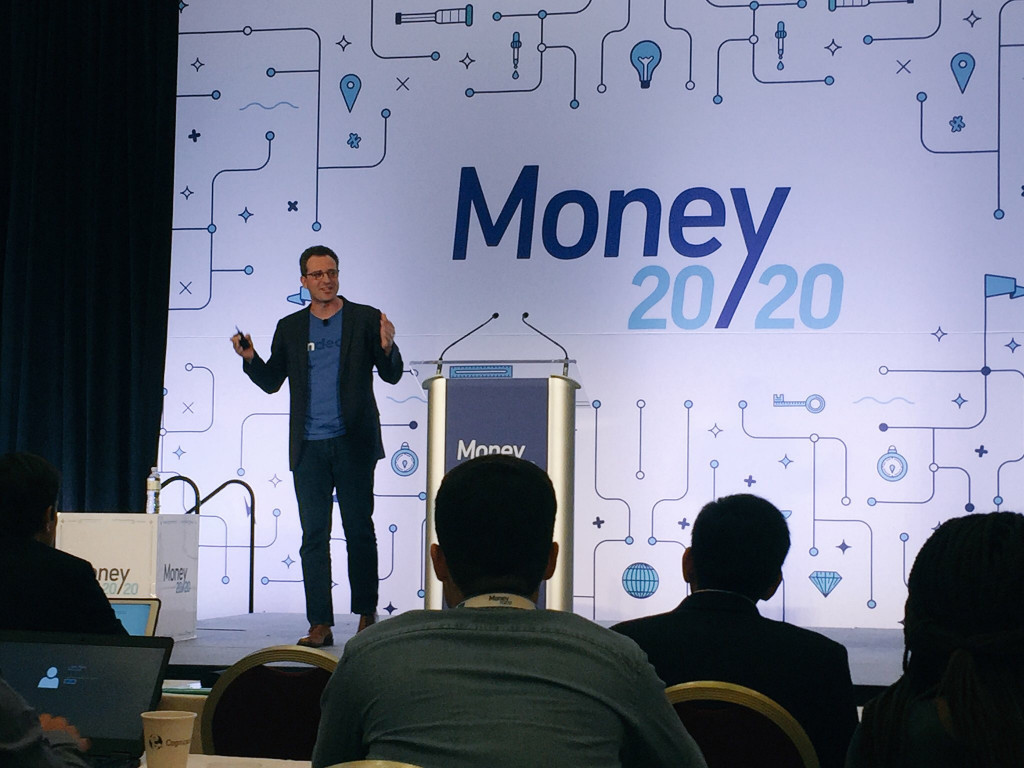 An announcement by OnDeck, Ingo Money and Visa this week at Money2020 may be more consequential than it appeared. That’s because the partnership enables OnDeck to actually fund a merchant’s bank account (not their debit card) on days, nights, weekends, and holidays. Such a feature is not possible in the realm of ACH where funding typically takes place on the next business day and only if the transaction is submitted before a predetermined cutoff time. deBanked got to learn more about how this works in an interview with OnDeck CEO Noah Breslow on Tuesday as well as the opportunity to pick his brain about a few other things. Below is a curated excerpt of the interview that has been edited for brevity.
deBanked: For this real time funding you announced, do you have to have a Visa debit card?
Breslow: You do not, but you have to have a debit card. 70% of small business owners have debit cards. And this will work with Visa or Mastercard.
deBanked: So you’re not actually funding a merchant’s debit card, you’re funding their bank account but using the Visa network as the mechanism?
Breslow: It’s the rails, it’s the way to get the money into a small business owner’s checking account. My prediction is that every funder in the industry is going to be doing this in a couple of years. It’s going to be faster and small businesses will start to expect it. Now instead of waiting 2 days to get the money into someone’s account, it can be done on nights, weekends, holidays, 365 days a year.
deBanked: So you can fund a merchant’s bank account on the weekend?
Breslow: Yes, it’s real time. And to be clear we partnered with Ingo Money, Visa has the rails. Ingo is our interface point, they do the PCI compliance and the rest. We looked at a bunch of different players in the market and Ingo was unique in that they had covered small business checking accounts. Some of this stuff is happening in consumer already. We’re the first lender to use these rails for either consumer or small business in the US.
deBanked: Has this already gone into effect?
Breslow: No, it’s coming out in a couple months. Early 2018.
deBanked: Does this system work with every bank already?
Breslow: It doesn’t work with every bank yet. It works with most of them, all of the major ones.
deBanked: Speaking of payments… Square. PayPal. They’re both payments companies first that went into lending. Is there a potential reverse play for OnDeck to go into payments?
Breslow: Right now our product expansion stuff is very focused on additional lending products. I still feel like we haven’t lived up to our full potential there. There’s a couple other product categories that we’ve looked at and thought about. Equipment finance is one, invoice factoring, small business credit cards. And so we look to be the best small business lender in the world with the best set of products. And then we can partner with a lot of the payments companies. But right now, no we’re not going to sell merchant processing. Never say never, but not in the near future.
deBanked: Any news on the Chase front?
Breslow: We re-upped our agreement with them in early August. The customer experience is amazing, our platform is scaling, and we’re making progress. I can’t tell you a lot of other details about it.
deBanked: I’ve heard from folks in the industry about merchants who are being debited by Chase either daily or weekly. Is that you?
Breslow: That would be our platform. Chase’s product is more or less like the OnDeck product but cheaper obviously. It’s a daily or weekly collected loan. It goes up to 24 months for $200,000.
deBanked: I want to ask you about brokers, or as you call them “funding advisors.” Do you anticipate reliance on them increasing or decreasing?
Breslow: Stable. I don’t anticipate it moving up or down. We really like the funding advisors that we have and we’re continuing to grow with them. We’re also adding some new ones.
deBanked: What makes a good broker? What can they do to do things right?
Breslow: The value equation between the merchant, the lender and yourself has to be in balance. They should also be efficient and know the credit box of the lender they’re working with. They should invest in their employees, train them, and they should become more sophisticated about their online marketing and CRMs, which we’ve been seeing.
deBanked: Everyone’s talking about blockchain at this conference. Is there a way that blockchain fits into online lending and possibly OnDeck?
Breslow: I love the technology, I’m very intrigued by it. But we’re not actively using it and it’s not like I have a secret blockchain project in the works.
deBanked: Is there a universe in which OnDeck considers making an acquisition of a company?
Breslow: So we’re not totally opposed to that. They’re might be an opportunity for a complementary product or a complementary team. I think you’re going to see a lot of consolidation in the industry in the next 3-5 years.
The Top Small Business Funders By Revenue
October 23, 2017The below chart ranks several companies in the non-bank small business financing space by revenue over the last 5 years. The data is primarily drawn from reports submitted to the Inc. 5000 list, public earnings statements, or published media reports. It is not comprehensive. Companies for which no data is publicly available are excluded.
| Company | 2016 | 2015 | 2014 | 2013 | 2012 |
| Square1 | $1,708,721,000 | $1,267,118,000 | $850,192,000 | $552,433,000 | $203,449,000 |
| OnDeck2 | $291,300,000 | $254,700,000 | $158,100,000 | $65,200,000 | $25,600,000 |
| Kabbage3 | $171,784,000 | $97,461,712 | $40,193,000 | ||
| Swift Capital4 | $88,600,000 | $51,400,000 | $27,540,900 | $11,703,500 | |
| National Funding | $75,693,096 | $59,075,878 | $39,048,959 | $26,707,000 | $18,643,813 |
| Reliant Funding5 | $51,946,472 | $11,294,044 | $9,723,924 | $5,968,009 | $2,096,324 |
| Fora Financial6 | $41,590,720 | $33,974,000 | $26,932,581 | $18,418,300 | |
| Forward Financing | $28,305,078 | ||||
| Gibraltar Business Capital | $15,984,688 | ||||
| Tax Guard | $9,886,365 | $8,197,755 | $5,142,739 | $4,354,787 | |
| United Capital Source | $8,465,260 | $3,917,193 | |||
| Blue Bridge Financial | $6,569,714 | $5,470,564 | |||
| Lighter Capital | $6,364,417 | $4,364,907 | |||
| Fast Capital 360 | $6,264,924 | ||||
| US Business Funding | $5,794,936 | ||||
| Cashbloom | $5,404,123 | $4,804,112 | $3,941,819 | $3,823,893 | $2,555,140 |
| Fund&Grow | $4,082,130 | ||||
| Nav | $2,663,344 | ||||
| Priority Funding Solutions | $2,599,931 | ||||
| StreetShares | $647,119 | $239,593 | |||
| CAN Capital7 | $213,402,616 | $269,852,762 | $215,503,978 | $151,606,959 | |
| Bizfi8 | $79,886,000 | $51,475,000 | $38,715,312 | ||
| Quick Bridge Funding | $48,856,909 | $44,603,626 | |||
| Funding Circle Holdings9 | $39,411,279 | $20,100,000 | $8,100,000 | ||
| Capify10 | $37,860,596 | $41,119,291 | |||
| Credibly11 | $26,265,198 | $14,603,213 | $7,013,359 | ||
| Envision Capital Group | $21,034,113 | $19,432,205 | $12,071,976 | $11,173,853 | |
| Capital Advance Solutions | $4,856,377 | ||||
| Channel Partners Capital | $2,207,927 | $4,013,608 | $3,673,990 | $2,208,488 | |
| Bankers Healthcare Group | $93,825,129 | $61,332,289 | |||
| Strada Capital | $8,765,600 | ||||
| Direct Capital | $432,780,164 | $329,350,716 | |||
| Snap Advances | $21,946,000 | ||||
| American Finance Solutions12 | $5,871,832 | $6,359,078 | |||
| The Business Backer13 | $19,593,171 | $11,205,755 | $9,615,062 |
1Square (SQ) went public in 2015
2OnDeck (ONDK) went public in 2014
3Kabbage received a $1.25B+ private market valuation in August 2017
4Swift Capital was acquired by PayPal (PYPL) in August 2017
5Reliant Funding was acquired by a PE firm in 2014
6Fora Financial was acquired by a PE firm in 2015
7CAN Capital ceased funding operations in December 2016 but resumed in July 2017
8Bizfi wound down in 2017. Credibly secured the servicing rights of their portfolio
9Funding Circle’s primary market is the UK
10Capify’s US operations were wound down in early 2017 and their operations were integrated with Strategic Funding Source. Capify’s international companies are still operating
11Credibly received a significant equity investment from a PE firm in 2015
12American Finance Solutions was acquired by Rapid Capital Funding in 2014, who was then immediately acquired by North American Bancard
13The Business Backer was acquired by Enova (ENVA) in 2015
The Voice of Main Street – Small Businesses Share Their Experience With Non-bank Finance
October 18, 2017
If she hadn’t scored the $250,000 loan through Breakout Capital in 2015, Jackie Luo says, the commercial-software firm she heads in Baltimore could not have made the “strategic hires” and purchased the new server to support additional customers and maintain the company’s 30% growth rate.
“Without that infusion of capital” from the McLean (Va.)-based lender, says Luo, chief executive at E-ISG Asset Intelligence, the software solutions provider would have been hard-pressed to deploy the “bandwidth and capacity” necessary to meet burgeoning demand.
And demand there is. Luo says billing for her company’s services helping more than 100 businesses and government agencies improve operational efficiency by keeping tabs on multiple assets — human, financial and equipment — topped $1.5 million last year, up from $1 million in 2015. This year, moreover, E-ISG is on track to collect nearly $2 million.
Meantime, she says, the $250,000, 10-year note at 6% interest she obtained with the help of Breakout was both a good deal and convenient: she reports securing the financing in three weeks, compared with the six months that a commercial bank would likely have taken. In addition, she’s been able to forge a better relationship with Breakout than with a faceless financial institution.
“We are a small business,” she says, “and we’d be just one in a million at a big bank like Wells Fargo. They wouldn’t give us much attention.” With Breakout, Luo adds: “I have the freedom to make decisions about infrastructure investments without worrying about the short-term. And I don’t have to deal with people second-guessing me.”
Had she not gotten the financing, moreover, “I would not be able to pay myself,” she says. “I’d have to use my salary as working capital.”
Luo is not alone. Her company’s story of finding much-needed capital from a nonbank financial company is increasingly common. It has always been challenging for small businesses to obtain credit from a big bank — roughly a financial institution larger than $10 billion in assets. But the small and community banks that have been the lifeblood for small businesses have also been winding down their small-business lending as well, according to a March, 2016, working paper published by the Federal Reserve Bank of Philadelphia.
“As recently as 1997, small banks, with less than $10 billion in assets, accounted for 77% of the small business lending market share issued by commercial banks,” co-authors Julapa Jagtiani and Catharine Lemieux write in “Small Business Lending: Challenges and Opportunities for Community Banks.” However, the market share dropped to 43% in 2015 for small business loans with origination amounts less than $1 million held by depository institutions.
“The decline is even more severe for small business loans of less than $100,000,” they add, “where the market share for small banks under $10 billion declined from 82% in 1997 to only 29% in 2015.”
 The Philadelphia Fed study notes that alternative nonbank lenders are filling a widening gap. “By using technology and unconventional underwriting techniques, many alternative lenders are competing for borrowers with offers of faster processing times, automatic applications, minimal demands for financial documents, and funding as soon as the same day.” And the Fed study finds that it’s likely that nonbank lenders, which are growing rapidly, are having a positive effect by “increasing the availability of credit, particularly to newer businesses that do not have the credit history required by traditional lenders.”
Meantime, the Small Business Administration reports that small businesses remain essential to the health of the U.S. economy. Businesses with fewer than 500 employees account for 55% of overall employment in the U.S., according to the agency, and are responsible for creating two out of every three net new jobs. Which means that alternative funding sources — which do not, it is worth noting, depend on depositors’ money, as banks do — are playing an increasingly important and largely unrecognized role in the country’s economic fortunes, notes Cornelius Hurley, a law professor at Boston University and executive director of the Online Lending Policy Institute. “They’re still a small percentage of the overall lending picture,” he says of nonbank financial companies, “but they’re an emerging force and a lot of small businesspeople certainly depend on them. If they disappeared tomorrow,” he adds, “a lot of businesses would be wiped out too.”
To find out what is happening in the real world, deBanked interviewed small business owners around the country: among others, a Houston sports medicine provider, a Connecticut restaurateur, a Midwestern truck hauler, and a Maryland hardware-store owner. Some recounted being shunned by banks because of poor credit while others registered unhappiness with traditional financial institutions as inconvenient and impersonal. While some who turned to alternative lenders admitted they would have preferred not to be paying dearly for borrowing or for cash advances, most said the tradeoff was worth it.
The existence of alternative lenders has made it possible for these businesspeople to meet payrolls, pay contractors and suppliers even when business was slow or billings stalled. Customers with alternative funders – in addition to Breakout’s customers, deBanked spoke to clients of Pearl Capital Business Funding and Merchants Advance Network– also reported that they were able to purchase or replace equipment and maintain inventory, hire additional employees and accept new customers, pay for upkeep and upgrades of their business’s physical plant, and make other expenditures necessary to keep operations up-and-running.
Jason, for example, who heads a family business in Louisiana manufacturing and selling pesticides (and who asked to be identified only by his first name), reports that his suppliers began demanding that he pay in advance for chemical feedstock after he took a “financial hit following a nasty divorce.”
The roughly $1 million (annual sales) business — which was started by his parents back in 1960 — furnishes chemicals mainly to cotton farmers and homeowners in Louisiana and Texas, most of whom purchase the company’s products through feed and hardware stores. Jason says he spends a substantial amount of time on the road handling sales and distribution.
 His suppliers not only require him to pay for the chemicals upfront but, following his divorce, they now insist upon larger purchases as well. Following the departure of a previous lender, he says, Breakout stepped in with an $80,000, 12-month loan in March, 2016, which he was able to repay within six months. This was followed by a $60,000 borrowing in March, 2017, which he again paid down early – in 90 days, Jason says – and the account manager at Breakout “went to bat for me and gave me an additional discount for early payment.”
Had Breakout not provided external funding, Jason says, he would have been “wiped out.” He adds with feeling: “It would have meant the end of me.” And sinking the fortunes of the company would also have spelled job losses for five employees, including both his son, who works part-time, and his sister, the business’s co-manager. “Now I’m out of the hole,” he says.
In Houston, Anna, co-owner of a physical therapy and sports medicine concern, was interviewed in August just before Hurricane Harvey loomed on the horizon. “We’d been around for four years and growing rapidly,” she says, asking to be identified only by her first name, and “we couldn’t keep up with the growth.”
Anna recalls that a few years ago (she is vague about the exact dates) the company needed $50,000 to $60,000 to add equipment and staff to meet the growing demand. Because of some “ups and downs” in her business and credit history, however, a bank loan was out of the question. “My credit wasn’t the best,” Anna says, “and we had not been in business the five-to-seven years that most banks want.” She began casting about for financing and quickly saw that factoring would not be a suitable choice for a business like hers, which depends heavily on third-party payments from health insurance providers. “Companies using factoring are taking money based on credit card payments,” she says, “and we’re not a restaurant or a bar. So we can’t pay a percentage of every transaction.” Typically, she notes, getting paid by an insurance company involves a “90-day turnaround.”
 Anna went online, did some research, and talked to three or four nonbank lenders searching for the “right kind of company.” That led her to Breakout. “What I really liked about them is that they did a lot of due diligence on our field,” she says. “They did their homework, asking us: ‘What are your collections and payroll? How much outstanding debt do you have?’ They also asked to see our actual bank statements.”
Despite the high level of due diligence that Breakout performed, Anna says, it only took “maybe three or four days” for the loan to be approved and for the money to land in her bank account. Before long, she was off to the races. With the added capital, she hired three more employees – bringing the employee headcount to 18 — purchased more gym equipment, made payroll, and paid off miscellaneous expenses.
The added capacity and fortified staff, meanwhile, enabled the company to “almost triple its volume,” the entrepreneur says. And not only did the financing “put me in a good financial place,” Anna adds, but after repayment, Breakout made it possible for her to effect a merger with a competitor by approving a second loan for about $30,000. “The best thing about Breakout,” she says, “has been the communication. One time I did need to make a payment two or three days late. But I just called (the account manager). I was very surprised because these kinds of companies are seen as a last resort. But it was like they were investing in us.”
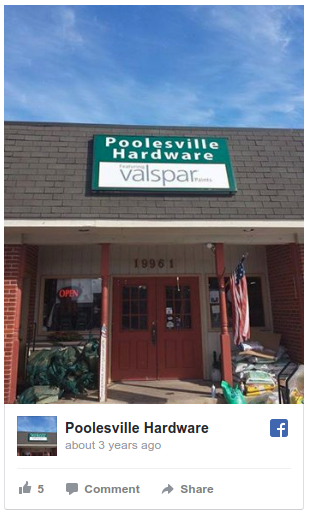
John Speelman, who owns Poolesville Hardware in Poolesville, Md., can boast a raft of five-star Yelp reviews online. “Extremely helpful and friendly service, surprisingly good selection (and) the complete opposite of a big box hardware chain,” raves one customer. “It is so rare to find a well-stocked store that has helpful personnel—makes this store a real gem!” says another fan.
For his part, Speelman attributes much of his hardware store’s popularity to the financing arrangement that he’s been able to work out over the past eight years with Merchants Advance Network, a Fort Lauderdale (Fla.)-based alternative funder. “It takes money to make money,” is one of his pet aphorisms.
Located roughly 35 miles west of the White House, the hardware store boasts a clientele who tend to arrive in BMW’s rather than the pickup trucks that predominated a decade or so ago in this exurban community of some 5,000 denizens. Whatever their class background, though, they’re looking for items that are not a good match for an online purchase. “People don’t buy a toilet plunger, a can of paint or picture-hanging stuff online,” Speelman says. “Because they want to do that today,” he says, “they won’t order with Amazon.”
“One industry that has not been impacted” by online merchandisers, he adds, “is the garden center. They’ll buy a garden hose, weed killer and seeding,” he explains of his regular customers. “And light bulbs” while they’re there, he adds. “We’re like the 7-Eleven — a convenience store.”
To guarantee that convenience, Speelman pays cash-in-advance for most of his inventory, and banks have not been helpful. He contrasts the relationship he has with Michael Scalise, the chief executive at Merchants Advance, with loan officers at commercial banks. “It’s hard to get a loan for anything in retail,” he says. Never mind that he maintains “a high credit rating and I never bounce a check,” he went on. “There are no more local banks. At M&T Bank, all the managers I knew are gone and there’s always a new teller. The banking industry is a revolving door.” So he opts for capital from Merchants Advance “when I need 30-40-50 grand in a day, I use Mike’s money” even though the cost can be as steep as 25%, he says. If he doesn’t have something in stock – specialty items like ammo boxes, a Sugarplum tent, as many as 32 packs of size D batteries, metric measuring tapes – he can put in a special order with suppliers. But he prides himself on the full panoply of wares on his shelves. “You can’t sell from an empty cart,” is another of his favorite sayings.
Lori Hitchcock, who also draws capital from Merchants Advance, is manifestly displeased with the banking industry. She’s an owner with her husband of Hitchcock Trucking, the couple’s 60-year-old family business, which is located on a ten-acre tract in Webberville, Mich., situated between Detroit and Lansing, the state capital.
Of her experience with banks, Hitchcock says: “At the time we went with (Merchants Advance), banks weren’t lending. And they’re still not lending. We’re considered high-maintenance and high-risk. Banks don’t want a bunch of trucks” should they foreclose on a loan, she observes. “If you’re a farmer, they can take all your land. Great! In this crazy world you live in, it’s hard to get the banks interested.”
 The Hitchcock family’s fleet of ten Peterbilt semis hitch up to more than 20 trailers and truck bodies – flatbeds, dump trucks, vans, and refrigerated trucks or “reefers” – and haul grain, sweet corn, onions, celery, fertilizer, and soft drinks across the Midwest. Most recently, she says, the family business took out $80,000 from Merchants Advance to expand its fleet and buy another reefer trailer and a backhoe. “Out here in the country, you always need a backhoe,” she says.
To satisfy her lender, the company makes daily ACH payments. “I’m not going to lie and say that things aren’t tight,” she says. “It is a burden. You just have to have constant cash-flow – which we do have. And it’s important to have good relationships…I can usually tell three weeks in advance if (making payments) is going to be challenging. So it all comes down to being loyal to people.”
Whatever the struggle to keep up with debt payments, it beats using her own money. “My husband and I are raising a family,” Hitchcock says, “and it’s nice having the cash so you’re not putting your personal earnings into the company.”
In Manchester, Conn., a stone’s throw east of Hartford, Corey Wry says that he wouldn’t be able to operate his two, highly rated restaurants just off Interstate 84 – Corey’s Catsup & Mustard and Pastrami on Wry – if he didn’t have funding from Pearl Capital, a New York (N.Y.)-based alternative funding company. A graduate of Johnson & Wales University in Providence, a restaurant-and hotel school, Wry describes himself as “a culinary guy” whose first love is serving food that’s both innovatively prepared and delicious. He candidly admits that his credit hit “rock bottom” after a confluence of untoward events.

Last year, a third restaurant in town, Chops & Catch, that he and some partners had “bootstrapped” had to shut down after six years of operation. Despite generally favorable reviews for such creative fare as the “lobsterburger,” the surf-and-turf themed restaurant was a money-loser. He was also struggling to pay off credit cards. And he’d been late more than once on car payments.
At the same time, Wry was in the process of moving Pastrami & Wry — a deli whose moniker is wordplay on his last name – to a new location. Both the general contractor and electrician were “over-budget” on that project, he says. Meanwhile, Catsup and Mustard, a hamburger spot, needed to be spruced up. Says he: “It was getting busier and the original seats were worn. I had a hole in a booth big enough to swallow someone.”
He approached a few banks for a loan and “it did not seem like it was going to happen,” he says. “Then I got a cold call from one of these financiers. Some of them had super-high rates. When you have bad credit but need to make capital improvements you do what you have to do.”
He’s accessed more than $100,000 from several alternative funding sources, including Pearl – from which he reports getting merchant cash advances for $30,000. But hard as it is to meet the obligations, which typically require a daily ACH payment, the financing has made renovating the burger place possible. Moreover, he’d still be on the hook with plumbers and other contractors – all of whom are local tradesmen and would likely be paying him personal visits until they were repaid — for the relocation of Pastrami & Wry.
“Business is good,” says Wry, who at 40 is single, often works 15-hour days, and says that he doesn’t have time for a girlfriend, much less a wife and family. “I’ve still got $3,200 on the books with the electrician,” he adds, “which means that I won’t be able to purchase a deli slicer. I have to plan these things out…”

James McGehee, a partner at the boutique accounting and tax-preparation firm McGehee, Davis & Associates, which is located in the Denver suburb of White Ridge, reports that the firm took a merchant cash advance from Pearl Capital, among other financiers, to bridge the gap between tax season and the rest of the year when billings invariably diminish. “Our overhead is pretty high,” he explains. “We’ve added two employees. We’ve been expanding on what we were doing, adding tax and accounting clients.”
A very conservative, sober-sounding man, McGehee explained that his credit was nonetheless “trashed” after he suffered from health problems five years ago. “Major stuff,” he says, “it was open-heart surgery.” The medical ordeal meant that he could not work for a time and had trouble paying his bills. “Some family members helped me through the mortgage and utilities payments and I ended up in arrears and in credit card debt,” he says.
All of which made an alternative source of financing his firm’s only option. “I’m not sure how we heard about Pearl,” he says. “I think they just happened to call. We took out [$11,000]. It was not a huge amount. We also borrowed $9,000 from another entity. We paid it all back during tax season. The terms were pretty steep,” McGehee adds.
“But when you need the money for cash-flow,” he explains, “you just absorb it. You grin and bear it. When you need the money, you need the money.”
Lead Generators Facing Rougher Road
October 13, 2017 Lead generators for alternative funders are facing stronger headwinds these days. The business has gotten tougher for a whole host of reasons. A pullback in alternative lending necessitates fewer leads. On top of that, funders, ISOs and brokers have gotten pickier about the types of leads they’ll accept. What’s more, stricter application of the Telephone Consumer Protection Act (TCPA) is hampering lead generators’ ability to solicit business owners. As a result, some lead generators have faded away, while others have been developing additional business lines or are broadening their reach to other areas within financial services to buoy earnings.
“I don’t see any growth in the space for the next six months, or maybe a year,” says Michael O’Hare, chief executive of Blindbid, a lead generation company in Colorado Springs, Colorado. “It’s really unclear right now what’s going to happen, but we’ll see.”
The alternative funding industry has been in somewhat of a funk since spring 2016 when Lending Club grabbed headlines with a scandal that spooked the industry and also took out several senior managers, including the company’s then-CEO.
It was the first time in the industry’s relatively short history that people realized “it wasn’t all puppy dogs and ice cream,” says Justin Benton, a partner at Lenders Marketing in Santa Monica, Calif., a lead generator in the alternative funding space.
Since that time, there’s been a lot of movement in the market, including companies that are consolidating or exiting the business, pumping the brakes or making shifts in product lines, Benton says. These developments have all had a big impact on the sheer number of clients that are looking for leads, he says.
Late last year, for instance, CAN Capital Inc. stopped funding for several months, though it’s back in business as of early July. This summer, Bizfi, one of the stalwarts of the alternative financing space, began giving pink slips to staff and in August the company sold the servicing rights to its $250 million loan portfolio to rival Credibly.
There aren’t as many start-up ISOs or companies entering the alternative funding space—meaning more leads for existing funders—which, of course, is a boon for them.
“There are still roughly 75,000 business owners every week who meet the criteria for an [MCA]. Now instead of there being 5,000 options in the space, there are 2,000, so those 2,000 are gobbling it all up,” Benton says.
 At the same time, however, TCPA regulations have gotten more stringent, making it dangerous to solicit businesses, says O’Hare of Blindbid. “Any phone call you make, you can get sued,” he says.
Large funding companies generally take TCPA very seriously—especially if they’ve gotten hit with violations, O’Hare says. Smaller funders and brokers, however, aren’t always as familiar with the restrictions; they think it’s only an issue if you’re calling consumers, as opposed to calling businesses, but that’s not the case. “A lot of businesses today are using their cell phone as a main business line and also for personal use. If you call a cell phone that’s on the DNC [Do Not Call Registry], you can potentially get sued.”
Last year, he had a situation where a plaintiff pretended to be an interested business. When he passed along the referral, the plaintiff’s attorney claimed TCPA violations and ultimately sued the funder. The funder balked, and it created numerous issues for his company.
His company now tries to educate funders about how to protect themselves from TCPA litigation. He sends out emails to funders with information about TCPA and provides contact information of attorneys who are well-versed in TCPA rules. He also provides funders with risk mitigation tactics and shares his list of known TCPA litigators so funders won’t accidentally call them. He also provides direction to clients that receive a demand letter or complaint on how to respond and offers a list of TCPA defense attorneys, if they need.
“We’ve become almost extreme in how we try to avoid problems related to TCPA,” O’Hare says.
To be sure, some of the changes lead generators are experiencing are indicative of a maturing industry.
A few years ago, lead generators could be less selective who they approached initially because the concept of alternative funding was so new to merchants, says Bob Squiers, chief executive of Meridian Leads, a lead generator in Deerfield Beach, Fla. Now, however, the cat is out of the bag, and, with business owners getting multiple calls a day, it’s harder to get their attention, he says.
“They know, they’ve heard, they’ve been pitched. There’s not too many unturned business owners. It’s about getting them at the right time.”
As a result, lead generation today requires more data to discern the good leads from the bad. Instead of going after half a million restaurants, lead generators are targeting the 20 percent that data suggests are the most viable funding candidates. “It’s more of a sniper approach than a shotgun approach,” Squiers says.
 Rob Buchanan, senior sales executive at Infogroup in Papillion, Nebraska, who focuses on lead-generation for the fintech space, notes that within the past 18 months or so, clients have been going after “low-hanging fruit” when it comes to leads. They are looking for leads where business owners are actively looking for financing as opposed to relying primarily on UCC data. They are still using UCC data, but to a lesser extent than they were in the past, he says.
Not only do clients want very targeted and specific types of companies—but they are changing their minds more frequently about the types of businesses they’re looking for, says Matthew Martin, managing director and principal at Silver Bullet Marketing, a lead-generating and marketing company in Danbury, Conn. They might ask for businesses of a particular size or credit quality—they are even seeking to exclude businesses within certain zip codes. They are also more amenable to leads from industries they deemed too risky a few years ago.
“I have clients that are constantly changing the parameters of what they want,” Martin says.
The problem is that once you start narrowing the leads of possible merchants that can be funded, lead costs go up and many funders don’t want to pay for that, says O’Hare of Blindbid. “The glory days when everything was wide open and you could generate leads really cheaply are pretty much gone.”
Meanwhile, as some lead generators have faded into the sunset, others are forging ahead in search of new opportunities.
Benton of Lenders Marketing, for instance, says his company has started to focus its efforts in other areas of lending, including SBA, new business, mortgage, commercial, residential, auto and student loans.
Digital marketing is another area experiencing increased demand. Business owners that need money tend to use Google to find funding companies. Infogroup’s digital marketing leads these businesses directly to funders, ISOs and brokers, Buchanan says.
“More and more funders, brokers and ISOs are leaning toward doing digital marketing,” he says.
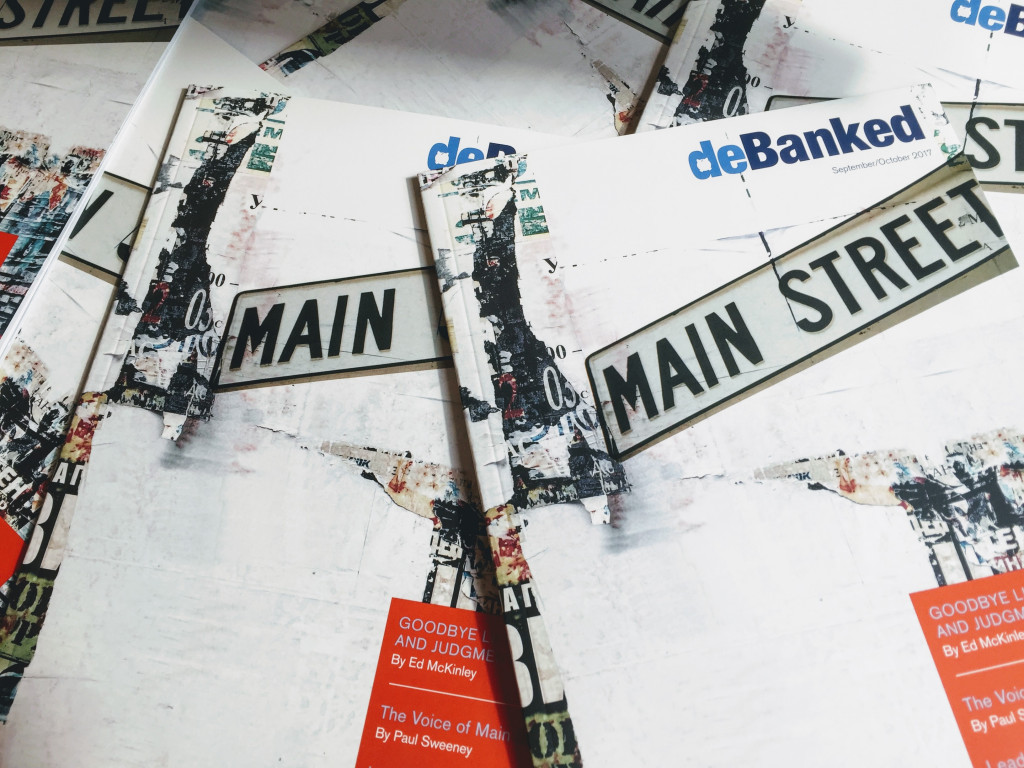
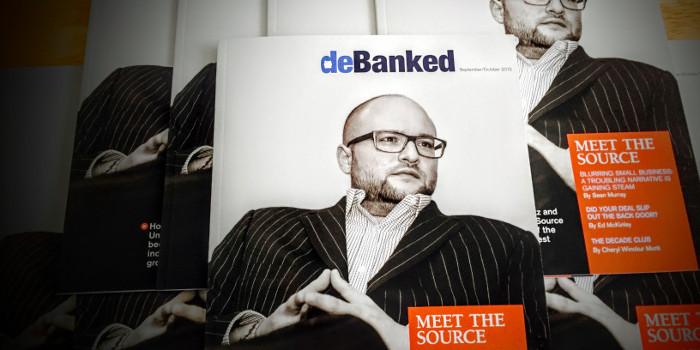
The Sept/Oct 2017 Issue of deBanked Magazine Has Shipped
October 12, 2017The latest issue of deBanked Magazine has shipped. In this issue we explore a new rule implemented by credit bureaus surrounding the reporting of liens and judgments, the shifting landscape for lead generators, and once again, what merchants themselves are saying about their experiences with online loans and merchant cash advances. There’s a lot more of course!!!
If you’re already subscribed, you should receive a copy soon. If you haven’t subscribed, you can make sure to get all future issues FREE by SIGNING UP HERE
Bizfi Alum Jared Weitz Reflects on Demise of Former Employer and Rise of UCS
October 9, 2017 Jared Weitz has come a long way since his earlier days as one of the original Bizfi employees. Today he’s at the helm of online funding marketplace United Capital Source (UCS), which has been on a tear since deBanked last spoke with Weitz a couple of years ago. The UCS founder and chief executive took some time to revisit with us about having to painfully watch the demise of his former employer, which is where he cut his teeth in this business, and the rise of his own company UCS as a funding marketplace.
In some ways, the more things change the more they stay the same. Since the last time Weitz spoke with us, the company’s location remains in the heart of Times Square in New York, and UCS has grown its staff by only four people including two sales reps. What has changed, however, is the amount of funding that the company has done and the size of the average transaction, all of which have blossomed.
“When we first spoke a few years ago we were doing $8 million to $10 million a month in funding volume. Now we are doing between $14 million and $16 million per month,” said Weitz.
He added that where the company differentiates itself is that while a few years ago the products they were selling were predominately in the sub-prime space now they sell other products, which allows merchants to “swim upstream” when they qualify for that.
The result has been bolstered partnerships and product offerings and an average loan size that has jumped from $30,000 to $40,000 per deal to a range of $500,000 to $2 million.
“We opened up the funnel to the kind of relationships we’re able to broker and the kinds of financings we’re able to offer. We’re playing in the field of SBAs, account receivables financing, lines of credit and asset backed loans. By offering these products our volume has jumped significantly and allowed us to talk to different referral partners.”
UCS does all of its own marketing and generates leads for their in-house sales reps. Those sales reps take a file from open to close and they analyze the small business owner’s needs on a consultative call.
“We understand their business and their pain points. The first question we ask isn’t how much do you need but what’s paining you in your business today that we can help you with?”
One such business owner recounted his experience with UCS to deBanked, saying that traditional banks were “an absolute pain” to secure funding. He spoke of the “very stressful” and time-consuming process of applying for a loan, saying he doesn’t have time to “jump through a million hoops to get a loan.”
“When I was initially looking to curb my temporary cash flow problem, I searched online for the best alternatives to traditional bank loans. I read all the reviews on companies and decided to call UCS,” the business owner told deBanked, adding that he’s been a UCS repeat customer for a number of years and is especially fond of the ease at which the process is completed.
“I could literally call Jared today and have six figures in my account tomorrow. The best part is the pay back process. They only take funds when I run credit card transactions. So, in my slow months, I don’t have to stress and worry about repaying the loan. UCS is a perfect fit for me,” the business owner said.
Eye Opener
As the seventh or eighth employee of Bizfi, Weitz really has been part of the evolution of online funding. He says the rise and fall of Bizfi has been an “eye opener” for him.
“It caused a bunch of funding companies to be a little gun shy when it comes to funding. I told my guys this too shall pass. People are shaken and wondering if it’s a larger global issue. Thankfully it’s not a global issue. There are plenty of funding companies that are well backed that are still funding. My group is well able to pick it back up. We have signed up with more funding companies to increase our offerings and make sure we have no concentration issues,” said Weitz.
And although he left the company to eventually launch UCS, which has proven to be a prudent move, he has nothing but respect for his former employer.
“My history there is very deep and I’ve got a genuine love for the founders of the company. It’s where I cut my teeth. I was really sad the day I heard they’re not funding anymore.”
In fact, Bizfi was one of the funders that UCS counted among its partners.
“We had a good book there. We started to see problems and began to shift where our new business was going. Thankfully it didn’t affect me. But it showed me that you should sign up with more funding companies. If you think the mix should be X go 50% more and be super cautious. This approach has worked out for us,” he said.
Weitz has advice for other funders that might be looking to grow at lightning speed.
“Someone that’s growing so fast while they’re also innovating and looking to close larger transactions that bring them to a bigger place – that’s hard to do all at once. Driving at 200 MPH either works out well and takes you to the finish line or it doesn’t work out really well. It’s really unfortunate that it didn’t work out for them.”
 Deal Competition
For its part, UCS competes with the likes of LendingTree and other online marketplaces, but that seems only to add an ounce of perspective to Weitz and the UCS team, driving them to adjust and remain nimble so that they can get the next deal.
“Healthy competition is good for us. We welcome anything like that. Some of my best learning experiences have been when we were beat out on a deal. I call the merchant personally and say hey, who gave you the deal? Honestly, I want to sign up with them and offer those rates to my clients. We form a friendship with both the funder and the small businesses,” he said.
UCS also counts some high-profile funders among its partners.
“We’ve worked with some funders forever and it’s been great. But we really had to also find folks that offer certain products but at a cheaper rate,” said Weitz, pointing to the scenario of a merchant having a few of those loans under their belt and improved credit as a result. “They are being solicited by depository banks and can qualify for that rate. We don’t want to lose the relationship. My thought process is sign up with similar folks with that product and when the time comes we can swim the merchant upstream.”
For instance, not all funders offer SBA loans but UCS has been doing so for the past two years. “It’s really kind of taken off for us over the last year. The same thing with accounts receivable and future order financing.”
UCS acts as both a broker and investor in their own deals, so they have a vested interest in the underwriting standards. “Investing with some of our funding partners on the syndication side allows us to have buying power and to take an actual interest in the merchant we’re dealing with,” said Weitz, adding that UCS takes a hybrid approach offering both a fully automated underwriting process for those merchants who want it but also having the capability to talk to the business owners, which is what the large majority of business owners prefer.