
Business Lending
Fundation’s $100 Million Credit Facility From Goldman Sachs Is A Return To Banking
August 23, 2016 The online lending party isn’t over yet. And neither is bank lending…
Fundation, which company CEO Sam Graziano described to the WSJ as a credit solutions provider rather than a lender, has secured a $100 million credit facility from Goldman Sachs. But they are a lender, a direct small business lender in fact, that uses their own balance sheet to make loans.
Fundation is different in that they bolt their platform on top of the traditional banking system. Their partnership with Regions Bank for example, allows Regions Bank customers to apply for a Fundation loan right through the Regions.com website.
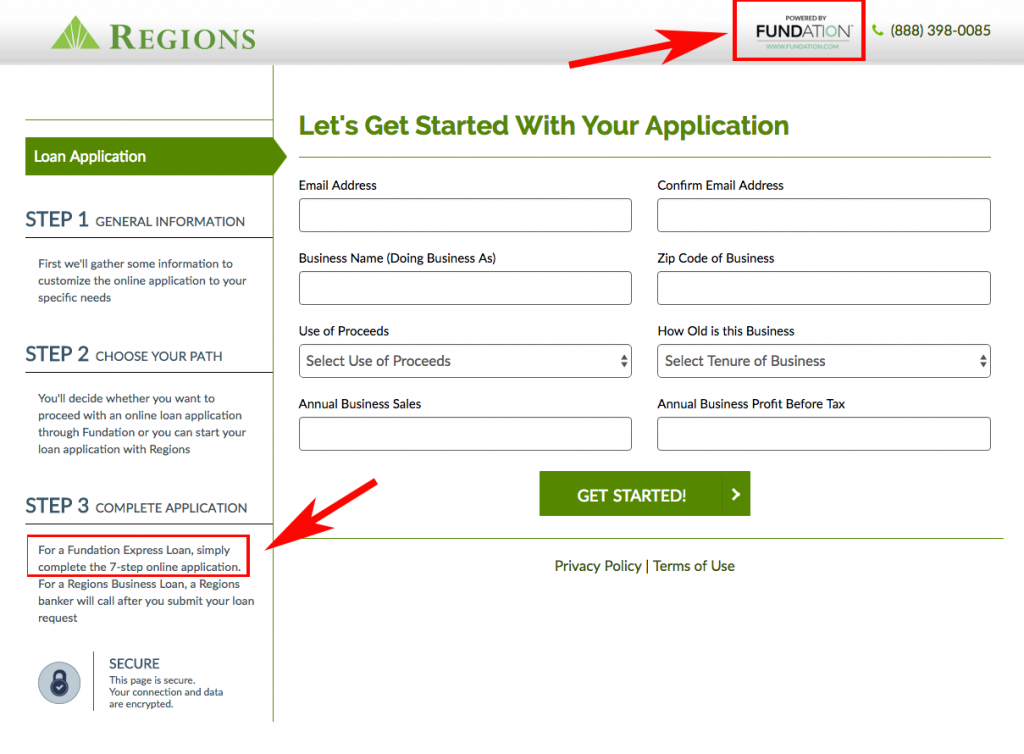
The sizable credit facility, the system it will help foster, and the name behind it further demonstrates the demise of peer-to-peer lending. “We decided to be an integrated partner of the banking system,” said Fundation’s Graziano to the WSJ in regards to the saturated environment of lending platforms.
The WSJ also reported that the firm will use the funds to make more loans to Regions bank customers as well as other community banks that they have partnered up with.
Bizfi Originates $144 Million in Q2; CAN Capital, Entrepreneur Media Launch Funding Center
August 16, 2016 Online small business loan marketplace, Bizfi said that it originated over $144 million in Q2 this year, a 25 percent increase compared to $116 million in Q2 last year. The New York-based company has facilitated financing for more than 3,580 small businesses through its platform.
The company forged many partnerships to expand its customer base and access to small businesses. In March of this year, Bizfi announced a partnership with Western Independent Bankers (WIB), a trade association with community and regional banks across the Western United States and in July, it joined hands with the National Directory of Registered Tax Return Preparers & Professionals (PTIN).
Bizfi also secured a $20 million investment from New York-based investment manager Metropolitan Equity Partners in June this year, supplementing the $65 million infusion in December last year to expand and optimize its funding programs and develop an effective marketing campaign to advertise those better.
In other news, small business lender CAN Capital and Entrepreneur Media launched the funding center offering funding products that include term loans — available from $2,500 up to $150,000 for a single location with range of terms from 3 to 36 months. Trak loans which are working capital loans available from $2,500 up to $150,000 and installment Loans provide funding from $50,000 to $100,000 with 2, 3, and 4 year terms and have fixed monthly payments.
Square Capital Outgrows Square
August 11, 2016 You don’t need to process payments through Square anymore to get a loan from Square Capital. Restaurants that use Upserve, a restaurant payments and data analytics system, are now eligible as well.
Formerly known as Swipely, Upserve is still relatively small, with only 7,000 restaurants as customers. But it’s a milestone for Square nonetheless, whose loan program within their own ecosystem has become so successful, that they feel comfortable venturing outside of it.
“We are proud to partner with Upserve and offer loans through Square Capital to even more small businesses who traditionally face barriers when seeking access to funds,” said Jacqueline Reses, Head of Square Capital.
The move puts them on a path to truly competing with other alternative lenders such as OnDeck and CAN Capital. Loans are repaid just like they are through Square, through a percentage of each day’s card sales with the option to repay early at no additional fee.
Calling Timeout On Financial Regulations, A Pump For Trump?
August 10, 2016
Only 24% of small business owners say that Hillary Clinton is the presidential candidate that has their best interest at heart, according to a survey conducted by Capify, a business financing company based in New York. 53% selected Donald Trump.
And whatever your opinions about Trump, his proposed moratorium on new financial regulations could entice both small businesses and alternative financial companies to consider a Trump presidency.
“Under my plan, no American company will pay more than 15% of their business income in taxes,” Trump said in Detroit on August 8th.
A report published by the National Federation of Independent Business (NFIB) last month found that 20% of business owners ranked taxes as the single most important problem facing their business. Only 2% reported that financing was their top business problem.
Message received? It appears not
In states like Illinois, some legislators are focusing their efforts on finding ways to make it harder for small businesses to obtain financing, convinced that questionable lending practices are the source of their problems, not taxes. But in a call with Bryan Schneider, secretary of the Illinois Department of Financial and Professional Regulation, he told deBanked that no one has complained of any small-business lending problems in Illinois to state regulators.
Regulators should not indulge in creating solutions in search of problems, Sec. Schneider cautioned. “When you’re a hammer, the world looks like a nail,” he said, suggesting that regulators sometimes base their actions on anecdotal isolated incidents instead of reserving action to correct widespread problems.
And that’s why a moratorium on financial regulations (albeit on the federal level) might also resonate with small businesses. Lawmakers don’t appear to be addressing their grievances and ironically, passing new laws that make it harder to obtain financing could potentially even exacerbate the problems they’re already vocalizing.
Small businesses seemed to have become aware of the government-as-obstructionist role however since 22% of them surveyed in the NFIB study, said that government requirements and red tape were the single most important problem they faced, more than anything else.
The Finance Side
A timeout is not a sure-fire way to woo Wall Street however, since a moratorium on federal regulations could actually serve as a hindrance for some financial companies hoping to reach some legal framework consensus down the road. Last year, Bizfi founder Stephen Sheinbaum, said that a 50-state patchwork of laws would make operating companies like his more challenging. “Personally, I’d be glad to see it on the federal level, we won’t have to deal with 50 individual states, which is more unruly,” Sheinbaum said in regards to potential regulation.
But a timeout on making any moves might indeed be in order anyway, given the questions that are being asked by some federal legislators. Last month during a hearing, Rep. David Scott asked what made business loans different from consumer loans. Parris Sanz, the Chief Legal Officer of CAN Capital, who was there testifying on behalf of the Electronic Transactions Association (ETA), gave his answer.
But there is a fear, just by those questions, that some legislators are still having trouble understanding the fundamentals. And that may be why a dozen trade associations and lobbying groups have formed in the last year to provide educational resources about alternative financing.
In states like Illinois, Scott Talbott, SVP of government affairs for the ETA, said they are encouraging legislators to adopt a “go-slow approach” that affords enough time to understand how the industry operates and what proposed laws or regulations would do to change that.
Keep it Simple?
With Trump, despite all his quirks, it’s possible that his ideas about a moratorium, could be a deciding factor in how small business owners and those employed by alternative financial companies vote. Lower taxes, timeout on regulations, has the potential to resonate far and wide.
60% of small business owners think that the outcome of the presidential election will have a severe impact on small businesses, according to the Capify survey. 29% said it possibly will have a severe impact. With taxes and government red tape at the top of their list of grievances, there might just be a pump for trump on both sides of the alternative finance aisle.
OnDeck is NOT a Marketplace Lender
August 9, 2016
It’s finally time to stop calling OnDeck a marketplace lender.
The company only sold 15.6% of its originated loans through the OnDeck Marketplace, according to their Q2 earnings report. That’s down from 26% in the prior quarter. It’s not hard to see why that might be as the Gain on Sale Rate was only 3.5% in Q2, a significant drop from the 5.7% in Q1 and 7.8% at this time last year.
On the earnings call, OnDeck’s chief officers argued that demand for their loans remained very high but that investors are requiring more return for the same risk. With the profit incentive to sell loans severely diminished, the company plans to continue selling only 15% – 25% of their loans going forward on the basis of keeping institutional relationships and diversification.
But if not a marketplace? Then?
OnDeck is a non-bank commercial balance sheet lender. And as a result, the company’s cash dropped from $160 million on December 31, 2015 to only $78 million at the end of Q2. OnDeck CFO Howard Katzenberg said that this wasn’t a burn, but rather cash being invested into their loans, all part of their plan of moving away from the marketplace. The company still has $300 million in GAAP equity, $100 million available to it from its warehouse lenders, and other debt facilities that it plans to increase for more leverage.
OnDeck funded a whopping $590 million in loans in Q2 but posted a net loss of $17.9 million. Origination figures include the full loan principal amount on renewals even though part of the principal may be used to pay off an existing loan.
Marketing costs remained relatively stable as did loan performance. Little was said about their relationship with JPMorgan Chase other than the fact that it’s still “early days at this point.”
Have You “deBanked” Yet?
August 5, 2016If you’re not already subscribed, you can make sure that you receive the July/August 2016 edition in print by subscribing here.
Among the featured stories and content are:
- The role of MCA/business-loan brokers around the world contrasted with the U.S.
- The continued growth of alternative commercial finance
- How to grow an MCA or business loan brokerage
- Uber’s new finance program
- And much more!
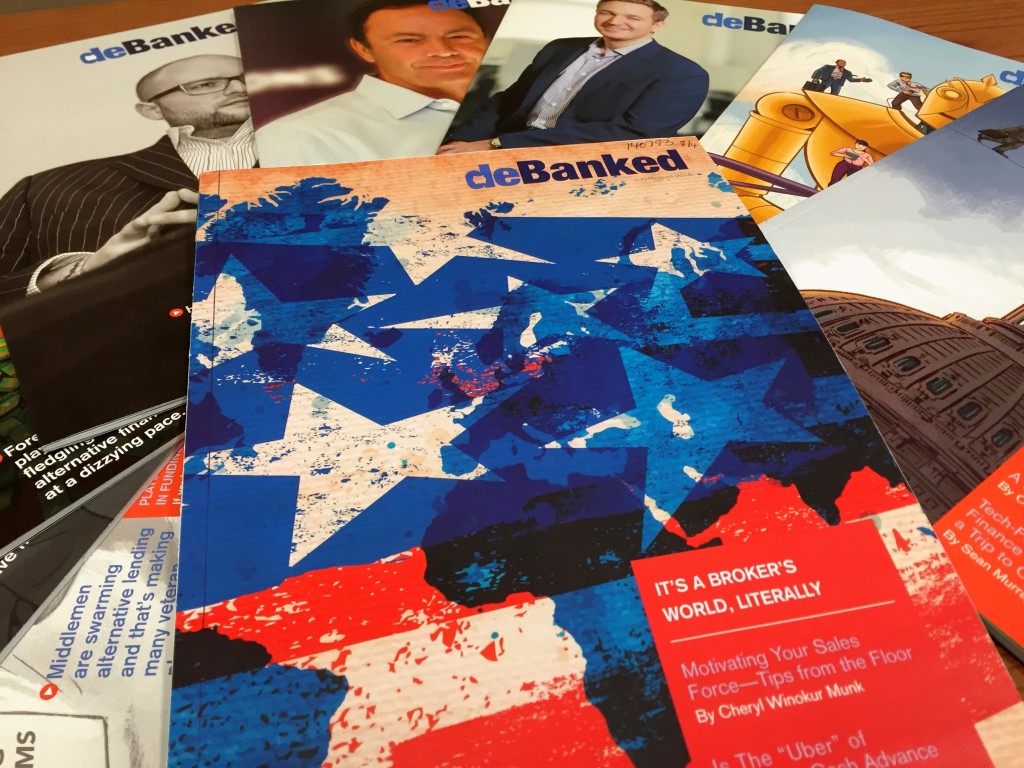
Are you involved in funding businesses outside the bank? It sounds like you’ve de-banked! We hope you enjoy this issue. The digital version will be online later this month.
Square Capital Revs Up, Funds $189M to Small Biz in Q2
August 4, 2016
Square is proving that the business loan sector is still hot, especially since their payment processing ecosystem requires nearly no marketing budget to advertise Square Capital. With $189 million funded in Q2, a growth of 123% year-over-year, their shift from merchant cash advances to loans seems to have had the desired effect since they have attracted even more investors willing to buy them.
“We sell a majority of our loans to third-party investors for an upfront fee and a small ongoing servicing fee. In addition, we continue to have a strong continued pipeline of interested investors,” the company said in its earnings report.
The average loan size remains small, only $6,000, but ranges from $1,000 to $100,000. Square CFO Sarah Friar, said during the earnings call that their data shows an overall increase in the gross payment volume of merchants who use their loans, which indicates that borrowers are indeed using the funds to grow their businesses.
A typical Square Capital loan is close to 10% of a seller’s annual processing sales and the average repayment term is 9 months. Loss rates remained steady at 4%.
Friar also said that PayPal Working Capital and American Express Working Capital were not really competition since they are working directly with their own existing user base.
The company made about 34,000 loans in Q2.
California Finance Lenders Law Licensing Compliance for Merchant Cash Advance Financiers
August 2, 2016 Since the Richard B. Clark v. AdvanceMe Inc. class action case settlement was brought to the awareness of the Merchant Cash Advance (“MCA”) industry, many MCAs applied and obtained a California Finance Lenders Law License from the Department of Business Oversight. (“DBO”)
After your company obtains a California Finance Lenders Law license, it will then need to comply with the California Finance Lenders Law. (“CFLL”)
CFLL does not contain specific financial code sections and regulations to regulate MCAs. However, CFLL regulates consumer and commercial loans. So, MCAs licensed under the CFLL will need to comply with the code sections and regulations that apply to commercial loans, assuming that MCAs provide advances that are each “bona fide” $5,000 or more in principal amount and for commercial purposes.
The MCA contract you use when making advances in other states is likely not in compliance with CFLL. CFLL regulation includes without limitation, (either directly or by incorporation of other California and federal laws) the rates and charges, marketing and advertising, disclosures, contractual provisions, electronic transactions, collections, credit applications, default and repossession, brokers and finders, and general operations of main and branch offices.
The CFLL license application requires the MCA company’s principal (corporate officer or LLC manager) to acknowledge on behalf of the MCA company, that it read the contents of and is familiar with the CFLL, and that it agrees to comply with the CFLL.
Lack of compliance can be brought to the attention of DBO’s enforcement officials as a result of either, a customer or competitor complaint, a DBO audit, through the Annual Report that must be filed by CFLL licensees by March 15 of each year, or by other means.
It is important to not only obtain the CFLL license, but to also comply with the CFLL to keep the license. DBO publishes online enforcement actions, such as Desist and Refrain Orders and Accusations. A CFLL licensee has a right to request an administrative hearing to defend itself and present its case. Unfortunately, although the legality of this practice by DBO is questionable, DBO publishes online none-final (and also final) administrative enforcement actions such as Desist and Refrain Orders (“D&Rs”) and Accusations. (publishing of final administrative orders is specifically authorized by the Financial Code but not none-final orders) Potential customers and competitors who review none-final D&Rs, are under the mistaken belief that the D&R is a final order, and may therefore refuse to conduct business with the licensee.
MCAs who are either CFLL licensees or potential licensees should familiarize themselves with CFLL law to avoid administrative enforcement actions, court actions, loss of business, and other adverse repercussions.