
Archive for 2018
Alternative Lending Set to Boost Small Business Strength in 2018
January 16, 2018 Small business lending saw a 2017 surge, according to the U.S. Small Business Credit Monthly Report from PayNet, with 11 of 18 sectors experiencing a lending increase over the past 12 months.
Experts believe 2018 will continue to foster a friendly environment for smaller enterprises.
“A combination of small business optimism and favorable tax changes will likely spur increased demand for small business loans in 2018,” Gerri Detweiler, education director at Nav, tells deBanked. “This, combined with personal credit scores and business credit scores at all-time highs, means 2018 should be another record year for small business lending.”
Detweiler added that big banks have begun to fine tune their incorporation of alternative data sources into underwriting decisions. She believes that those who continue to do this well are on track for a “very good year” in 2018.
Head of marketing at Fundbox, Greg Powell, also believes in the strength of alternative data as a catalyst for small business growth due to more flexible vetting processes.
“Over 60% of small businesses are looking to make a capital investment in the year 2018,” he said. “On the supply side, you have a growing wealth of options that small businesses can choose from. That for me would be a cause for a lot of optimism of starting out a new business in the year 2018.”
“What we’re seeing is a fundamental shift in the way that businesses can be underwritten,” Powell continued,” adding that Fundbox and others like it are able to reach small businesses that no one else can.
Fundbox bypasses the need for a small business owner’s personal credit score or personal guarantee by putting more focus on factors such as the value of the borrower’s previous three months worth of transaction value and a flexible benchmark of $50K or more in annual revenues.
Lending standards such as this have led to a loan application climate that is “a lot more fluid than in the past,” according to Powell.
Defendants in Forged COJ Case Failed to Respond to The Complaint
January 16, 2018The lawsuit brought by FundKite against defendants alleged to have forged a Confession of Judgment (COJ) is not going so well for the defendants. Last week, FundKite filed a proposed order for a default judgment since none of the defendants ever appeared to defend themselves.
 Meanwhile, circumstances surrounding the suspicious notary stamp on the COJ in the case have become a lot more clear. Originally, the merchant asked how a New York notary stamp ended up on the documents he claims are forged when the merchant himself resides in Florida.
According to an affidavit by Jennifer Gately, the notary, she was asked by someone employed by the ISO to sign off on a document for a merchant without the merchant present. She refused. Soon after, her notary stamp was stolen. She not only reported this theft to the National Notary Association, but she also filed a police report.
The relationship between the person working for the ISO and her, is that they both lived at the same address, explaining how the theft would’ve been relatively easy to carry out.
“I have never worked with any of the listed defendants on any matters, including concerning financial transactions,” she declared.
The case is filed under Index Number: 656692/2017 in the New York Supreme Court. You can download the original complaint here.
Stacking Lawsuit Trial Date Set
January 16, 2018The lawsuit between RapidAdvance and Pearl Capital has a trial date, June 25, 2018. RapidAdvance, who filed the complaint in 2015 in the Circuit Court for Montgomery County in Maryland, has sought to recover damages for tortious interference.
Considering that RapidAdvance’s loan to the merchant at hand was only for $31,000, this litigation, which is now more than 2 years-old and scheduled for trial, is likely more about the parties attempting to set a precedent.
The case is Small Business Financial Solutions, LLC v. Pearl Beta Funding, LLC Case No. 411478-V.
New Mexico Bill Would Allow State Employees to Repay Loans Via Paychecks
January 15, 2018 Proposed legislation would enable New Mexico to offer small loans to state employees that are paid back via deductions from their paychecks.
Put forth by Democratic state Senator Bill Tallman, the bill would put a 30 percent ceiling on interest rates for loans obtained via the program and limit repayment to 12 percent of gross salary or wages.
According to the Associated Press, Tallman says the bill is aimed at lowering debt burdens on state workers.
Should it pass, Tallman’s initiative would serve as another step for the state in its current battle against predatory lending tactics. As of this month, small lenders in New Mexico are held to a maximum of 175 percent interest on all loans finalized from January 1, onward.
Doug Farry, executive vice president of Employee Loan Solutions Inc., which deploys the employee lending service, True Connect, believes such a strategy can prove successful at the state level.
“It’s a benefit program,” said Farry while discussing the bill. “There’s no reason why it can’t work for a state government as well as a county or city.”
Aimed at empowering workers that face obstacles when applying for credit via traditional avenues, True Connect mainly serves private employers but has seen increased interest in the public sector. This includes government organizations such as Santa Fe Public Schools and others within the state of New Mexico.
At no cost to their participating employer and without submitting a credit score, workers can sign up for small loans via the company’s website.
Typically the funds are deposited with in one business day, and the loan is repaid over the course of 26 paychecks at a flat rate of 24.9% interest.
New Mexico’s decision regarding the practice is yet to be determined, but should the bill pass, the state may soon have followers.
Farry says that True Connect is currently in talks with multiple state governments about including a similar system in their benefits package.
Payday Loan Convict Scott Tucker to be Featured in Netflix Docuseries
January 14, 2018Payday loan mastermind Scott Tucker, who was recently sentenced to 16 years in prison, will be featured in Dirty Money, a Netflix docuseries focused on tales of greed.
 Tucker was among the most prolific payday lenders in the United States, using Native American tribes to shield himself from state laws while generating billions of dollars in revenue. Prior to his conviction on charges of participating in a racketeering enterprise through the collection of unlawful debt, wire fraud, money laundering, and violations of the Truth In Lending Act, he garnered the largest FTC judgment in history, a staggering $1.3 billion.
Tucker’s penchant for racing fancy cars that includes a professional career with some notable victories likely secured his place in the annals of financial villains.
The docuseries begins on January 26th.
Jersey City is Quietly Becoming a Fintech Hub
January 11, 2018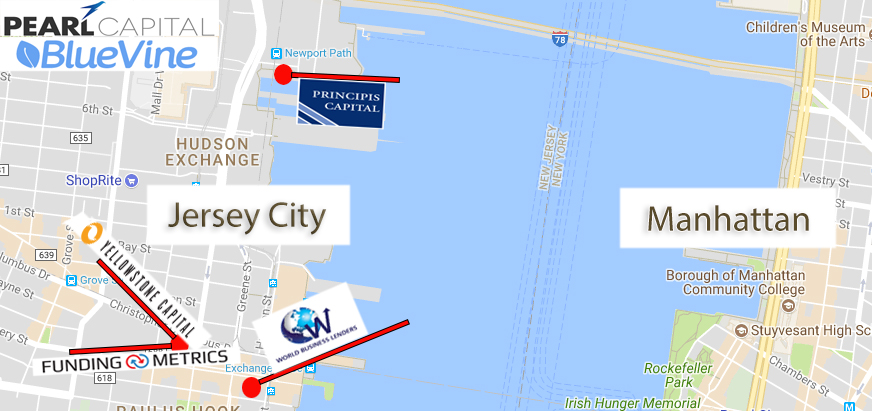 Jersey City is luring yet another innovative small business finance company to their community. This time it’s NYC-based Pearl Capital. According to NJ state records, Pearl was approved on January 9th for a total of $5.6 million over 10 years to relocate under the Grow NJ tax program to boost jobs in the area.
Other finance companies that have relocated to Jersey City, thanks to Grow NJ, are Yellowstone Capital, World Business Lenders, and Principis Capital. But that’s not all, companies like BlueVine and Funding Metrics have also set up operational centers there.
We do not yet know what address Pearl intends to move to.
What’s Lending Got to do With Cryptocurrency?
January 10, 2018 Facebook and Snapchat might be the last things that employees are being distracted by these days. Instead it’s Coinbase and Blockfolio, two cryptocurrency apps, that are quickly stealing the attention of young finance professionals. And the interest in Bitcoin, Ethereum and alt coins is causing some in the industry to wonder if the phenomenon can somehow be connected to online lending and merchant cash advance.
A meetup hosted by partners of Central Diligence Group (CDG) on Tuesday night in NYC, for example, was geared towards cryptocurrency enthusiasts. CDG is a merchant cash advance and business lending consulting firm. Those that attended, talked candidly about Ripple, Bitcoin, Ethereum, and the hot topic of Initial Coin Offerings (ICOs). And it did seem all connected. Companies successfully raised more than $3 billion through ICOs in 2017, for example, some of them online lending companies.
 ETHLend and SALT, blockchain-based p2p lenders, each raised $16.2 million and $48.5 million respectively through ICOs. What’s more, their crypto market caps currently stand at $325 million and $754 million respectively. The latter is nearly twice as valuable as online lender OnDeck. The founder of Ripple, meanwhile, briefly became one of the richest men in the entire world.
Whether these valuations are overdone is besides the point. A smart phone is all that’s required to get in on the action and trade thousands of cryptocurrencies online, many of which move up and down by astronomical percentages over the course of a day. Becoming a millionaire overnight by hitting on the right one is a dream sought after by many. And young people, especially millennials, are become unconsciously comfortable transacting in non-government-backed currencies through technology that completely shuts out banks.
And that may be the shift in all of this to pay attention to. It isn’t that a local restaurant is going to collateralize their Bitcoin to get a loan and outcompete an MCA company, but that a portion of the monetary system eventually starts to sidestep banks.
Trying to collect on that judgment? Good luck tracing the money in cryptos.
Need to freeze funds? You can’t freeze someone’s Bitcoins if they’ve got them stored on their own hardware.
Evaluating a business’s bank statements? The transactions can only be verified on a blockchain.
You might not believe me, but it’s incredibly likely that you’ve encountered a client that has defaulted on an MCA or loan whose stash of money has been obscured in cryptos all the while their bank statements appear to show insolvency.
It’s also likely that you’ve encountered a client that has used the proceeds of their MCA or loan to buy a crypto. Maybe not the whole amount, but with some of it. One study, for example, revealed that 18% of people have purchased Bitcoin using credit. Bloomberg reported that the phrase “buy bitcoin with credit card,” just recently spiked to an all-time high.
People are even taking out mortgages to buy Bitcoin, according to CNBC.
If you think cryptocurrency is an industry completely independent of your business, consider that the market cap of cryptocurrencies is currently valued at more than $700 billion. That’s nearly twice the market cap of Goldman Sachs and JPMorgan, COMBINED. The #3 cryptocurrency by market cap, Ripple, is being pitched almost entirely to traditional financial institutions.
Bet all you want on the prediction that this bubble will burst. Maybe it will. But the underlying technology, transacting without banks in non-government backed currencies that may be difficult to trace and recover, is a genie that’s not returning to its bottle anytime soon.
In the meantime, now might be a good time to poll your employees or colleagues about their knowledge or use of cryptocurrency. You may be surprised by what you find, especially among the younger crowd.
——–
Disclaimer: I currently hold a material amount of Ether, the currency of the Ethereum blockchain.
Trial in Murder of Universal Merchant Funding Execs to Begin Feb 5th
January 7, 2018Nearly one year ago, Michael Genovese, the owner of Universal Merchant Funding, and Carl Clark, an employee, were found dead inside the businesses’s office in Staten Island. Former employee Ricky Dennis was arrested soon after for the double-murder. His trial is slated to begin on February 5th, according to SI Live.
Dennis had previously served time in prison for using a gun during a violent crime.
Genovese was a known operator in the small business finance community. Clark was a regular on the Daily Funder forum, and for a time was one of its most active users.