Regulation

SEC Finding Said that Prosper Misled Investors

April 22, 2019
Article by:

Prosper MarketplaceFrom approximately July 2015 until May 2017, Prosper excluded certain non-performing loans from its calculation of annualized net returns that it reported to its investors, according to an SEC order released last Friday. The order found that Prosper reported overstated annualized net returns to more than 30,000 investors on individual account pages on Prosper’s website and in emails soliciting additional investments from investors.

As a result of the inflated numbered, which the SEC order says Prosper management was aware of, many investors decided to make additional investments based on the overstated annualized net returns. The SEC order said that Prosper failed to identify and correct the error that overstated its annualized net returns “despite Prosper’s knowledge that it no longer understood how annualized net returns were calculated and despite investor complaints about the calculation.”

“For almost two years, Prosper told tens of thousands of investors that their returns were higher than they actually were despite warning signs that should have alerted Prosper that it was miscalculating those returns,” said Daniel Michael, Chief of the SEC Enforcement Division’s Complex Financial Instruments Unit.

Prosper neither admitted nor denied the findings. The company did not refute the SEC order’s findings, including that it violated the antifraud provision contained in Section 17(a)(2) of the Securities Act of 1933. Prosper will pay a $3 million penalty for miscalculating and overstating annualized net returns to retail and other investors.

According to a 2017 Financial Times story, one Prosper investor wrote on the Lend Academy forum in 2017 that their returns were restated from about 14 percent to 7 percent.

“Shame on me for just assuming that I was getting a higher rate,” the investor wrote, “but shame on Prosper x 1000 for misleading investors.”   

In a written statement to deBanked today, a Prosper representative characterized the miscalculation as an error only, not a scheme. She conveyed that when Prosper discovered the error in 2017, they notified investors who were impacted and changed the numbers so that they accurately reflected the investors’ returns.

“We’re pleased to have the SEC inquiry resolved and appreciate the SEC’s recognition of our cooperation as the agency looked into this matter,” read a statement provided by Prosper. “Since discovering and fixing this issue two years ago, we have put additional controls in place designed to detect and prevent similar errors in the future, and we are committed to providing transparent information on returns to our retail investors.”

Prosper’s CEO, David Kimball, was awarded “Executive of the Year” at this year’s LendIt Fintech conference earlier this month.

In 2018, the company originated $2.8 billion in loans, remaining flat compared to 2017. Prosper’s net revenue last year was $104 million, a decrease compared to $116 million in 2017. Founded in 2005 and headquartered in San Francisco, Prosper provides personal loans up to $40,000 and was one of the first peer to peer lenders.

Lots of Tech Buzzwords, Scary Problems

April 16, 2019
Article by:

advanced machine-learning, algorithms, big data, streamlined, technology, consumer-friendly

End of the word fintech?A federal regulator cut through the shield of fintech buzzwords on Monday when it announced that a darling of online lending valued at $2 billion, failed to properly handle rudimentary loan practices. The lender is Chicago-based Avant, who reportedly settled with the FTC for $3.85 million.

According to the FTC, Avant struggled to accurately determine borrower loan balances and repeatedly mismanaged payments. FTC Bureau of Consumer Protection Director Andrew Smith said that Avant’s issues were systemic. “Online lenders need to understand that loan servicing is just as important to consumers as loan marketing and origination, and we will not hesitate to hold lenders liable for unfair or deceptive servicing practices,” he said in a press release.

The FTC alleged:
“When consumers got an email or verbal confirmation from Avant that their loan was paid off, the company came back for more – sometimes months later – claiming the payoff quote was erroneous. The FTC says Avant dinged consumers for extra fees and interest and even reported to credit bureaus that loans were delinquent after consumers paid the quoted payoff amount.”

The FTC further stated:
“The lawsuit also alleges that Avant charged consumers’ credit cards or took payments from their bank accounts without permission or in amounts larger than authorized. Sometimes Avant charged duplicate payments. One unfortunate consumer’s monthly payment was debited from his account eleven times in a single day. Another person called Avant’s customer service number trying to reduce his monthly payment only to be charged his entire balance. In other instances, Avant took consumers’ payoff balance twice. One consumer was stuck with overdraft fees and angry creditors when Avant withdrew his monthly payment three times in one day.”

In a subtle dig, the FTC said that online lending could be beneficial “if 21st century financial platforms abandon misleading 20th century practices.”

Under the settlement order, Avant, LLC will be prohibited from taking unauthorized payments and from collecting payment by means of remotely created check (RCC). The company also is prohibited from misrepresenting: the methods of payment accepted for monthly payments, partial payments, payoffs, or any other purpose; the amount of payment that will be sufficient to pay off in its entirety the balance of an account; when payments will be applied or credited; or any material fact regarding payments, fees, or charges.

New Jersey Bill Seeks to Eliminate Quick Easy Access to Small Business Loans

March 21, 2019
Article by:

New Jersey Capitol Building in TrentonThe speed at which a small business owner can access capital to grow and create jobs in New Jersey is too dangerous and must be stopped. This is the takeaway from a bill (S3617) proposed by New Jersey State Senator Nellie Pou that calls for a minimum 3-day waiting period between when contract terms are disclosed to an applicant and when they can actually go through with getting a business loan or merchant cash advance. If the transaction does not fund within 10 days of the terms being disclosed, it implies that the waiting process must start over if the applicant wishes to still go forward.

The motivation behind the bill is to presumably force small business owners to think about the terms for awhile. It would apply where the payment frequency is greater than bi-weekly or the maturity is less than two years. There’s other little caveats too. If it passed, funding small businesses same-day or next-day would effectively become illegal.

In addition, the bill calls for detailed contract disclosures, proof that the funds will be used to economically benefit the small business applicant, lenders to set up their own complaint departments, licensing, bonding requirements for brokers & lenders, a minimum net worth for a broker of $100,000, background checks, written examinations, and ethics classes as part of continuing required education.

Pou’s bill, which at this point has not had the opportunity to get traction yet, is separate from another bill, S2262, which in addition to disclosures, calls for merchant cash advances to be defined as loans in the state. S2262 passed the Senate in February and is now under consideration in the Assembly.

New York Legislators Introduce Small Business Usury Bill

February 20, 2019
Article by:

Two members of the New York State legislature have introduced a bill to apply consumer usury protections to small businesses. Bill A03638, introduced by New York Assemblymembers Yuh-Line Niou and Crystal Peoples-Stokes define a small business as “one which is resident in this state, independently owned and operated, not dominant in its field and employs one hundred or less persons.”

The bill is separate from the one introduced to outlaw Confessions of Judgment in financial contracts.

You can read the full text of the bill here.

New Jersey MCA & Business Loan Disclosure Bill Update (S2262)

February 6, 2019
Article by:

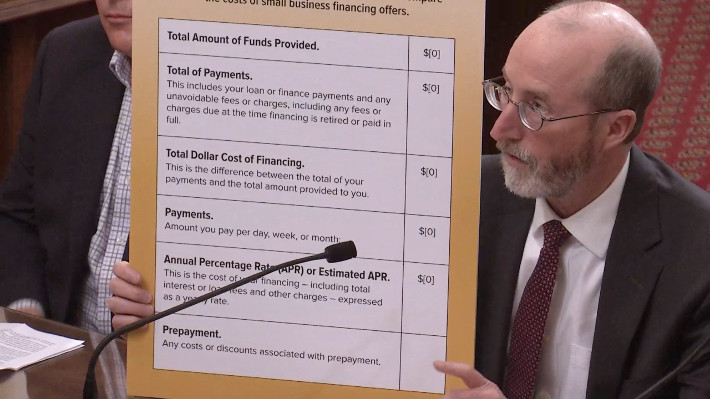
new jerseyBill S2262 in the New Jersey State Senate mandating disclosures on MCA and business loan contracts, was amended last week. In its current form, the bill, if it became law, would require MCA providers to disclose:

  • the total dollar costs to be charged to a small business concern, assuming the small business concern delivers all purchased receivables to providers at the time they are generated or at a mutually agreed upon time, and all required fees and charges that are paid by the small business concern and that cannot be avoided by the small business concern;
  • the amount financed, which shall mean the advance amount less any prepaid finance charges; and
  • for a cash advance that calculates repayment costs dependent on the small business concern’s future receivables, the estimated annual percentage rate, provided as a range, with at least three different repayment times provided and a narrative explanation of how each rate was derived. Any estimated annual percentage rate is to be calculated using a projected sales volume that is based on the small business concern’s average historical sales or the sales projections relied on by the provider in underwriting the cash advance; or
  • for a cash advance that calculates repayment costs as a fixed payment, the annual percentage rate, expressed as a nominal yearly rate, inclusive of any fees and finance charges.

Brokers would also be required to provide uniform fee disclosures to both the small business owner and lender or MCA funding provider in a document separate from the funding contract before a small business consummates a loan or MCA transaction.

Previously, the bill defined merchant cash advances as loans. The latest draft updated the definition to mean a financing option that allows a small business concern to sell all or a portion of its future sales collections or other future revenues in exchange for an immediate payment. It refers to this as an asset-based transaction.

You can follow the bill’s updates and read the latest drafts here.

S2262 was originally introduced 11 months ago in March 2018.

New York Introduces Bill to Ban COJs in Financial Contracts

February 4, 2019
Article by:

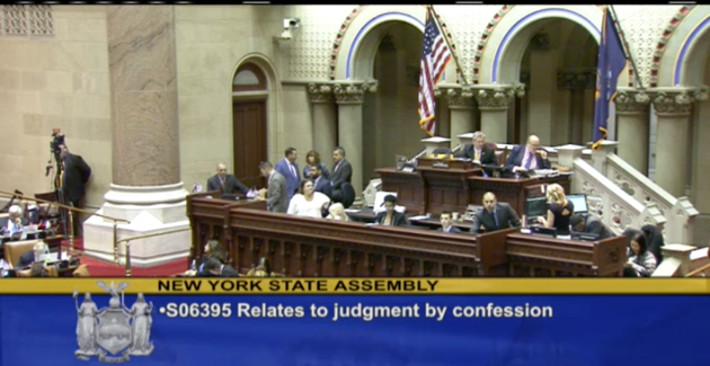
New York AssemblyNew York Assemblymembers Yuh-Line Niou and Crystal Peoples-Stokes have introduced a bill that would prohibit Confessions of Judgment (COJs) from being used in any contract or agreement for a financial product or service.

Peoples-Stokes’ district was one of the first districts to boycott COJs originated by merchant cash advance companies after Erie County Clerk Michael Kearns publicized that he would no longer approve them.

A03636 proposes the following:

§ 396-aaa. Confession of judgment requirement for certain contracts; prohibition.

1. No person shall require a confession of judgment in any contract or agreement for a financial product or service.

2. As used in this section the following terms shall have the following meanings:
(a) “Financial product or service” shall mean any financial product or financial service offered or provided by any person regulated or required to be regulated by the superintendent of financial services pursuant to the banking law or the insurance law or any financial product or service offered or sold to consumers except financial products or services: (i) regulated under the exclusive jurisdiction of a federal agency or authority, (ii) regulated for the purpose of consumer or investor protection by any other state agency, state department or state public authority, or (iii) where rules or regulations promulgated by the superintendent of financial services on such financial product or service would be preempted by federal law.

(b) “Financial product or service regulated for the purpose of consumer or investor protection”: (i) shall include (A) any product or service for which registration or licensing is required or for which the offeror or provider is required to be registered or licensed by state law, (B) any product or service as to which provisions for consumer or investor protection are specifically set forth for such product or service by state statute or regulation and (C) securities, commodities and real property subject to the provisions of article twenty-three-A of the general business law, and (ii) shall not include products or services solely subject to other general laws or regulations for the protection of consumers or investors.

Get The Affidavit or Waive It? Examining Confessions of Judgment

February 1, 2019
Article by:

This story appeared in deBanked’s Jan/Feb 2019 magazine issue. To receive copies in print, SUBSCRIBE FREE

cojsCaton Hanson, the chief legal officer and co-founder of the online credit-reporting and business-to-business matchmaker Nav, says that his Salt Lake City-based company would not associate with a small-business financier that included “confessions of judgment” in its credit contracts.

“If we understood that any of our merchant cash advance partners were using confessions of judgment as a means to enforce contracts,” Hanson told deBanked, “we would view that as abusive and distance ourselves from those partners. As a venture-backed company,” Hanson adds, “we have some significant investors, including Goldman Sachs, and I’m sure they would support us.”

Steve Denis, executive director of the Small Business Finance Association, which represents companies in the merchant cash advance (MCA) industry, says that, as an organization, “We’ve taken a strong stance against confessions of judgment.”

He reports that his Washington, D.C.-based trade group is prepared to work with legislators and policy-makers of any political party, regulators, business groups and the news media “to ban that type of practice.

“We’re fighting against the image that we’re payday lenders for business,” Denis says of the merchant cash advance industry. “We’re trying to figure out internally what we can do to stop that from happening and we have been speaking to members of Congress and their staff.”

“Confessions of judgment,” says Cornelius Hurley, a law professor at Boston University and executive director of the Online Lending Policy Institute, “are to the merchant cash advance industry what mandatory arbitration is to banks. Neither enforcement device reflects well on the firms that use them.”

These are just some of the reactions from members of the alternative lending and financial technology community to a blistering series of articles published by Bloomberg News on the use—and alleged misuse—of confessions of judgment (COJs) by merchant cash advance companies. The series charges the MCA industry with gulling unwary small businesses by not only charging high interest rates for quick cash but of using confession-laden contracts to seize their assets without due process.

The Bloomberg articles also reported that it doesn’t matter in which state the small business debtors reside. By bringing legal action in New York State courts, MCA companies have been able to use enforcement powers granted by the confessions to collect an estimated $1.5 billion from some 25,000 businesses since 2012.

“I don’t think anyone can read that series of articles and honestly say what went on were good practices and in the best interest of small business,” says SBFA’s Denis, noting that none of the companies cited in the Bloomberg series belonged to his trade group. “It’s shocking to see some companies in our space doing things we’d classify as predatory,” he adds. “As an industry we’re becoming more sophisticated, but there are still some bad actors out there.”

1800s englandA confession of judgment is a hand-me-down to U.S. jurisprudence from old English law. The term’s quaint, almost religious phrasing evokes images of drafty buildings, bleak London fog, and dowdy barristers in powdered wigs and solemn black gowns. (And perhaps debtor prisons as well.)

Yet while the legal provision’s wings have been clipped—the Federal Trade Commission banned the use of confessions of judgment in consumer credit transactions in 1985 and many states prohibit their use outright or in such cases as residential real estate contracts—COJs remain alive and well in many U.S. jurisdictions for commercial credit transactions.

Even so, most states where COJs are in use, such as California and Pennsylvania, have adopted safeguards. Here’s how the San Francisco law firm Stimmel, Stimmel and Smith describes a COJ.

“A confession of judgment is a private admission by the defendant to liability for a debt without having a trial. It is essentially a contract—or a clause with such a provision—in which the defendant agrees to let the plaintiff enter a judgment against him or her. The courts have held that such a process constitutes the defendant’s waiving vital constitutional rights, such as the right to due process, thus (the courts) have imposed strict requirements in order to have the confession of judgment enforceable.”

In California, those “strict requirements” include not only that a written statement be “signed and verified by the defendant under oath,” but that it must be accompanied by an independent attorney’s “declaration.” If no independent attorney signs the declaration or—worse still—the plaintiff’s attorney signs the document, the confession is invalid.

But if the confession is “properly executed,” the plaintiff is entitled to use the full panoply of tools for collection of the judgment, including “writs of execution” and “attachment of wages and assets.”

“ANY COMMERCIAL BANK IN PENNSYLVANIA WORTH ITS SALT INCLUDES THEM IN THEIR COMMERCIAL LOAN DOCUMENTS”


commercial leaseIn Pennsylvania, confessions of judgment are nearly as commonplace as Philadelphia Eagles’ and Pittsburgh Steelers’ fans, particularly in commercial real estate transactions. Says attorney Michael G. Louis, a partner at Philadelphia-area law firm Macelree Harvey, “They may go back to old English law, but if you get a business loan or commercial lease in Pennsylvania, a confession of judgment will be in there. It’s illegal in Pennsylvania for a consumer loan or residential real estate. But unless it’s a national tenant with a ton of bargaining power—a big anchor store and the owner of the shopping center really wants them—95% of commercial leasing contracts have them.

“And any commercial bank in Pennsylvania worth its salt includes them in their commercial loan documents,” Louis adds.

Pennsylvania’s laws governing COJs contain a number of additional safeguards. For example, the confession of judgment is part of the note, guaranty or lease agreement—not a separate document—but must be written in capital letters and highlighted. One of the defenses that used to be raised against COJs, Louis says, was that a contractual document was written in fine print “but we haven’t seen fine print for years.”

Other reforms in Pennsylvania have come about, moreover, as a result of a 1994 case known as “Jordan v. Fox Rothschild.” Says Louis: “It used to be lot worse. You used to be able to file a confession of judgment and levy on a defendant’s bank account before he knew what happened. It was brutal. But after the Fox Rothschild case, they changed the law to prevent taking away a defendant’s right of notice and the opportunity to be heard.”

Because of that case, which takes its name from the Fox Rothschild law firm and involved a dispute between a Philadelphia landlord renting commercial space to Jordan, a tenant, the law governing COJs in Pennsylvania requires, among other things, a 30-day notice before a creditor or landlord can execute on the confession. During that period the defendant has the opportunity to stay the execution or re-open the case for trial.

leaking roofDefenses against the execution of a COJ can entail arguments that creditors failed to comply with the proper language or procedures in drafting the document. But the most successful argument, Louis says, is a “factual defense.” Louis cites the case of a retail clothing store renting space in a shopping center that has a leaky roof. In the 30-day notice period after the landlord invoked the confession of judgment, the tenant was able to demonstrate to the court that he had asked the landlord “ten times” to fix the roof before spending the rent money on roof repairs. In such a case, the courts will grant the defendant a new trial but, Louis says, the parties typically reach a settlement. “Banks generally will waive a jury trial,” he notes, “because they don’t want to take a chance of getting hammered by a jury.”

A number of states, including Florida and Massachusetts ban the use of confessions of judgment. That’s one big reason that Miami attorney Roger Slade, a partner at Haber Law, advises clients that “there’s no place like home.” In other words: commercial contracts should specify that any legal disputes will be adjudicated in Florida. “It’s like having home field advantage in the NFL playoffs,” Slade remarked to deBanked. “You don’t want to play on someone else’s turf.”

He has also been warning Floridians for several years against the way that COJs were treated by New York courts. Writing in the blog, “The Florida Litigator,” Slade—a native New Yorker who is certified to practice law there as well as in Florida counseled in 2012: “If you live in New York, a creditor can have your client sign a confession of judgment and, in the event of a default on a loan, can march directly to the courthouse and have a final judgment entered by the clerk. That’s right—no complaint, no summons, no time to answer, no two-page motion to dismiss. The creditor gets to go right for the jugular.”

In addition, because of the “full faith and credit clause of the U.S. Constitution,” Slade notes in an interview, a contract that’s enforced by the New York courts must be honored in Florida. “Courts in Florida have no choice,” Slade says. “It’s a brutal system and it’s unfortunate.”

In December, two U.S. senators from opposing parties—Ohio Democrat Sherrod Brown and Florida Republican Marco Rubio—introduced bipartisan legislation to amend both the Federal Trade Commission Act and Truth in Lending Act to do away with COJs. Their legislative proposal reads:

“(N)o creditor may directly or indirectly take or receive from a borrower an obligation that constitutes or contains a congnovit or confession of judgment (for purposes other than executory process in the State of Louisiana), warrant of attorney, or other waiver of the right to notice and the opportunity to be heard in the event of suit or process theron.”

But with a dysfunctional and divided federal government, warring power factions in Washington, and an influential financial industry, there’s no telling how the legislation will fare. Meantime, the New York State attorney general’s office announced in December that it will investigate the use of COJs following the Bloomberg series. And New York Governor Andrew Cuomo has declared support for legislation that will, among other things, prohibit the use of confessions in judgment for small business credit contracts under $250,000 and restrict judgments by New York courts to in-state parties.

But if New York State or Congressional legislation are adopted it can have “unintended consequences” to merchant cash advance firms in the Empire State—and to their small business customers as well—asserts the general counsel for one MCA firm. “Losing the confession of judgment will be removing what little safety net there is in a risky industry,” the attorney says, noting that the industry has roughly a 15% default rate.

“IT IS NOT AS POWERFUL A TOOL AS THE BLOOMBERG NEWS STORIES WOULD HAVE YOU BELIEVE”


“It is not as powerful a tool as the Bloomberg news stories would have you believe,” this attorney, who spoke on the condition of anonymity, told deBanked. “The suggestion seems to be that the MCAs can use the confession of judgment to get back the total amount of money due—and then some—while leaving a trail of dead bodies behind. But that’s not the case.

“What is much more likely to be the case,” he adds, “is that MCA companies try to get the defaulting merchant back on track. And—probably more than we should and only after we’ve tried to reach out to them and failed—do we then reluctantly use the COJ as a last resort. At which point we hope we can recover some part of our exposure. The numbers vary, but the losses are always in the thousands of dollars. These are not micro-transactions.

“What’s going to happen,” he concludes, “is that It will not make sense for us to work with those merchants most in need of working capital. The unfortunate reality is that businesses who don’t have collateral and can’t get a Small Business Administration product will be left out in the cold.”

All of which prompts BU professor Hurley to argue that the “Swiss cheese” system of financial regulation among the 50 states continues to be a root cause of regulatory confusion. Echoing Miami attorney Slade’s concern about New York courts’ dictating to Florida citizens, Hurley likens the situation governing COJs with the disorderly array of state laws governing usury regulations.

In the 1978 “Marquette” decision, the U.S. Supreme Court ruled that a Nebraska bank, First of Omaha, could issue credit cards in Minnesota and charge interest rates that exceeded the usury rate ceiling in the Gopher State. Since then, usury rates enacted by state legislatures have become virtually unenforceable.

“The problem we’re seeing with confessions of judgment is a subset of the usury situation,” Hurley says. “One state’s disharmony becomes a cancer on the whole system. It’s a throwback to Colonial times with 50 states each having their own jurisdictions­—and it doesn’t work.”

50 statesHurley’s Online Lending Policy Institute has joined with the Electronic Transactions Association and recruited a phalanx of “academics, non-banks, law firms and other trade associations as members or affiliates” to form the Fintech Harmonization Task Force. It is monitoring the efforts by the 50 states to align their regulatory oversight of the booming financial technology industry which was recently recommended by a U.S. Treasury report.

Tom Ajamie, who practices law in New York and Houston and has won multimillion-dollar, blockbuster judgments against “dozens of financial institutions” including Wall Street investment firms, also argues for greater regulatory oversight. He urges greater funding and expansion of the powers of the Consumer Financial Protection Bureau to rein in “the anticipatory use” of confessions of judgment in commercial transactions.

However, notes Catherine Brennan, a partner at Hudson Cook in Baltimore, the job of protecting small businesses is outside the agency’s mandate. “The CFPB doesn’t have authority over commercial products as a general rule,” she explained in an interview. “Consumers are viewed as a vulnerable population in need of protections since the 1960’s.” As a society “we want protection for households because the consequences are high. A family could become homeless if they lose a house. Or (they) could lose employment if they lose a car and can’t drive. And there is also unequal bargaining power between lenders and consumers.

“Large institutions have lawyers to draft contracts and consumers have to agree on a take it or leave it basis. So there’s not a lot of negotiation and government has decided that consumers need protections, including a (Federal Trade Commission) ban on confessions of judgment.”

But Christopher Odinet, a law professor at the University of Oklahoma and a member of Hurley’s harmonization task force, sees the efforts of the federal government and the states to grapple with confessions of judgment as further recognition that small businesses have more in common with consumers than with big business. The COJ controversy follows on the recent passage of a commercial truth-in-lending bill by the State of California which, for the first time, stipulated that consumer-style disclosures should be included in business loans and financings under $500,000 made by non-bank financial organizations.

He cites the close-to-home example of an accomplished professional who got in over his head in financial dealings. “I recently observed a situation where a family member who is a very successful and affluent medical professional was relying on his own untrained business skills,” Odinet says. “He was about to enter into a sophisticated and complex business partnership relying on his intuition and general sense of confidence in the other party.”

Odinet says that he recommended that his relative hire a lawyer. Which, Odinet says, he did.

This story appeared in deBanked’s Jan/Feb 2019 magazine issue. To receive copies in print, SUBSCRIBE FREE

How an SBA Lender is Managing Through the Shutdown

January 10, 2019
Article by:
Everett Sands
Everett Sands, CEO, Lendistry

As a result of the U.S. government shutdown that started on December 22 of last year, hundreds of thousands of government employees have been working without pay. The shutdown has also temporarily stopped the Small Business Administration (SBA), a government agency, from operating. This means that obtaining an SBA loan, which is backed by the federal government, is no longer an option for American small business owners. (A lender cannot fund an SBA loan without the authorization of the SBA).  

While most SBA loans are funded by banks, a fair amount are also funded by non-bank lenders, like Lendistry, for which 60% of its business came from SBA loans last year. In his 20 year career, Lendistry CEO Everett Sands remembers another government shutdown in 2013. According to data collected by The New York Times, the 2013 shutdown lasted 16 days. As of today, the shutdown has lasted 20 days, and the longest shutdown since 1976 was 21 days.

Sands told deBanked that lenders like him are continuing to process the loans. However, they have to wait until the government re-opens before closing on any new loans. Since Sands and other SBA funders can’t close on the loans, they can’t yet generate money from them. Thankfully for Sands, he just recently started expanding his product offering.

“I think we feel a little bit calmer than we would have last year because we [recently] rolled out [new products,]” Sands said.  “An express line of credit program, a traditional line of credit, an express term product, and a commercial real estate product. So these products will not only keep us busy, but will allow us to weather the storm.”

Sands said that his team has been calling its borrowers and asking them if they would like to wait for their SBA loan to be processed or apply for a different kind of loan. He said that about half have decided to wait and half have decided to shop for another loan.

While SBA loans have been put on hold, Sands said that a government shutdown like this will likely increase the demand for loans in general, particularly among government contractors who are not getting paid.

“Historically, when there’s been a government shutdown, employees get their backpay. The government contractors do not. They just get delayed and pushed back further,” Sands said. “Generally, when people do not receive money, because the bills do not stop, they’re going to turn to resources…like lending organizations.”

As for SBA loans, once the shutdown is over, there will be a backlog, Sands said. He said that the SBA generally approves their loans in two days or less, but thinks that the approval time will probably move to 5 to 10 days if the shutdown stopped yesterday.

Sands joins most of the country in hoping that the shutdown will end soon. As it relates to his business: “I think it’s important to be able to offer clients all products that should be available to them, [including] the longer term [SBA] products which equals better cash flow. And if you think about it as a lender, you want to put your clients in the best position to pay you back.”

Despite the shutdown, 2018 was a very successful year for Lendistry with SBA lending. The company closed 92 SBA loans totaling $17.5 million and they have only been approved for SBA lending since June 2017, and only in California.

Founded in 2014, Lendistry employs 23 people. They offer loans of up to $1 million to small businesses in a variety of industries from restaurants to healthcare providers.