
Legal Briefs
Former Merchant Cash Advance CFO Charged With Fraud by New York Attorney General
January 4, 2019 A former merchant cash advance CFO and executive for a fund that provides capital to merchant cash advance companies, has been charged with fraud by the New York Attorney General. The allegations against Stephen Brown stem from his role as CFO of Cardis Enterprises International, a company that claimed to possess patented and proprietary technology to make low-value credit card transactions less expensive for merchants. Brown is the former CFO for Capital Stack, LLC/eProdigy Financial in New York. In reality, Cardis was a massive fraud and a ponzi scheme, the Attorney General alleges. The company raised tens of millions of dollars from duped investors.
Brown is one of twelve defendants, but is described as the most senior financial executive of the firm whose principal role was to draft and send investor update letters, which contained a host of false statements and omissions.
Among the allegations against Brown is that he lied to investors about being close to finalizing deals with Sony, Warner, and Universal. “At the time of Defendant Brown’s representation, only one introductory meeting between Cardis and each music company had taken place, and the parties had not even executed non-disclosure agreements,” the complaint says. Several other business deals Brown announced were either imaginary, had never made it past a simple introduction, or had already been outright rejected by the prospective partner.
Despite being the CFO, Brown did not even maintain a basic income statement, a formal share registry, or comprehensive records of its debts and obligations. When the scheme was suspected by investors, Brown doubled down on the lies, the complaint says.
On September 24, 2015, a Cardis investor emailed Defendant Brown asking for the “latest on Cardis” and whether it was “a complete loss,” while mentioning a recent investor lawsuit. Defendant Brown, copying Defendant Rosenblatt, responded that the lawsuit claiming fraud was “frivolous,” while claiming that Cardis’ relationship with Roc Nation was “developing” and ongoing. In fact, the lawsuit had merit, and Cardis’ relationship with Roc Nation was long over.
On February 28, 2018, a Cardis investor recorded a telephone conversation with Defendant Brown. The investor asked “what happened to the cash” investors put into Cardis. Defendant Brown responded by detailing the Company’s large budget and staff, while failing to disclose the substantial misuse of investor funds. The investor also questioned Defendant Brown about various investor lawsuits against Cardis and its principals. The investor asked: “After reading those lawsuits, why should we think that the company has any future?” In response, Defendant Brown told the investor “the lawsuits were not the most credible lawsuits,” attributing them to “angry investors.” Defendant Brown later told the investor “none of those lawsuits have any merit to them.” In fact, there was substantial merit to the investor lawsuits.
These misrepresentations and omissions were material to investors because they bore directly on Cardis’ viability.
The New York Post ran a story that labeled Cardis a Bernie Madoff-style scheme that falsely claimed ties to Jay-Z’s entertainment company.
The defendants stand accused of Material Misrepresentations, Repeated and Persistent Fraud and Illegality, Actual Fraud, Equitable Fraud, and Constructive Fraud. The Attorney General is pursuing restitution for victims, a ban from the securities industry in the State of New York, and to liquidate the company.
The docket # is 452353/2018 in the New York Supreme Court. The allegations have not yet been proven. According to LinkedIn, Brown currently lists himself as the President of GMA USA, LLC, President of CoreFund Capital LLC, and the CFO of Nanovibronix. He also lists being the CFO of eProdigy Financial for almost 3 years until early 2017.
Kornfelds Settle With SEC Over Woodbridge Ponzi Scheme
January 3, 2019Barry M. Kornfeld and Ferne Kornfeld, both fundraising agents for 1st Global Capital, have settled with the SEC for their role in Woodbridge Group of Companies LLC, a $1.2 billion ponzi scheme. Woodbridge was another Florida-based company that is unrelated to 1st Global Capital. As part of the settlement, the Kornfelds agreed to disgorge $3.69 million plus $690,497 in prejudgment interest on top of $650,000 in combined penalties. They also agreed to be permanently barred from selling securities.
Barry Kornfeld was already barred by the SEC for previous securities violations.
No wrongdoing has been alleged against the Kornfelds in the 1st Global Capital case thus far, but court records revealed that Barry Kornfeld raised $8 million from investors for the company. 1st Global Capital is currently in bankruptcy and was charged with securities fraud by the SEC.
Defunct MCA Company Tried to Escape Signed Confession of Judgment
December 13, 2018 When a Florida-based merchant cash advance company, World Global Financing (WGF), declared bankruptcy this past May, it entered into a binding settlement agreement with its largest creditor, a hedge fund known as Eaglewood.
There was a caveat.
Eaglewood required that WGF sign a Confession of Judgment (COJ) as part of the agreement that would afford Eaglewood the right to file and obtain a judgment without further litigation if WGF breached the settlement. On August 3, that’s exactly what happened. After WGF failed to make the stipulated payments to Eaglewood, the COJ was filed in the New York Supreme Court so as to obtain a nearly $6 million judgment against WGF and company founder Cyril Eskenazi.
While it can be virtually impossible to invalidate a COJ, the courthouse Clerk nonetheless refused to enter it because of alleged technical defects, one of which involved WGF’s use of an out-of-state notary to witness a New York State affidavit.
“The alleged Affidavit of Confession of Judgment upon which Eaglewood’s request for a Judgment by Confession stands like a house of cards is no affidavit at all under New York law, and cannot be used in a New York litigation,” WGF’s attorney argued.
The absurdity of the argument was not lost on Eaglewood because the notary WGF challenged on technical grounds was the notary that WGF and its counsel had themselves chosen and approved. Eaglewood called the charade of contesting the validity of one’s own affidavit signed in the presence of counsel, utterly frivolous and a fraud upon the Court.
Defects or not, the judge concurred with Eaglewood because WGF had irrevocably and unconditionally agreed to the entry of judgment if they breached the settlement agreement in the first place, which they did, rendering the alleged technical errors with the COJ itself a moot point.
The COJ was therefore deemed valid and the judge ordered the Clerk to enter the judgment.
On Nov 29, a judgment for $5,866,477 was entered against WGF and Eskenazi. The index # is 651489/2018 in the New York Supreme Court.
MCA Participations and Securities Law: Recognizing and Managing a Looming Threat
December 11, 2018Authors: Gregory J. Nowak and Mark T. Dabertin

Due to the high volume of relevant judicial decisions issued by New York courts over the past two years, the risk that enforceability of a merchant cash advance (MCA) contract1 might be successfully challenged as a disguised usurious loan has received ample attention in law firm white papers and published legal articles, including articles by Pepper Hamilton attorneys.2 Avoiding this risk of “loan re-characterization” is essential if the MCA industry is to achieve wider acceptance as a source of small business financing. But another risk—which we believe is largely unrecognized—could significantly throttle further expansion of MCA financing. This risk is that the funding structures MCA providers rely on to generate funding from third-party investors could be found to involve the issuance of unregistered securities. Unless an exception is available, that would be unlawful and could result in fines, penalties, defense costs and even rescission of the entire transaction, with the “issuer” being required to return investor capital.
Many MCA providers raise new funding by offering “participation interests” in their MCA contracts to third-party investors. These are usually structured in one of two ways. Under a “true participation,” the participant acquires the right to receive payments, and a resulting return on the participant’s investment, exclusively from the MCA provider. To this end, the participant receives no rights to enforce, nor any direct interest in, the underlying MCA contracts. Alternatively, the participation agreement may be structured so as to make each investor a pro rata “co-funder” of the underlying MCA contracts in an agreed-upon percentage (the “participation share”). Under this structure, the MCA provider’s contract with the merchant typically acknowledges the possible existence of “co-funders” in general terms, and does not require the merchant to ratify and accept named co-funders as they come into being. This add-on is usually accomplished through a novation to the MCA contract.
Under either of the above-described participation structures, the nature of the participant’s investment is purely passive, with no possibility for active involvement in the underlying MCA relationships. In fact, the participation agreement likely expressly prohibits such interference. The passive nature of a participant’s investment matters, because the presence of passivity, and the resulting reliance on the efforts of another party (i.e., the party offering the investment) to realize a profitable return, is a key factor for purposes of determining whether a security exists under the federal securities laws.
In SEC v. WJ Howey Co.,3> the U.S. Supreme Court established the following four-factor test for identifying the existence of a security: (1) an investment, (2) in a common enterprise, (3) with a reasonable expectation of profits, (4) to be derived from the entrepreneurial or managerial efforts of others. The facts of Howey concerned investments in an orange grove operation, where the investors were entirely dependent on the efforts of the orange grove manager/promoter to maintain the trees that the investor had invested in. In the case of an MCA participation structured as described above, all four Howey factors are arguably present. An investment is made with the expectation of realizing a profit. In addition, as discussed above, because that investment is passive in nature, its success hinges on the efforts of the MCA provider. Finally, at least one court has opined that the existence of common enterprise is inherent to any participation relationship.4
The Howey test, which seeks to identify the presence of an “investment contract,” is not the sole means for evaluating whether an investment constitutes a security. In Reves v. Ernst & Young, the U.S. Supreme Court recognized that the expansive definition of the term “security” under the Securities Act of 1933 and the Security Exchange Act of 1934 extends to other forms of “notes” besides investment contracts.5 In determining whether the “demand notes” at issue in Reves constituted a security, the court applied what is commonly known as the “close resemblance” test. Under this test, if the note in question bears a close resemblance to a type of note that has been judicially recognized as not involving a security, that note likewise will not be considered a security. For example, on its face, an MCA contract closely resembles “a short-term note secured by a lien on a small business or some of its assets.”6 However, in an MCA contract, the purchased future receivables provide the source of repayment of the advanced funds, as opposed to providing security for a lien.
This distinction is important. because in an MCA, the receivables do not yet exist, so there is nothing to lien. Rather, the MCA involves receivables to be created, presumably using the proceeds of the MCA to do so. Properly drafted MCAs sidestep all “note-like” characteristics, and make it clear that the MCA is a contract to purchase an asset (i.e., receivables) that are yet to be created. There is no sum certain for repayment – unlike a note, if the receivables turn out to be bad, the MCA provider has no recourse back to the merchant that created them. The receivables are not security for a loan; rather, the receivables are the property being forward purchased. MCAs are different in kind and extent from loans.
Notwithstanding the Howey test, and as noted above, it is possible to argue persuasively that an instrument that appears to be a security instead describes the terms of an individually negotiated contractual agreement. In this regard, in Marine Bank v. Weaver,7 the U.S. Supreme Court held that a contract between a bank and a married couple that called for the latter to pledge a certificate of deposit as security for a loan between the bank and an unrelated corporate borrower in exchange for the opportunity to share in the latter’s future profits did not involve a security. In doing so, the court distinguished the note in question from investments that fall within the “ordinary concept of a security. . . [which are offered] to a number of potential investors.”8 In contrast, the Court in Marine Bank found that the contested note created “a unique agreement [that was] negotiated one-on-one by the parties” and was therefore, “not a security.”9
In the absence of an applicable statutory exemption, the public offering of unregistered securities constitutes a criminal violation of the federal securities laws. Because securities can generally only be sold to the public by a registered broker-dealer, people who engage in selling such securities, as well as their related corporate actors, may be subject to monetary penalties for the resulting violations of law. An improperly structured MCA participation presents the risks that: (i) sales of participations made under the flawed structure could be declared void and subject to rescission; and (ii) both the MCA provider and its primary individual actors could be subject to criminal prosecution and resulting monetary penalties. In the remainder of this article, we discuss ways for effectively mitigating these risks.
Structuring the MCA participation so as to make each participant not merely a “co-funder” in name, but an actual party to each underlying MCA contract by means of a contract novation signed by the merchant and naming the individual participants, would arguably eliminate any risk that the structure might be deemed to involve the unlawful issuance of securities. Under this structure, each participant, at least in theory, could enforce the MCA contracts directly against the applicable merchants, without having to rely on the MCA provider. The main flaw with this option is that the MCA participation agreement necessarily prohibits such independent actions by the participant, because those actions could directly conflict with the economic interests of either or both the MCA provider or additional participants. Hence, any actual ability of the participant to be actively engaged in the underlying merchant relationships will be missing. As the number of participants increases to more than a handful, this structure – requiring as it does that the merchant ratify and accept every new participant as each participant is added, is unwieldy and becomes infeasible to administer.
One could also argue that including a requirement in the MCA participation agreements that the participant must evaluate independently the quality of each MCA contract before the purchase of the participation share precludes the existence of a common enterprise. However, unless each participant has its own series of MCAs, this distinction is unlikely to be of significance, because all participants are participating in the same MCA. Also, notwithstanding the obligation to conduct independent reviews, the MCA participant must still rely on the MCA provider to source qualified merchants. In addition, as noted above, the investor also must depend on the MCA provider’s success in collecting payments from merchants, which will determine whether a profitable return is achieved. Finally, where a pool of investors all share in the risks and benefits of a particular business enterprise (known in securities law as “horizontal commonality”), the resulting presumption of a common enterprise is extremely difficult to disprove.
In view of the above, we suggest that the best way to manage the risk that the participation structure might be viewed as involving the unauthorized issuance of securities is to embrace the substance, if not the precise letter, of the federal securities laws. Specifically, by structuring the participation in a manner that complies with the safe harbor from the requirement to register securities described in Section 506 of the SEC rules under the Securities Act of 1933. This entails: (i) only selling participations to accredited investors; (ii) describing the applicable risks (i.e., the risk factors) and potential conflicts of interest in an addendum to the participation agreement; (iii) making sure that all sales of participants are made on a one-to-one basis, with no general solicitation or marketing; and (iv) advising participants that the resale of their participation share may be subject to a one-year minimum holding period. (Of course, if the MCA pays off before the one year period and extinguishes the MCA, that is not an issue under this rule.)
We caution that the securities laws are both difficult to navigate and prone to divergent interpretations. The consequences of misinterpretation can be severe and could result in the rescission of existing participations and monetary penalties. Hence, this is not a DIY proposition.
Pepper Points
-
The risk that an MCA participation structure could be found by a regulator or court to constitute the unlawful issuance of securities is under appreciated, and has serious consequences that could throttle the availability and growth of MCA financing.
-
Although legal arguments can be made in support of the position that the most commonly used MCA participation structures do not involve the unlawful issuance of unregistered securities, none of those arguments is sufficiently persuasive to preclude the need for additional risk mitigation efforts.
-
Mitigation plans for managing the risk that a given MCA participation structure involves should incorporate complying with the substance, and the precise letter, of the federal securities laws.
The federal securities laws are difficult to navigate and prone to divergent interpretations. The consequences of misinterpretation are severe and could include the rescission of existing participations and assessments of monetary penalties, including against individual actors.
Endnotes
1 An MCA is a business financing option that involves the advance of funds to a merchant, typically to assist the merchant in managing its short-term cash flow needs, in exchange for the sale of a specified percentage of the merchant’s future receivables at a sizeable discount. It is a relatively new offshoot of “factoring,” which likewise involves the purchase and sale of receivables at a discount in exchange for an advance of funds to a business, with the primary difference being that the receivables in the case of MCA financing are not yet extant. An MCA contract might be deemed a disguised usurious loan for many reasons, including the inclusion of a set term within which the advance must be repaid in full to avoid default. The most critical factor in this regard is whether the MCA provider is looking to the purchased receivables for repayment, or to the merchant itself or its individual owner(s); e.g., in the form of a financial guarantee given by the owner(s).
2 For a broader discussion of MCA financing, and the risk of re-characterization as a usurious loan, see: https://www.pepperlaw.com/publications/recent-litigation-illustrates-why-merchant-cash-advances-are-not-loans-2017-04-20/.
3 328 U.S. 293 (1946).
4 Provident National Bank v. Frankfort Trust Co., 468 F. Supp. 448, 454 (E.D. Pa. 1979) (By its “very nature” any participation involves a common enterprise.).
5 494 U.S. 56, 64 (1990) (“The demand notes here may well not be ‘investment contracts,’ but that does not mean they are ‘notes.’ To hold that a ‘note’ is not a ‘security’ unless it meets a test designed for an entirely different variety of instrument ‘would make the Acts’ enumeration of many types of instruments superfluous’ Landreth Timber, 471 U.S. at 692, and would be inconsistent with Congress’ intent to regulate the entire body of instruments sold as investments, see supra at 60-62”.).
6 Id. at 65.
7 455 U.S. 551 (1982).
8 Id. at 552.
9 Id.at 560. In Vorrius v. Harvey, 570 F. Supp. 537, 541 (S.D.N.Y. 1983), the court followed Marine Bank in finding that a contested loan participation agreement involved an individually negotiated contract versus a security. A key factor in that case, however, was the existence of a comprehensive federal regulatory scheme apart from the federal securities laws in the form of banking laws and regulations, which made application of the former unnecessary for purposes of protecting the interest of investors. No such alternative regulatory scheme exists in the case of the MCA industry, which is generally unregulated.
The material in this publication was created as of the date set forth above and is based on laws, court decisions, administrative rulings and congressional materials that existed at that time, and should not be construed as legal advice or legal opinions on specific facts. The information in this publication is not intended to create, and the transmission and receipt of it does not constitute, a lawyer-client relationship.
1st Global Capital Consents With SEC
November 28, 2018Subject to approval in two courts, 1 Global Capital LLC (aka 1st Global Capital) has confirmed it will consent with the SEC to be permanently enjoined and restrained from violating securities laws. The papers were submitted to the Court yesterday.
Though the terms include 1st Global Capital’s California counterpart, 1 West Capital, LLC, there is no connection to the separate securities charges pending against company founder and former CEO Carl Ruderman. Ruderman is seeking to dismiss those charges. According to court records, his reply to the SEC’s opposition is due this Friday.
SEC Scoffs at 1st Global Capital’s Attempt to Dismiss Securities Complaint
November 17, 2018The SEC is not impressed with 1st Global Capital’s attempt to dismiss the charges it stands accused of. Yesterday, the SEC filed opposition papers, writing “Having defrauded thousands of investors out of almost $300 million, Defendant Carl Ruderman now asks the Court to let him escape the consequences of his actions by dismissing the Amended Complaint against him based on a series of inaccurate and incomplete facts, incorrect legal standards, and infirm legal arguments.”
1st Global and Ruderman (who was the company’s owner and CEO), argued that the SEC does not have subject matter jurisdiction and that the notes between 1st Global and investors were not securities.
“Ruderman misstates the standards for evaluating whether a note is a security, and does not even bother to address the separate test for determining whether an investment qualifies as an investment contract,” the SEC claims. “The investment 1 Global offered and sold to investors was a security.”
Parallel to the SEC case, bankruptcy proceedings are continuing to move forward as well.
There has been no word on criminal charges since 1st Global revealed it was being investigated by the US attorney’s office in July.
The SEC’s opposition to 1st Global’s motion to dismiss can be downloaded here.
“Out Of State” MCA Funder Not Precluded From Entering COJs in New York, Court Rules
October 18, 2018In May 2017, Funding Metrics (FM), a small business funding provider, entered a signed Confession of Judgment (COJ) in Westchester County, NY against a California-based customer. The Court issued a judgment a mere five days later.
That should have been the end of it, but on July 26th, the customer hired law firm White & Williams to challenge the judgment’s validity on the basis that New York Business Corporations Law § 1314 limits the circumstances in which a non-resident corporation may bring an action or special proceeding against another non-resident corporation. Neither FM nor the customer were based in New York nor had any connections to New York whatsoever, they alleged, which precludes such a judgment from being entered there. But it’s doubly bad, defendants argued, because the judgment by confession statute in New York is unconstitutional as it waives the defendants’ due process rights.
The Honorable Terry Jane Ruderman was unmoved by the arguments, pointing out that not only was FM registered to do business in New York and claimed to have an office there but that defendants incorrectly relied on § 1314 because a Confession of judgment is not an action, nor a special proceeding.
[…]That statute does not preclude the judgment entered here, entered by confession of judgment. By such a document, a person “agree[s] to the entry of judgment upon the occurrence or nonoccurrence of an event” (see Black’s Law Dictionary [10th ed. 2014]), giving the holder a remedy that does not require proof of the nature of the transaction or allow for interposing defenses (see Soler v_Klimova, 5 AD3d 294 [1st Dept 2004]). Therefore, in entering the judgment, the court does not inquire into the underlying transaction, including with regard to such matters as the home state of the corporate plaintiff.
Moreover, while the Business Corporations Law § 1314 applies to “maintaining actions or special proceedings,” the statute providing for judgments by confession does not require commencement of an action; it clearly states that “a judgment by confession may be entered, without an action, … upon an affidavit executed by the defendant” ( CPLR 3218 [emphasis added]).
Defendants’ constitutionality argument was rejected as “meritless” and all of their other arguments not discussed in the order were explicitly rejected.
You can download the decision here.
The case # is 57737/2017 in Westchester County in the New York Supreme Court. The law firm representing plaintiff Funding Metrics was Stein Adler Dabah & Zelkowitz.
ISO Pretending to be Funder May Be Sent to Jail
October 14, 2018A New York Supreme Court judge ordered on Thursday that Long Island-based ISO JTT Funding either be fined or sent to prison if it does not comply with a previous restraining order obtained by NYC-based funder Accel Capital.
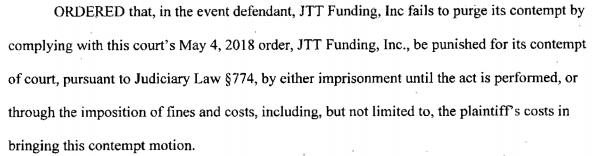
Accel alleges that JTT funding has been impersonating it through correspondence and on contracts, a scheme that was outed when merchants claimed they had been duped into sending thousands of dollars upfront to JTT (disguised as Accel) to obtain a loan yet never received one. Accel responded by suing JTT and obtained a restraining order on default when the defendant failed to respond.
According to the Financial Times, JTT Funding is owned by Queens-born mixed martial arts fighter Jim “The Tyrant” Boudourakis. In his October 2017 interview with the publication, Boudourakis said, “There was a learning curve, going from being a fighter to a salesman. But I’m good with people.” FT also reported that his company had 18 full-time salespeople and was funding $4 – $5 million per month.
In an unrelated suit, JTT Funding is accused of forging a confession of judgment.
The Accel Capital suit can be found in the New York Supreme Court under Index Number: 153447/2018