Business Lending
Flender Makes BIG Mark in Ireland’s SME Lending Market
November 26, 2019 Ireland can seem like a small place, so much so that on my way to meeting with Colin Canny, Flender’s Head of Partnerships, I quite literally bumped into Flender’s co-founder & CEO Kristjan Koik who was walking through Dublin’s Silicon Docks. I recognized Koik from the who’s who catalogue of executives I had compiled before traveling abroad to explore the Irish fintech scene. He was cordial and polite. And yet through his demeanor I sensed there was more, that there was a story to be told even if it was not ready to be shared.
The following month Flender would reveal remarkable news, a new €75 million funding line, bringing their total to €109 million raised since the company’s founding in 2015. The company is backed by Eiffel Investment Group, Enterprise Ireland, entrepreneur Mark Roden and former Ireland rugby player Jamie Heaslip.
This large amount of funding, even by UK or US standards, makes Flender stand out, and so when I finally meet with Canny on that warm Fall day in September, I’m pretty thankful he afforded me the time.
Flender, Canny explains, is derived from Flexible Lender. The pamphlet he produces and hands to me says that their idea is simple, to provide businesses with the funding they need and ensure the application process is fast, easy, and transparent.
Application details for products like term loans and merchant cash advances require the usual stips like historical bank statements, a profit & loss statement, and a balance sheet. But there’s also a section quintessentially Irish, that is that it can be beneficial to submit your last 2 years herd numbers if you’re a farmer, complete with your last 12 months Milk Reports and property acreage figure.
 Canny explains that Flender is not a high-risk fall-back lender, but rather the opposite. “Our credit process is extremely tight,” he says, “in line with banks.” And with good rationale, seeing that the company is still somewhat reliant on a peer-to-peer funding model. More than half of individual peers on the platform are Irish but Canny says that it’s not unusual for non-residents including Americans to lend on the platform as well.
Canny says the Irish market is very “community based.” The transparency of the marketplace aligns with that characterization. Like other peer-to-peer small business lenders in Ireland, borrower identity is publicly accessible on the platform, as are the terms of the loan. Anyone can view the business name of a prospective borrower on the website, the address, a bio, and even their “story.”
Flender taps several marketing channels like Google Adwords, radio, direct sales, and even brokers. Canny says they generate an underwriting decision in as quick as 4-6 hours and fund a business in as little as 24 hours. Borrowers like the product so much that many renew. Seventy percent of the SMEs in the country are peer-to-peer bankable, Canny explains, creating a wide playing field to target.
Meawnwhile, CEO Kristjan Koik told the Irish Times that the top 3 banks in Ireland have 92 percent of the SME lending marketshare so there is still a ton of opportunity for non-banks like Flender to grab hold of.
As for how the massive credit line impacts them going forward? Koik told the Times that they would be cutting interest rates by up to 1 percent across their various loan products. Interest rates now start as low as 6.45% and terms range up to 36 months.
As Canny and I part ways I present one final question, will Flender be expanding abroad? I get no definitive answer. He was cordial and polite, and yet I sensed through his demeanor that there was more, perhaps even a story in the works that was not yet ready to be shared.
Canadian Lenders Summit Recap
November 23, 2019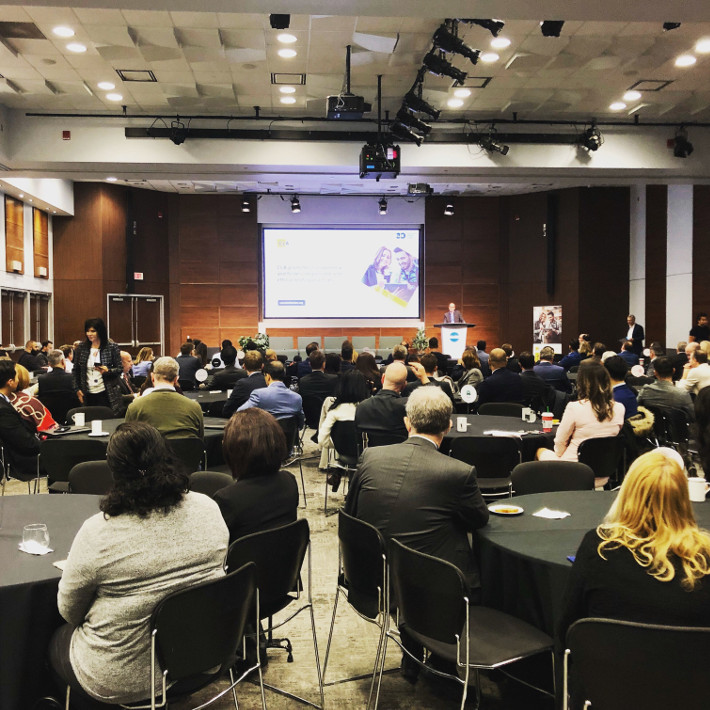 The Canadian Lenders Association’s largest annual event brought together hundreds of executives from the fintech and lending industries. It was hosted at MaRS, a dedicated launchpad for startups in Downtown Toronto that occupies more than 1.5 million square feet and is home to more than 120 tenants, many of which are global tech companies.
After OnDeck Canada CEO Neil Wechsler was introduced as the new chairman of the association, the day kicked off with a presentation by Craig Alexander, the Chief Economist of Deloitte Canada. Alexander explained that after some major warning signs sounded off late last year and early this year, Canadian growth and positive economic indicators have returned. He opined that politics in Canada and the United States will play a strong role in the economic outcomes of both countries going forward.
Panels on a variety of topics dominated the rest of the day with an interlude keynote from author Alex Tapscott who spoke about the financial services revolution.
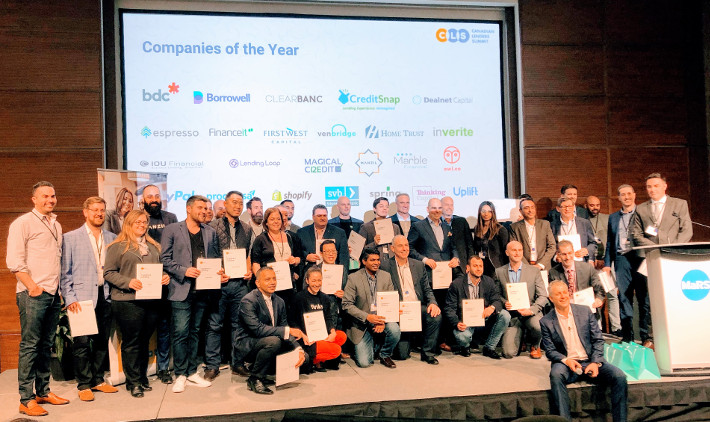
The sessions concluded with an award ceremony focused around the Top 25 Company Leaders in Lending and the Top 25 Executive Leaders in Lending. The Canadian Lenders Association will make videos of the sessions available online. deBanked was in attendance.
IOU Financial Originated $41.4M in Loans in Q3, Continued Profitability
November 14, 2019IOU Financial originated $41.4M in business loans in Q3, according to the company’s latest published financial statements. The figure is a modest increase over Q2’s $38.5M. IOU also kept up its trend of profitability with net income $1M.
Shares of IOU, which trade on the Toronto Stock Exchange, are valued at around (CAD) 14 cents and equate to a market cap of approximately (CAD) $14M.
Costs, Losses Soar At StreetShares
November 12, 2019 StreetShares increased revenue by nearly 40% year-over-year, according to the company’s latest fiscal year 2019 filing, but costs soared and increased by almost 90%.
StreetShares reported a staggering $12.3M loss on only $4.4M in revenue. That loss was much wider than the previous year’s loss of $6.5M on $3.2M in revenue.
Whereas startups may spend heavily on sales and marketing as they prioritize growth and scale, StreetShares’ primary cost, as in prior years, continues to be payroll. The company spent approximately $7 million in payroll and payroll taxes in fiscal year 2019.
The margin by which payroll exceeds revenue is increasing (157% in FY ’19 vs 144% in FY ’18). For comparison purposes, payroll expense makes up less than 25% of revenue for StreetShares rival IOU Financial.
StreetShares’ source of funds has shifted away from institutional investors and professional investors to retail investors. Retail investors only provided 43.89% of funds in FY ’18 but provided 86.72% of funds in FY ’19.
Retail investors, permissible under Regulation A, do not invest in individual loans but rather they lend money to StreetShares for which the company can use for lending or for “general corporate purposes” or “other products at the discretion of the company.” In return retail investors receive a fixed 5% annual return.
As of May 2019, the company reported that 80% of funds they lend out go to US veteran small businesses. A veteran small business is defined as “a company that is at least 25% owned by a veteran or military spouse or has a veteran or military spouse as the co-guarantor.”
Factoring for Freelancers
November 8, 2019 The number of freelancers in America is quickly growing year on year, with a recent study indicating the percentage of full-time freelancers has increased from 17% of the workforce in 2014 to 28% in 2019. Representing a host of fields, from writing and photography to marketing and programming, the incomes and needs of such workers vary as much as their roles do, however a commonality between them is their difficulties with financing.
Being infamous for the difficulties involved in getting paid, freelancers have historically had trouble with the timings of payments. With 59% of freelancers reporting that they live pay check to pay check, missing a payment or waiting until an untimely employer responds to an invoice may not be possible for many; and beyond payments, banks have yet to catch up with the needs of freelancers.
“There’s this great big area in between consumer banking and business banking that freelancers fall into and the big banks aren’t dealing with that,” George Kurtyka of Joust explained. “They have strategies but it’s not really something they know how to do.”
Kurtyka, after a period of jumping between phone services, payments, and the fintech end of banking, is now COO and Co-founder of Joust, a financial services company occupied with providing for those freelancers ill-suited to traditional banking, which has been operating since 2017.
How are they going about it? Following a conversation Kurtyka had with a friend who told him over half of freelancers don’t separate their business and personal finances, he figured the best place to start was with bank accounts, which became the first product available from Joust. Next was the issue of non-payment, a problem his team thought was suited to underwriting. Offering guaranteed payment within 30 days for 1% of the invoice or instant payment for 6%, factoring, via its PayArmour product has become a large part of Joust’s business model.
“It feels almost like an insurance product,” Kurtyka observed. “When you send an invoice, we’re doing risk assessment on you, we’ve onboarded you and given you a bank account so we know about you.”
And so, after an early partnership with the Freelancers Union, Joust has been offering its cocktail of banking, invoicing, and alternative financing services to freelancers and self-owned businesspeople across America, with eyes on expanding its products further down the line.
“As you can imagine, we can start with just invoice factoring, but we can move into working capital and lines of credit … We’ve heard stories of freelancers losing houses and apartments because they were paid late. The next step is income smoothing. If you can predict how much you’re going to earn, we can smooth your income and then work with one of our bank partners to prequalify you for a loan. We’re obviously not a chartered institution but we work with a host of chartered banks and payments companies and we sit on top of them and the great news is we work with a lot of partners who want access to this burgeoning market of freelancers who may not qualify for a FICO score because their income is like this … Down the line we’d love to offer loans and mortgages. We think the underwriting models we’re building could be like the next FICOs for freelancers.”
Selecting a Third-Party Commercial Collection Agency
November 8, 2019 It’s said that anyone can lend money out but the hard part is getting paid back. The latter part is full of nuance, a 32-page white paper authored by Minnesota-based Dedicated Commercial Recovery (Dedicated) reveals.
“Choosing a third-party commercial collection agency is a matter of comparing potential returns and risks in order to achieve an optimal balance of both,” the report opines. “The purpose of this paper is to present one possible outline for making such a balanced choice.”
While it may be views that Dedicated espouses, the report stops short of self-promotion while raising valuable questions that anybody contracting with a commercial collection agency would benefit from considering. After all, even if third-party collections inherently suggests that relations between the original parties have broken down, the collections experience can set the final tone on how a customer feels about your brand.
That’s just the tip of the iceberg, according to the report. The collections process can have legal implications, present operational challenges, and ultimately impact the efficient orderly flow of business.
David Goldin is BACK – The Scoop Behind His Return
November 7, 2019 “When I started, the term merchant cash advance didn’t even exist. There really were no business loans back then, the word ‘fintech’ didn’t exist, ‘alternative lender’ didn’t exist … Back in the day it was all about getting a credit facility, and that was like the iPhone 5, and now we’re the iPhone 11. There’s more ways to be a lot less stressful, a lot more productive, and a lot less time consuming. There’s other financial instruments to really help companies excel.”
This is how David Goldin speaks of the difference between the early days of the alternative funding industry, a marketplace which he helped form in the pre-crash years of the noughties, and now, a moment which sees the CEO’s return to the market after years abroad.
Having founded Capify, an alternative finance company, in 2002, Goldin had worked in the space for over a decade before he exited the US market in January of 2017, choosing to instead focus his efforts on the UK and Australia.
Over two years later, Goldin is back in the States with Lender Capital Partners, offering capital to commercial finance companies, with a priority given to those who deal in MCAs and business loans. “It’s very exciting, I’m coming in from a different perspective,” noted Goldin. “It’s still a great industry. I’m just coming at it from a different angle which I think could be a lot more productive and scale a lot faster.”
And as well as funding the funders, this new angle includes forward flow programs, a commitment to participate in deals up to $1 million, credit facilities in the range of $20-100 million, a system by which point of sale providers are able to provide merchant financing via their software, and the Broker Graduate Program. The last of these being LCP’s in-house channel open to brokers who originate a minimum of $500,000 a month, and who want to receive capital and advice from LCP in order to become a direct funder.
When asked why he chose to return via this more top-down approach to the industry, Goldin explained that “there’s enough good players here that are trying to originate on the merchant side, so rather than try to reinvent the wheel I thought I’d come in with my years of experience running a MCA alternative lending platform in the US, knowing what the pain points are.”
Made possible through a partnership with Basepoint Capital, LCP is there to help MCA and business loans companies through both the good times and the bad, according to its founder, saying that what was a lesson for him partly informs LCP’s model.
“The time to raise money is when you don’t need it. If you run into trouble where your lender gets spooked or either has their own financial issues, or it’s a regulatory or macroeconomic condition, you just can’t bring in a new lender within 30 or 60 days, and if you do it’s not going to be on favorable economic terms. It’s really going to be a desperate attempt to get it … It’s almost like having more than one internet connection in your office, if one goes down you have a backup with no downtime.”
GoDaddy Now Offers Kabbage Business Lines of Credit To Its Customers
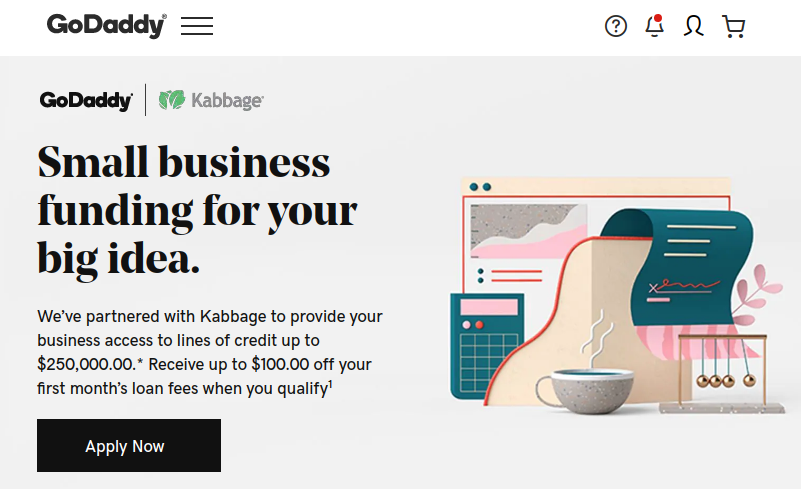
November 4, 2019 A curious thing popped up in my Godaddy account dashboard on Monday. Underneath the section to manage my domains, a “Deals from GoDaddy Partners” box offered me $300 in Free Yelp Ads on one side and a business line of credit from Kabbage up to $250,000 on the other.
The Kabbage offer is brand new, according to a joint announcement that came out the same day publicizing a “strategic partnership” between the two companies.
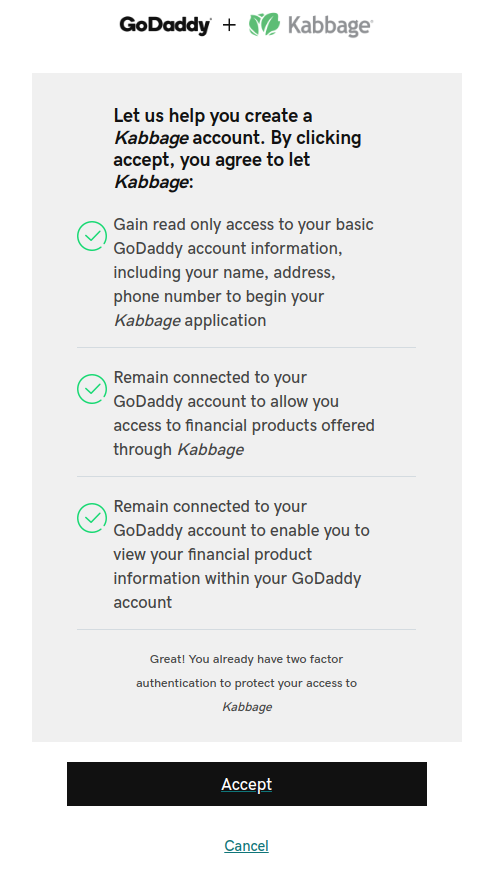
By clicking on it, I found that GoDaddy customers can transmit their account information to Kabbage by clicking a button to begin the loan application process. If a loan is approved, GoDaddy customers save up to $100 on their first monthly loan fee, the website states.
While a simple web domain may only cost around $10 a year, Kabbage has suggested that funds be used for other purposes like staffing up for the busy holiday season, purchasing additional inventory or equipment, or applying it toward digital marketing initiatives.
Borrowers will be able to access the Kabbage dashboard from their Godaddy accounts, an FAQ says.
Below are some screenshots: