Sean Murray is the President and Chief Editor of deBanked and the founder of the Broker Fair Conference. Connect with me on LinkedIn or follow me on twitter. You can view all future deBanked events here.
Articles by Sean Murray

LoanDepot to be Lending’s Next IPO?
October 9, 2015 loanDepot, which describes itself as a leading technology-enabled U.S. consumer lending platform, has publicly filed their S-1 registration form. Originating more than $50 billion worth of loans since 2010, that makes them the nation’s second largest direct-to-consumer non-bank originator. Their products range from home loans to unsecured personal loans.
The filing states they seek to raise $100 million, however that number might be revised upward. For loanDepot’s CEO Anthony Hsieh, this is business as usual. According to Crunchbase, he founded LoansDirect.com in 1994 and merged with ETRADE Financial in 2001 to create ETRADE Mortgage. His next company, Home Loan Center, Inc., merged with Lending Tree.
loanDepot is a natural succession to similar businesses he’s built over the past 20 years.
For Lending, It Might as Well be 1997
October 9, 2015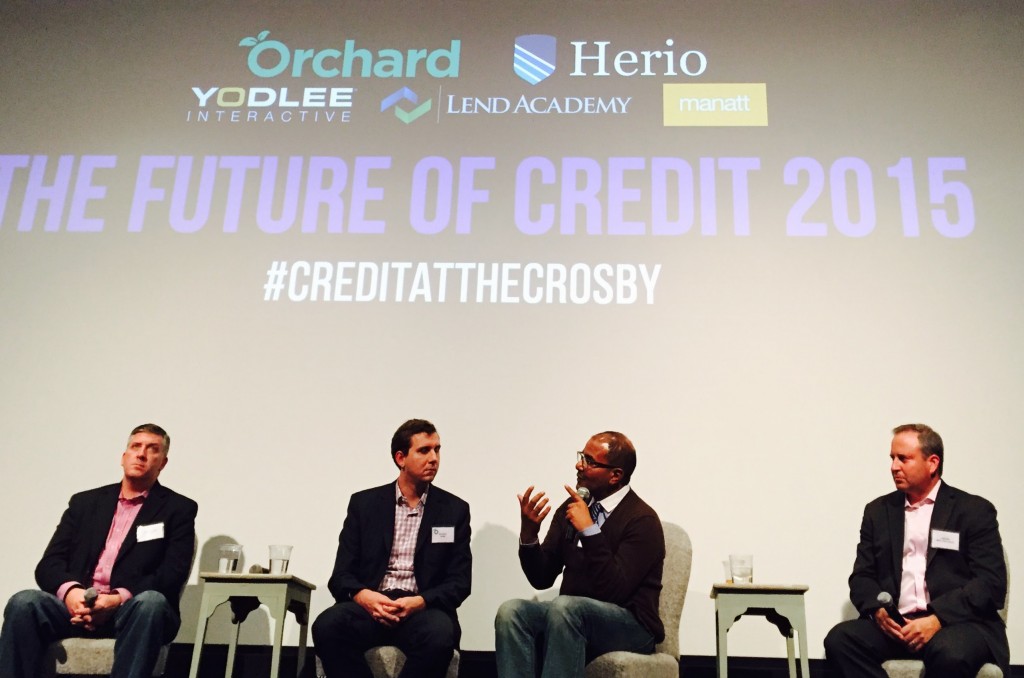 If you did any business with OnDeck between 2008 and 2014, you probably spoke with or at least knew of Sherif Hassan. His last position with the company before he left in May, 2014 was the Vice President of Major Markets. About six months later OnDeck went public and Hassan, one of the company’s earliest employees, was not there to celebrate it.
That’s because Hassan was busy working on something new, Herio Capital, a provider of working capital to small businesses that just recently surpassed more than $10 million in funding since inception.
Herio teamed up with Orchard on Thursday evening, September 8th to present The Future of Credit 2015.
“This is e-commerce in 1997 right now for lending,” said Jason Jones, a partner in Lend Academy who moderated the event’s panel. And Hassan, who is now easily considered an industry veteran, explained what set his new company apart.
It’s apparently not all algorithms when it comes to small business either. “We’re using our data to do all the heavy lifting and we’re using our people to do all the thinking,” Hassan said. And while they can take a deal from start to finish in four hours, they still have a human credit committee process. Other industry leaders have reported using similar approaches. “I like eyes on a deal,” said Orion First Financial CEO David Schaefer back in June at the AltLend conference. But for Herio, APIs and data allow the company to do a lot of filtering before anyone even touches the deal. Yodlee’s bank verification product reportedly plays a big role in being able to do that and Terry McKeown, Yodlee’s Data Practice Manager was coincidentally also on the panel.
Next to Hassan sat Matt Burton, the CEO of Orchard Platform, who was previously the 7th employee of Admeld, a company that was acquired by Google in 2011 for $400 million. His co-founder, Angela Ceresnie, is a former VP of Risk Management at Citibank and Director of Risk Management at American Express.
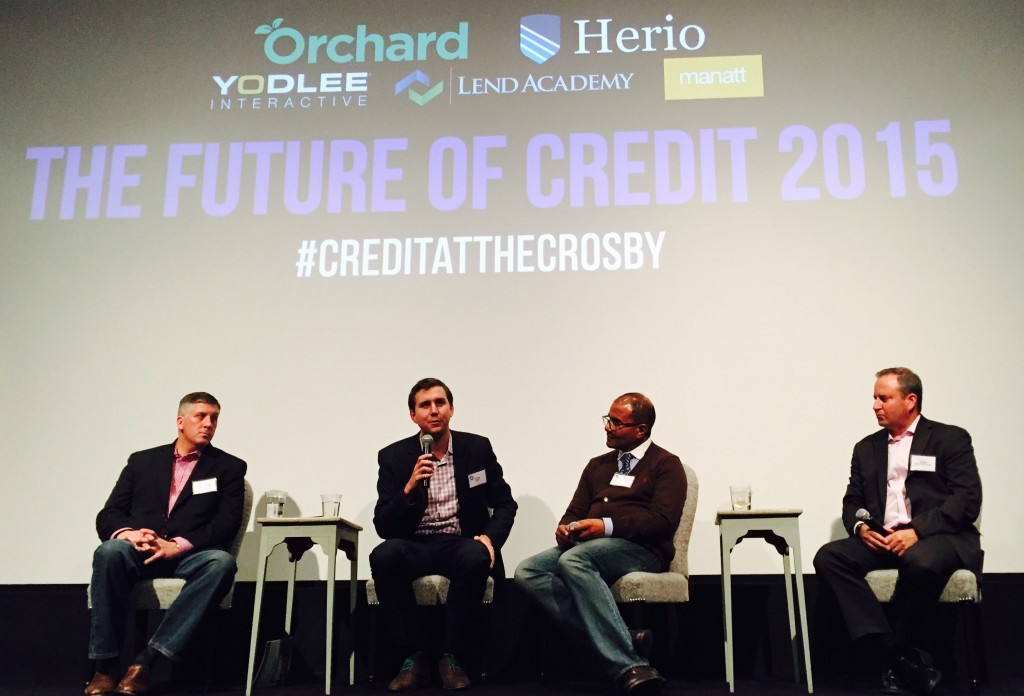 Speaking on the availability of decisioning tools, Burton said “there’s never been a better time to enter the space.” That may seem counter-intuitive since the frenzy of M&A activity and capital raising over the last couple years has had some players worried there’s a bubble brewing, but studies show they may just be filling a growing gap. Small business lending is actually shrinking in the traditional banking sector in part because of Dodd-Frank.
“Community banks are being destroyed,” said Burton. “All the products they used to be able to provide have been taken away.” That’s not just his opinion either. Three weeks ago, the heads of the Independent Community Bankers of America and National Association of Federal Credit Unions offered testimony to the House Small Business Committee that demonstrated the carnage that regulations were having on their industry. During that hearing, Subcommittee Chairman Tom Rice said, “the burdens created by Dodd-Frank are causing many small financial institutions to merge with larger entities or shut their doors completely, resulting in far fewer options where there were already not many options to choose from.”
So today’s online lending industry might seem really big but it’s relatively small when compared to the shoes they’re trying to fill. Case in point, nearly 10% of the 104 companies that responded to the Treasury RFI on marketplace lending attended Herio & Orchard’s three hour event in New York City. That was determined by a quick show of hands from the audience when asked by Manatt Phelps and Phillips attorney Brian Korn. The industry didn’t seem so big all the sudden.
Korn, making a lawyer joke, likened the Treasury RFI to the first discovery request in a lawsuit, but argued the Treasury Department is not really in a position to be the regulator in this space. He believed their motivation came down to, are we doing enough for small business and are we doing enough to protect consumers?
A more serious issue was the Madden v. Midland decision which has put National Bank Act preemption in uncertain legal limbo. For those still unsure what preemption means, Korn offered an example of a 16-year old obtaining a driver’s license in one state and driving to another state where the minimum driving age is 17. The driver can legally export their home state’s minimum driving age and drive in a state where the age limit is higher. It’s that model which is uncertain now thanks to Madden v. Midland, but with interest rates not with drivers’ licenses.
So what’s the Future of Credit as the event was so aptly named? One could argue that whatever the future is, Orchard and Herio will likely have a place in it. The panelists mostly agreed that while some online lenders might be at risk in the next credit cycle, the online lending concept is here to stay. That’s because the borrowers themselves have changed. Nobody’s going to want to walk into a bank anymore and fill out paperwork after this, they argued.
If Lend Academy’s Jason Jones was right about this being like e-commerce in 1997, then it’s certainly incredible to think that the future of credit is something we can hardly even imagine yet.
FinSight Acquires Stake in Fundry, Yellowstone Capital’s Parent Company
October 7, 2015 Though neither company has made an announcement, deBanked has learned that FinSight Ventures, a venture capital firm that was a late stage investor in Lending Club, has acquired a stake in NY-based Fundry. As reported last week, Fundry is the newly formed parent company of Yellowstone Capital and Green Capital. Combined, they have originated more than $1 billion in small business funding since inception.
It was a small piece of equity, a single digit percentage share of ownership, said a source with knowledge of the transaction. In return, Fundry reportedly got a big boost in their valuation, though we were unable to ascertain a figure.
FinSight participated in Lending Club’s $125 million equity round back in May of 2013 that gave the company a $1.55 billion valuation and put them on track for an IPO. They were part of another equity round with Lending Club in April, 2014.
The transaction with Fundry is a nod to the industry that merchant cash advances have a lot more room to grow and perhaps a signal that Fundry is also on some kind of track.
Stop Saying Alternative Lending Isn’t Regulated
October 7, 2015 I cringe every time I hear someone say that alternative business lending or merchant cash advances are completely unregulated. It’s true as a generality that there are fewer restrictions on commercial transactions than there are on consumer transactions, but fewer doesn’t mean none. If you are operating your funding business with the impression that it’s all unregulated, then you’re probably doing it wrong and should hire a lawyer (or several) immediately.
Things like interest rates, truth in advertising, and the banking system are already regulated. Who can invest and what has to be disclosed in an investment is regulated. Email marketing and telemarketing are regulated. The ACH network is regulated. Credit card processors and payment networks are regulated. Credit reporting and the process of declining someone for credit is regulated.
As de-banked as merchant cash advances and non-bank loans look, they all go through the traditional banking system and still obviously operate under state and federal laws just like everyone else. That means compliance with the OCC, OFAC, FED, FCC, FTC, SEC, IRS, state regulatory bodies and more. So when critics say there are no regulations in place for these products, one has to wonder what the heck they’re talking about.
In the context of merchant cash advances, there’s a pervasive myth that the process of purchasing future assets is really all just a loophole to charge Annual Percentage Rates (APRs) in excess of state usury caps. I can’t speak on behalf of all purchase agreements in general since every financial company structures theirs differently, but in a true purchase of future assets, it is literally impossible to calculate an APR. It’s not just a matter omitting the word loan from the agreement either, it’s the uncertainty of the seller’s future sales to which the agreement ultimately hinges upon (among other factors), that make such a calculation indeterminate even if one wanted to generate one just for comparison’s sake. These are purely commercial transactions that fall under the umbrella of factoring and they have no basis for comparison with loans. Oh, and they’re not new.
According to wikipedia, “factoring’s origins lie in the financing of trade, particularly international trade. It is said that factoring originated with ancient Mesopotamian culture, with rules of factoring preserved in the Code of Hammurabi [about 4,000 years ago]. Factoring as a fact of business life was underway in England prior to 1400, and it came to America with the Pilgrims, around 1620.”
 While the subtle nuances of merchant cash advances may only be a couple decades old, the system on which they’re based precedes the arrival of Jesus. That makes the concept understandably new… if you’re a Stegosaurus.
But here in modern times, the courts in many states have reviewed these agreements and generally respect the arrangements when they are well-defined and compliant with state and federal laws. There’s that regulation thing again…
For funding companies that deal in actual loans, the industry is heavily regulated. The non-bank lenders we hear about on a daily basis have to acquire state licenses where applicable or forge partnerships with chartered banks to create a relationship in which the banks themselves are the ones that actually originate the loans. That means despite the excitement and fanfare of tech-based disruption, many of these lenders are really just servicing loans made by traditional banks. Kind of a bummer, isn’t it?
And when it comes to sales tactics, it’s important to remember that deceptive advertising is already illegal.
The regulation and compliance hurdles in FinTech are cumbersome even if some of the companies involved in the business appear scrappy and amateurish. According to a report that was recently published by accounting firm KPMG, titled Value-Based Compliance: A Marketplace Lending Call to Action, they offer a non-exhaustive list of federal legislation and networks:
- Anti-Money Laundering (AML)
- Bank Secrecy Act (BSA)
- Blue Sky Laws
- Card Act (CARD)
- Dodd-Frank Wall Street Reform and Consumer Protection Act
- Electronic Funds Transfer Act (EFTA)
- Electronic Signatures in Global and National Commerce Act (ESIGN)
- Equal Credit Opportunity Act (ECOA)
- Fair and Accurate Transactions Act (FACTA)
- Fair Credit Reporting Act (FCRA)
- Fair Debt Collection Practices Act (FDCPA)
- Fair Housing Act (FHAct)
- Financial Crimes Enforcement Network (FinCEN)
- Gramm-Leach Bliley Act (GLBA)
- Know Your Customer (KYC)
- Service Member Civil Relief Act (SCRA)
- Truth in Lending Act (TILA)
- Unfair, Deceptive or Abusive Acts or Practices (UDAAP)
- USA Patriot Act
Completely unregulated you say? You are sadly mistaken. =\
Lending Club is Transforming the Banking Industry
October 6, 2015Earlier today, Lending Club CEO Renaud Laplanche appeared on Bloomberg TV. When asked about the recent volatility in the financial markets, Laplanche said that he has seen no retrenchment from investors on their platform. But a future economic downturn is something they are prepared for, he explained, because the ’08 -’09 financial crisis taught them a lot.
Watch the short video interview below:
Not showing up? Click to see it here
Fake Business Loan Application Fees Leads to Two Convictions
October 5, 2015 Two men were convicted last week of perpetrating an advance fee fraud scheme. David C. Jackson and Alexander D. Hurt defrauded more than 40 individuals out of $4.5 million, mainly by directing small businesses hoping to get a loan to pay phony application fees, collateral fees, or commitment fees. “These defendants and their co-conspirators took advantage of individuals and business owners who had limited options in acquiring business loans in the difficult financial environment that existed after the recession of 2008,” states a report issued by the Department of Justice.
Deirdre M. Daly, United States Attorney for the District of Connecticut, said that people need to be careful about loan offers online. “Those seeking business loans need to be wary of any provider of funding that requires significant fees in advance—especially those who use the Internet to prey upon trusting people who are unable to verify the representations made,” Daly said.
“Jackson was previously convicted of federal bank fraud and money laundering offenses in October 2006 and was sentenced to 41 months in prison, followed by five years of supervised release,” the DOJ report says. “He was released from federal prison in September 2009 and operated this advance fee fraud scheme while on supervised release.”
The two used a slew of personal aliases and business names to cover their trail. The business names included:
- Jalin Realty Capital Advisors, LLC
- American Capital Holdings, LLC
- Brightway Financial Group, LLC
An archived version of American Capital Holding’s website said the following on the home page:
“In today’s economic climate, finding reliable funding sources can be frustrating. Fortunately, we are partnered with an investment fund that provides commercial real estate development and acquisition projects. Due to our professionalism & honesty we have achieved massive trust worldwide.”
One lesson here would be to cautious of anyone who says they have “achieved massive trust” but another is to conduct background checks on the online lender you’re considering.
And of course never pay a fee upfront for the promise of a loan in return.
Federal Reserve Governor Lael Brainard Speaks About Alternative Lenders
October 4, 2015Federal Reserve Governor Lael Brainard gave the September 30th closing keynote address at the Community Banking in the 21st Century 2015 Conference and here are some of the highlights of what she had to say about online lenders and merchant cash advances:
The data that are available suggest that the various types of online alternative lenders have captured a small but rapidly growing share of lending since the financial crisis. In aggregate, the outstanding portfolio balances of these lenders have doubled every year since the mid-2000s. It is estimated that online alternative lenders originated $12 billion in 2014, with unsecured consumer loans representing $7 billion and small business loans accounting for approximately $5 billion.13 While this amount represents only a small fraction of U.S. unsecured consumer and small business lending overall, the rate of growth is notable.
Although rates vary by platform and borrower characteristics, when taking into account origination fees and repayment periods, the average annual cost of borrowing, or APR, associated with loans and credit products offered by online alternative small business lenders tend to be higher than those associated with traditional bank products. Reports suggest that some borrowers are willing to pay a higher price in exchange for an easy application process, a quick decision, and rapid availability of funds.
While some see online alternative lenders as a disruptive threat to traditional lenders, banks increasingly are finding ways to partner with online alternative lenders, including through loan purchases and referral agreements. Loan purchases by community banks of loans originated by online alternative lenders have been focused on unsecured consumer debt. As the percentage of unsecured consumer debt outstanding held by community banks has been declining in recent years, several banks have partnered with online alternative lenders to grow and diversify their portfolios of unsecured consumer debt.
In contrast to the consumer loan activity, the small business partnerships that have developed so far are largely fee-based referral partnerships. In these partnerships, banks refer to online alternative lenders some of their small business customers who are usually seeking loan amounts that the referring banks may see as too costly to underwrite and service, particularly in the size range below $100,000.
Across the Federal Reserve System, we are actively following developments in the alternative online lending space and have engaged with several alternative online lenders over the past few years to learn more about the industry, the technology, and the business models as well as engaging with bankers to understand how these developments are affecting their markets.Most recently, several alternative lenders have participated in events where we have joined with community development finance experts to discuss ways to adopt platform lending technology to better serve low- and moderate-income borrowers and small business owners.
We want to better understand the opportunities presented by technological advances that may bring new data to bear and help lenders make available credit to a more diverse set of small business borrowers. In some cases, partnerships between community banks and online platforms may help expand access to credit for consumers and small businesses, and help banks retain and grow their customer base.
As regulators, we also want to help the various stakeholders anticipate and carefully manage the associated risks. Of course, third-party and vendor risks are factors that banks should always take into account when introducing new products and services. Taking the time to identify and mitigate risks is a prudent step that banks can take to avoid unintended consequences when entering into partnership agreements with alternative online lenders. In addition, banks should consider whether the partnerships provide new opportunities to diversify their portfolios if they are purchasing loans, and whether the partnerships provide opportunities to offer new products that are a good strategic fit for their bank and their customers.
It is also important for banks to carefully consider regulatory compliance. When purchasing consumer loans originated by online alternative lenders, banks should examine whether fair lending or unfair or deceptive acts or practices issues result from the origination and underwriting methods used by online alternative lenders. To the extent that the underlying algorithms used for credit decisionmaking use nontraditional data sources, it will be important to ensure that this does not lead to disparate treatment or have a disparate impact on a prohibited basis.
Aside from these risks, banks should consider a variety of others, including the implications of credit risk stemming from the purchase of loans and reputational risk if referrals to online alternative lending platforms end badly.
The risks I have described so far have primarily been from the perspective of banks considering partnerships with online alternative lenders. Another important set of concerns are focused on the small business borrowers who may be considering online alternative loans. Some have raised concerns about the high APRs associated with some online alternative lending products. Others have raised concerns about the risk that some small business borrowers may have difficulty fully understanding the terms of the various loan products or the risk of becoming trapped in layered debt that poses risks to the survival of their businesses. Some industry participants have recently proposed that online lenders follow a voluntary set of guidelines designed to standardize best practices and mitigate these risks. It is too soon to determine whether such efforts of industry participants to self-police will be sufficient. Even with these efforts, some have suggested a need for regulators to take a more active role in defining and enforcing standards that apply more broadly in this sector.
World Business Lenders Acquires Uber Capital, Adds Another Branch
October 2, 2015 Zachary Ramirez, a Branch Manager for NY-based World Business Lenders (WBL) confirmed the company had set up two new branches.
South Miami-based Uber Capital was acquired and will become a WBL branch. “The founders of Uber Capital, Jessica Fonseca, Tim Fenimore and Tristan Olmedo-Tigertail have joined WBL as Co-Branch Managers,” wrote Ramirez. The company was organized only 8 months ago.
Additionally, WBL has formed a new in-house branch at their 120 W. 45th Street office in Manhattan. “Michael John and his team have joined WBL to establish a new branch designated as the Midtown Branch located at our headquarters location,” Ramirez wrote.
The lender has made scores of small acquisitions this year, particularly merchant cash advance ISOs. As one of the few players in the industry to operate under a multi-branch model, they have no intention of slowing down. “We plan on acquiring many, many more branches in the coming months,” Ramirez posted.