
Archive for 2018
Fintech Was Back on Capitol Hill
February 1, 2018A House financial services subcommittee hearing this past Tuesday put fintech and online lending back in the spotlight. The most notable witness that testified was Nat Hoopes, Executive Director of the Marketplace Lending Association (MLA). The MLA represents companies like Lending Club, Prosper, Funding Circle, Avant, Marlette Funding, Affirm, CommonBond, Upstart, PeerStreet, and StreetShares.
Hoopes testified that “this industry is effectively serving the broad American ‘middle class’ that remains our engine for economic growth and prosperity.” He also cited data from dv01. “More than one million unsecured marketplace personal loans were issued last year – with an average loan balance of approximately $14,000 and a term of greater than 4 years – far from being a small dollar, short term loan,” he said. “[Marketplace Lending Platforms] offering consumer loans do so at an average of 14.7% APR and 100% of the loans are below the 36% APR threshold.”
Prof. Adam J. Levitin, a Georgetown University Law Professor, played the role of fintech skeptic and called for state and federal regulation to address what he believed were lingering issues.
“What is new about fintechs is that they are nonbank financial companies with ready ability to acquire consumers because of the Internet,” Levitin testified. “This means that despite the regular use of buzzwords like ‘transformative’ and ‘disruptive’ in discussions about fintechs, there really isn’t anything particularly transformative or disruptive about them.
You can watch a recording of the full hearing below:
Click the links to view the testimonies of the following witnesses
- Mr. Nathaniel Hoopes, Executive Director, Marketplace Lending Association (TTF)
- Mr. Brian Knight, Director, Program on Financial Regulation and Senior Research Fellow, Mercatus Center, George Mason University (TTF)
- Mr. Brian Peters, Executive Director, Financial Innovation Now (TTF)
- Mr. Andrew Smith, Partner, Covington and Burling, LLP (TTF)
- Prof. Adam J. Levitin, Professor of Law, Georgetown University Law Center (TTF)
Kalamata Capital / Biz2Credit Lawsuit Settled
January 31, 2018An old dispute between Kalamata Capital and Biz2Credit came to an end today, according to court records. A stipulation of discontinuance with prejudice was filed that confirmed the parties had settled all matters between them.
Kalamata Capital had originally brought the action against Biz2Credit in December 2014.
Yellowstone Capital Originates $60 Million in Funded Deals in January
January 31, 2018A company email circulated by Yellowstone Capital late Wednesday afternoon said that they originated $60 million in funded deals for the month of January. That’s a 20% increase over the company’s most recent monthly totals.
The top performing sales rep grossed $302,000 in commission in January alone, the email also stated.
Yellowstone Capital is based in Jersey City, NJ.
Facebook Bans Crypto Ads. Is it The Right Move?
January 31, 2018 Facebook announced yesterday that it had banned all ads promoting Bitcoin or anything related to cryptocurrencies.
The new item on the Prohibited Content list for Facebook ads reads: “Ads must not promote financial products and services that are frequently associated with misleading or deceptive promotional practices, such as binary options, initial coin offerings, or cryptocurrency.”
In light of the fact that Bitcoin rose in value by about 1600% in 2017, cryptocurrency has received enormous mainstream interest in recent months.
At a memorial last week for the former owner of The Strand bookstore in Manhattan, actor Fran Lebowitz finished her remarks by saying “And can someone tell me what Bitcoin is?” Lucky for her, the well-known economist, Paul Krugman, happened to be speaking next and answered the question.
Right as momentum is building for cryptocurrencies, Facebook’s action warns the public that digital currencies are still shady.
Aside from the inherent mystery of cryptocurrency – that users are not identifiable – recent revelations have revealed that a cryptocurrency called Tether may be artificially sustaining Bitcoin. If this is true, it could have a devastating effect on the value of the most traded cryptocurrency.
In an explanation of Facebook’s new policy, the social media giant’s product management director, Rob Leathern, wrote: “This policy is part of an ongoing effort to improve the integrity and security of our ads, and to make it harder for scammers to profit from a presence on Facebook.”
Leathern wrote that the new policy is “intentionally broad” so that Facebook can better identify deceptive practices.
Is Facebook doing the right thing?
James Altucher, an investor and finance writer who has invested in cryptocurrencies since 2013 and sells “Crypto Trader,” an educational package for $2,000, thinks so.
“Ninety-nine percent of cryptocurrencies are total scams,” Altucher has written on his blog.
“I think this is a very good move for Facebook,” he told Recode.net.
Law Firm Sued for Tortious Interference With Loans and MCAs
January 31, 2018Rhode Island Superior Court has a tortious interference case on its hands. Small Business Term Loans, Inc., and BFS West, Inc. v Christopher M. Mulhearn, and Law Office of Christopher M. Mulhearn, Inc. is yet another front in the debt settlement war enveloping the alternative finance industry.
Here, the plaintiffs (known to many as BFS Capital), allege that Mulhearn and his law office attempt to persuade BFS Capital’s customers to breach their obligations to BFS Capital while routinely making misleading representations to their customers, including by promising to save them money by settling their obligations to BFS Capital for a discounted amount when they have no legitimate basis for being able to make such promises.
At least seven customers are alleged to have breached their agreements as a result of the defendants’ actions.
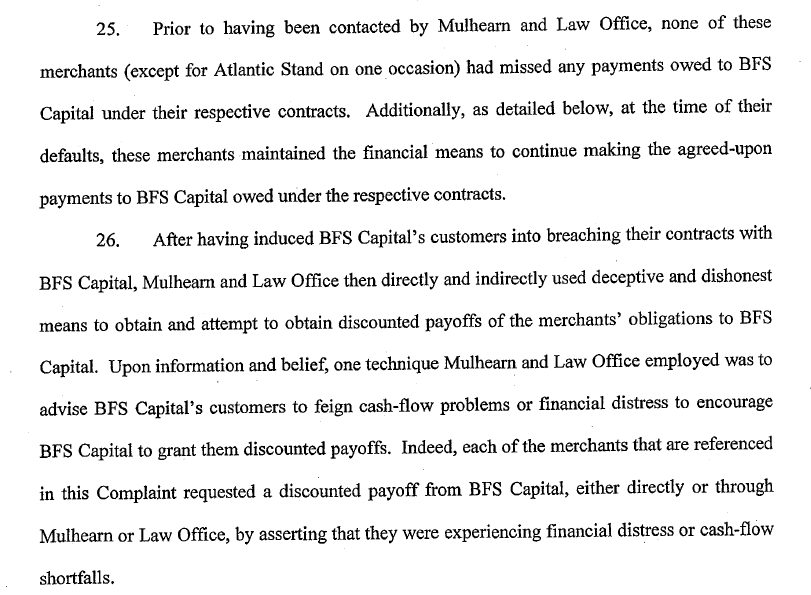
The defendants have not yet responded to the complaint. The suit is registered in Providence/Bristol County Superior Court of Rhode Island under case # PC-2018-0094.
Other such companies that have found themselves on the receiving end of a tortious interference lawsuit include MCA Helpline, Protection Legal Group, and Creditors Relief.
StreetShares Completes $23 Million Investment, Sticking With Their Plan
January 30, 2018 StreetShares, the small business lender focused on making loans to veteran-owned businesses, completed a $23 million series B funding round last week. The round was led by a $20 million investment from Rotunda Capital Partners, LLC, with an additional $3 million from existing investors, including Stoney Lonesome Group.
According to the company’s June 30th 2017 fiscal year-end financial statements, it only made 751 loans in a 12-month period. Other companies may make thousands in the same period.
However, this is because StreetShares approach to earning is different than most online lending companies. Rather than relying primarily on increasing the volume of loans to generate revenue, they also earn by co-investing in loans, according to Mark Rockefeller, CEO and Co-founder of the three and a half year-old Reston, VA-based company.
In an email, Rockefeller, who is himself a veteran, also conveyed that they have sought out VC equity investors who are patient and want them to issue high quality loans.
According to StreetShares’ June 30th fiscal year-end financial statements, the company’s revenues were $2,168,067 and its losses were $6,193,154. While this might be of concern to other companies, this isn’t alarming to Rockefeller. It’s part of the plan.
“Our patient approach means we’re not going to be profitable for a couple more years. But it also means we’ll still be here in 50 years.”
Default Judgment Against MCA Company Vacated
January 30, 2018A default judgment against a South Florida merchant cash advance company has been vacated, according to court records. 1st Global Capital fell victim to a mishap last November when they failed to a respond to a lawsuit defendant’s counterclaim of usury.
1st Global, who learned about it through a blog post, responded by filing a motion to set the judgment aside. On January 26th, however, the Court approved a settlement reached by both parties. A stipulation was that the judgment be vacated.
The case is now closed.
BlueVine doubles invoice financing credit lines to up to $5 million
January 30, 2018BlueVine also increases business line of credit to $200,000; opens New Jersey office
REDWOOD CITY, Calif. – January 30, 2018 – BlueVine has doubled the credit line size for its invoice factoring product to up to $5 million, underscoring the online business lender’s push to offer fast and flexible working capital financing to small and medium-sized businesses.
BlueVine also increased the limit for its business line of credit product to $200,000 from $150,000, making its Flex Credit product an even more attractive financing option for larger or fast-growing companies.
“In just four years, we’ve dramatically increased our invoice factoring credit line to $5 million, and our business line of credit to $200,000,” BlueVine CEO and founder Eyal Lifshitz said. “We continue to be fully committed to providing business owners with robust financing options to help them thrive.”
BlueVine helped Mindstar Aviation unlock capital trapped in unpaid invoices. The Virginia-based company, which develops and writes software for flight simulators, used to wrestle with cash flow gaps while waiting for customers to pay their bills, which often took 45 days or longer.
BlueVine allowed Mindstar to get cash advances on those invoices.
“Because we have BlueVine in place to make a purchase, we could proceed immediately,” said Johnny Johnson, the company’s executive vice president. “We don’t have to wait, which could impact a project timeline. BlueVine financing is easy. It’s quick. No hassle. BlueVine is not nickel-and-diming people, charging fees here and fees there. It’s really straightforward and easy to understand.”
A business line of credit from BlueVine enabled entrepreneur Jesse Urrutia, owner of MarketMe, a video production company in San Carlos, California, to take on bigger clients and grow his business.
“In the past, if I didn’t have cash to pay for a production, I would just turn down the project,” Urrutia said. “It’s ridiculous to turn business down because you don’t have the money. BlueVine fixed that for us.”
BlueVine also announced the opening of its new office in Jersey City, New Jersey, from where the company hopes to better serve customers and partners on the East Coast. Aside from its headquarters in Redwood City, BlueVine also has offices in New Orleans and Tel Aviv.
BlueVine revolutionized business lending with a highly automated, completely online invoice factoring platform that allows businesses to get advances on unpaid invoices.
In 2016, BlueVine introduced a 6-month business line of credit called Flex Credit based on weekly payments. The company introduced a 12-month line of credit based on monthly payments in 2017.
About BlueVine
BlueVine provides flexible working capital financing to small and medium-sized businesses, giving them quick access to funds needed to purchase inventory, cover expenses, or expand operations. A fintech pioneer, BlueVine developed a fully-online cloud-based platform for invoice factoring, revolutionizing the 4,000-year old financing system that allows businesses to receive cash advances on outstanding invoices. BlueVine also offers FlexCredit, business line of credit financing based on 6-month and 12-month payment terms. Based in Redwood City, Calif., BlueVine has raised $273 million in equity and debt funding and is funded by Lightspeed Venture Partners, 83NORTH, Correlation Ventures, Citi Ventures, Menlo Ventures, Rakuten Fintech Fund and other private investors.