
Story Series: broker
How Mike Rose and Fidelity Funding Group Charged Like a Rhino
August 31, 2026 “We teach our guys to be rhinos: wake up every day, brush your horns, charge after what your heart desires, and don’t take no for an answer,” said Mike Rose, CEO of Fidelity Funding Group, a revenue-based financing brokerage.
This past July, Fidelity funded $24 million. The achievement was announced on Instagram with a splashy graphic declaring a new record and crediting his team, the Rhino Army. Scroll through Rose’s page and you’ll see that the previous record had been set in June—and the record before that in May. The new records just keep coming.
“I have like a 40-page success guide that I give every employee when they start here,” Rose said. “The first seven pages don’t talk about cash advances. It doesn’t mention it. It’s the rhino mentality: how a rhino eats, how a rhino breathes, how a rhino talks, how a rhino conducts themselves, and that’s the culture we instill here in everybody.”
Rose attributes his obsession with rhinos to Rhinoceros Success, a 1980 book by Scott Alexander that argues the key to success is developing a rhinoceros mindset. Rose has become a true believer in the philosophy, and it has helped him grow and manage a sprawling brokerage empire spread across eight office locations.
“I spend about 80% of my time in the Wall, New Jersey office, but I bounce around to all of the locations,” Rose said. “I go down to Florida once every couple of months, I spend time in St. Pete, I spend time in the Plantation office, the three offices that are in Jersey, and the two that are in New York City: Brooklyn and Staten Island, I go to about once every two weeks.”
The system works for him, and there is demand to open even more locations, but Rose doesn’t want to get too far ahead of himself.
“I’m capping my growth because I have to control it and make sure that I give the guys the infrastructure and time they need with what I’m building,” Rose said.
Part of maintaining that control means delegating operational responsibility to a manager in each office, with those managers checking in with him every day. Each office specializes in traditional outbound sales, a job spent almost entirely on the phone. It’s a model Rose knows well. In a former life, he owned several AT&T authorized retail stores, and before that, he was cold-calling to sell phone plans when he was just 18 or 19 years old.
“AT&T wanted to go corporate, right? And they started getting rid of a lot of the authorized retailers, so they changed the commission structures,” Rose said.
That shift prompted Rose to explore other options in 2017, when he was introduced to the concept of merchant cash advance.
Rose ended up working at Universal Merchant Funding, where he learned the nuts and bolts of the business from the company’s CEO, Michael Genovese. He started in July 2017, got his feet wet by funding a few deals, and soon became so close with Genovese that Genovese and his wife attended Rose’s wedding that November.
“I would spend the night sitting in his back office there on Buel Avenue, talking with him about the business, just picking his brain, asking him questions,” Rose said. “and annoying him sometimes because I wanted to learn so much about it because I wanted to be good at what I do.”
Meanwhile, Rose, who rarely missed a day of work, had to leave the office on the afternoon of January 24, 2018, after snacking on a co-worker’s almonds and suffering a severe allergic reaction.
“I called Mike at like 6 o’clock, and he’s like, ‘Don’t worry about it, kid. I’ll see you tomorrow,'” Rose said.
An hour later, Michael Genovese and Carl Clark, a manager at the office, were killed in a double murder that sent shockwaves through Staten Island and the industry in which Rose worked. The perpetrator, who was later convicted, was a former employee and known ex-con whom Genovese had given a chance in an effort to help him turn his life around. He is now serving 30 years to life in prison.
While grieving the loss, Rose explored his options and eventually went to work for another Staten Island-based brokerage. There, he and a partner, Phil, had the opportunity to build an operation of their own out of the basement of a building.
“I think we funded $150,000 our first month, and we thought we were rock stars,” Rose said.
During that experience, he learned how every part of the brokerage business worked, including hiring, training, signing up with funders, submitting deals, cold calling, closing deals, and more.
“I’ve done every role that you could imagine for a broker shop,” Rose said.
The company grew, new locations opened, and financial success followed. Then that company also suffered a personal tragedy, and the situation changed.
“We had 30 people all looking to me and Phil for answers,” Rose said.
So Rose and his partner launched Fidelity Funding Group at the end of 2021. The team went with them.
They were very intentional about the name they chose.
“The definition of fidelity is a group of people or persons all supporting one cause and loyal to one cause,” he explained.
 Starting over again, still in Staten Island, Rose and the crew charged forward.
“And we just started funding, and we built up to $2 million a month to $4 million a month,” he shared.
Eventually, that range jumped to $5 million to $7 million a month. As the company continued hiring—and as it became increasingly apparent that many employees were enduring long commutes to Staten Island—Fidelity opened another office in New Jersey.
Their success attracted attention, and soon much smaller brokerages began reaching out about coming under Fidelity’s umbrella, recognizing the strength that can come with greater scale.
“When you start in this industry, the bigger companies don’t take you seriously…you have to be in business for two years at least to get signed up with these companies,” Rose explained. “And then if you don’t fund volume with them, they cut you off because it’s a waste of their time, energy, and resources.”
An important component of Fidelity’s process is that its brokers conduct their own merchant interviews before the full paperwork is submitted to any funders.
“I want to build a relationship with them. I want to see that they’re not just another name and number on a piece of paper, I’m not shot-gunning it to 10 places and praying for the best,” Rose said. “I also want to know what they’re doing with the money.”
Even in 2026, brokers across the industry continue to tell deBanked that personal human involvement remains a critical element of succeeding in the business. Rose explained the persistence of that phenomenon in the age of AI this way:
“…a lot of business owners want to be able to talk about their business and tell you what they’re doing. Their business is their baby. The same way Fidelity is my baby, and I will talk to anybody who will listen about it. I’ll talk to the guy at the car wash about my business. These business owners do the same thing. They spend more time with the business than they do with the family. They need somebody to talk to.”
These days, after reaching $24 million in funding in a single month, Rose remains heavily involved in the hiring and training process. During this interview, he sat beneath a large painting of a boxing rhinoceros poised in a fighting stance. Its belt reads “Born to Win.”
“There’s two types of animals in the world,” Rose said, referring to his favorite book’s philosophy. “There’s cows, which are lazy animals that eat the grass at their feet and take what the world gives them. That’s 99% of the world, and there’s nothing wrong with that… we teach our guys to be rhinos.”
An SMB Financing Brokerage Experiences Strong Growth in a Changing Digital Marketing Era
August 25, 2026 “You will really have trouble in the long term growing out an SMB financing brokerage if you don’t have a robust digital marketing strategy in place.” That’s what Zack Fiddle, co-founder and CEO of CapFront, told deBanked in early 2023, before the AI revolution swept across the internet. The company has kept up so well, in fact, that it recorded a three-year growth rate of 124%, landing it at No. 2,607 on the Inc. 5000 list in 2026.
“This year we’ve made a big push on strategic partnerships and affiliates for lead acquisition,” Fiddle told deBanked just this month. “If you do some quick Google searches or LLM searches for top business loans and top financing providers, you’ll find us on a lot of those rate comparison chart lists.”
Fiddle said that in previous years, CapFront hadn’t really delved into that style of marketing. More recently, however, the company has gotten into a rhythm of leaning on key relationships with a broader reach than CapFront has on its own—and has been leveraging them with considerable success.
“Obviously AI has come in, it’s really changed the landscape for digital marketing, especially in the SEO space,” he said.
Fiddle is not alone in that observation. Some of the larger online customer aggregators in finance, including publicly traded companies, have reported similar trends over the last 18 months, that traditional online search engines are not as dependable as they used to be.
“Diversification is always really important,” Fiddle said. “We have a number of different strategies beyond affiliate and partnership lead acquisition to try to find the most high quality and diverse leads, and that’s been a main focus for us this year.”
Along the way, they’re using every new technology available.
“Our Claude Cowork bill has definitely increased exponentially over the past few months, but I’ll just say this, I think that it’s allowed us to move significantly faster than we had in prior years,” he said.
For example, a major project initially expected to be completed by the end of the year accelerated to the point that it is now nearly finished.
“Things, are just moving a lot faster and if you have the right people and allocation of resources at your disposal, you can make things happen pretty quickly,” he said.
While there are numerous ways that “AI” is doing “cool and interesting” things at the company, Fiddle volunteered one of the more exotic use cases CapFront has begun rolling out.
“For the sales enablement’s part of it, we’re utilizing our VP of Sales Training’s mind as [a] sales coach.”
It is what it sounds like. They’ve essentially encapsulated a working replica of an employee’s mind into an AI chatbot that anyone at the company can interact with.
“I ran all sorts of tests on this myself and it’s just really cool to see, like I feel like I’m talking to this guy,” Fiddle asserted, as if such capabilities are simply to be expected these days.
The AI VP bot was given access to hundreds of thousands of the company’s sales call transcripts, with the real VP’s feedback and advice on those calls modeled into it. That’s the most basic way to describe it but it’s actually considerably more built out and complex.
“I’m able to do some mental exercises now and spit out some ideas that maybe a couple years ago I had in the back of my mind but I just knew they weren’t really in reach with what we had at our disposal,” Fiddle said. “But now it’s starting to get to the point where I feel like if I can imagine it, I could build it.”
For all the fanfare around technology, Fiddle acknowledges that one thing hasn’t changed: a business owner’s dependence on human interaction to help navigate financing options. CapFront can do everything in its power to make the process as efficient and user-friendly as possible, but there is still a personal side to it.
“You still want to be able to give them access to a human at the end of the day, because human relationships are what drive customer relationships, not self-servicing. I guess for some borrowers, maybe they like that, but I think in my experience, even this year in 2026, the majority of borrowers want to speak to a human.”
From the New Kids on the Block to #668 in the Country
August 21, 2026 “I work 100 hours a week. I’ve been doing that for four years and eight months, and my top sales guys work anywhere from 60 to 80 hours a week,” said Frankie DiAntonio, CEO of Lexington Capital Holdings, a small business finance brokerage headquarterd in Port Jefferson Station, Long Island.
It’s a grind that he literally dedicates seven days a week to.
“Every day. I do not miss a day. Even holidays, Christmas. I’m still here. I go see my family, but I make sure that I wake up earlier those days. I’ll be here from like five, six a.m. to like whenever…” he added.
DiAntonio recently turned 27 years old, and he calls the sacrifice—one of total dedication to success—an investment. To his credit, he already has something to show for the effort. His company just placed No. 668 on the 2026 Inc. 5000 list after recording a whopping three-year growth rate of 514%. He says he ended up being the second-youngest CEO to make the list.
The earliest mention of DiAntonio on deBanked was recorded in April of 2022, when his company had only been in business for three months and he was still almost completely new to the industry. In a quote he supplied at the time, he called Lexington Capital “the new kids on the block.” Now, with close to a hundred employees and a reputation for being one of the most in-demand brokerage partners in the business, the company can point to its system as a model that yields results.
“There’s like a Lexington way around here, and if you don’t kind of buy into what we’re doing around here, it’s kind of hard for you to succeed,” said DiAntonio. Most of the Lexonites who work there and have bought into the system are 20-somethings like DiAntonio. Part of that means they need to put in the effort to become great at a rapid pace, especially when much of their competition may have more than a decade’s head start in experience.
“The only way to shorten the gap of getting really good at sales very quickly is to work as many hours as humanly possible on your craft,” said DiAntonio. And so those around him go all-in and embrace a lifestyle that’s not always understood by their peers. Outsiders may see sales, long hours, and an industry that moves at lightning speed and subtly preach that they should prepare a backup plan if it doesn’t work out. DiAntonio says there is no backup plan. The plan is Lexington.
“As an entrepreneur, I don’t think that you can have a backup plan because I’ve noticed in life, and not even just my life, but others, that if you don’t have two feet in to do something, you won’t be successful,” said DiAntonio on this subject. “If you always have in the back of your mind that this might not work out, and have an exit plan, an exit strategy, I’ve seen that those people never really seem to work out.”
Less than a year ago, deBanked was invited to cover the ribbon-cutting ceremony for the company’s new 16,000-square-foot office, where some of the old hands who had been with DiAntonio from the beginning, along with new recruits, expressed an unbridled optimism about the work culture there. DiAntonio credited a number of his very first hires as integral to everything that has happened since inception.
“Those first few hires that you have are so key for the future trajectory of your company because they’re going to set the tone and the foundation and the culture for the rest of the company, like Corey [Digi], Ryan [Showe], and my sister [Nicollete DiAntonio] care so much that it makes everyone else care,” he said.
It’s worth mentioning that Corey was one of six finalists in deBanked’s Broker Battle in 2024, and Ryan won the entire competition in 2025.
But what’s the secret sauce to funding deals beyond long hours and company culture? When it comes to customer acquisition, they have “a good crossbreed of everything.”
“…cold outreach still works, paid ads still work, cold emailing still works,” he says, while adding that they spend about 20% of their profits trying out different things, including technological enhancements. Some of those efforts involve AI and are designed to move deals from their intake systems to funding with the appropriate partner in the shortest amount of time possible. When merchants find them through social media specifically, they tend to find them on Facebook, LinkedIn, and YouTube, in that order. But DiAntonio said Google still dominates the online channel for business owners seeking capital. It helps that when prospective customers find Lexington there, they also see a perfect 5-star rating aggregated from more than 1,100 reviews.
As for the plan from here, DiAntonio said the next milestone they hope to break is $100 million in annual revenue, and to eventually conduct an IPO within five years.
“We got a lot of eyes on us,” DiAntonio said. “There’s a lot of people who want to invest in Lexington at this moment in time.”
Customer Experience, Personalized Service Makes Small Business Finance Brokerage One of the Fastest Growing in the Nation
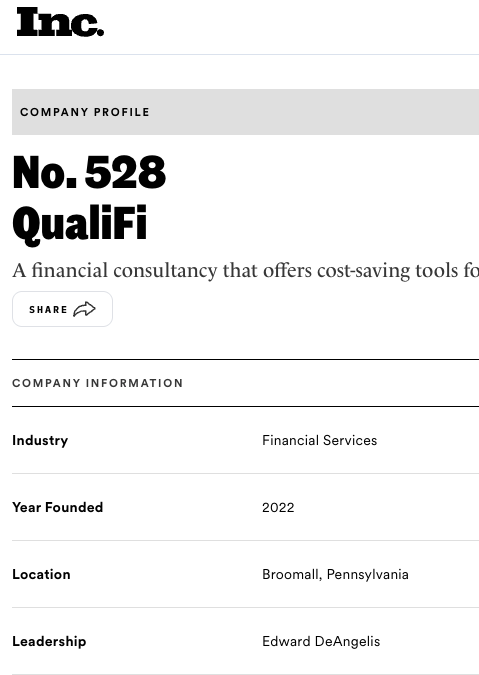
August 17, 2026 “I would say 90% of all of our interactions we send out a Zoom link, and we do a video call,” said Edward DeAngelis, CEO of QualiFi, “We call it our discovery call. It’s typically a 30 minute, very in depth discovery call with every one of our clients.”
In an era when hyper-growth has become increasingly dependent on automation and AI, QualiFi is finding opportunity by honing in on the human experience. That approach has helped the company generate 658% growth over the past three years and become the ninth-fastest-growing company in Pennsylvania. The Inc. 5000 also ranked QualiFi as the 528th fastest-growing company nationally and second overall among companies that would describe themselves as small business finance brokerages.
QualiFi invests heavily in technology as well, but uses it to make its processes better and more efficient rather than replace crucial elements such as customer service.
“Sometimes if you’re just on a phone call and the business owner’s busy, they got you in one ear and three employees in the other ear, and they might not be paying attention on some of our discovery calls,” DeAngelis said. “We have the CEO on the [Zoom] call. We have their CFO. They might have one of their operations managers. Sometimes we have Zoom calls with three or four members from the business owner’s company. So we feel like it’s much more personable.”
DeAngelis said the objective of the call is to understand clients’ needs and then set a path to meet them, whether immediately or further down the line. From there, the company uses whatever method of communication gets the job done.
 “We use all forms of communication after we have a relationship built, it could be a quick text if we just need something, an email, a phone call, there’s definitely several phone calls that happen throughout,” DeAngelis said.
Suffice it to say, Zoom alone has not led to QualiFi’s success. This past June, DeAngelis was on the big stage at Broker Fair, where he presented to hundreds of brokers in New York City about his company’s history and its journey toward 10xing a broker shop. There, he attributed the company’s success to ingredients including company culture, the client experience, proper hiring, onboarding, and training, among other things.
In a clip that circulated across social media from his presentation, DeAngelis said of culture, “It’s not about posters and ping pong tables.”
“Your team’s on the front lines. And if you really take care of your team, your team’s taking care of your clients, and it kind of snowballs if they feel good about their company, they feel good about their leaders, they’re going to feel good about their products and their services that they’re offering,” he told deBanked. “It just trickles down.”
DeAngelis largely credited his team for QualiFi’s Inc. 5000 placement as well. “I have to pass all the credit back to our team that’s in the trenches every day, our management team, our sales reps, our processing team,” he said.
About 60-65% of QualiFi clients’ first transactions are lines of credit. The company offers unsecured and secured financing, term loans, SBA loans, MCAs, and more.
DeAngelis and his business partner, Jason Maury, set out from the beginning to build a $100 million company. While they have not reached that milestone yet, QualiFi has already experienced tremendous growth.
“We’re going to continue every day, ‘1% better every day,’ that’s our motto,” DeAngelis said, “and we’re just going to try to do good in the world and continue to make everything a better place at QualiFi.”
Speed to Lead, Closing the Deal, and Running an ISO Shop
April 15, 2026 I sat down with Nicole Cruz, CEO of Redline Capital Inc, a brokerage based in in Secaucus, New Jersey. Cruz spilled some of the secret sauce, including what happened when she tried lead sources that her peers and competitors adamantly claimed weren’t good. Cruz started in the industry in 2018 and worked as a sales rep and ISO rep before trying her hand at starting her own company. One of the signature elements of their sales culture is the daily “power hours” they have. When I arrived on site, they were in the middle of one. She explains it all and more in our talk.
You can follow Cruz on her Instagram here.
While we’re posting some short video snippets across social media, you can listen to the full thing on Spotify while you’re on your commute.
Also, make sure you’re registered for Broker Fair, coming up on June 1 in New York City! Brokerfair.org.
Eddie DeAngelis to Speak at Broker Fair 2026
March 31, 2026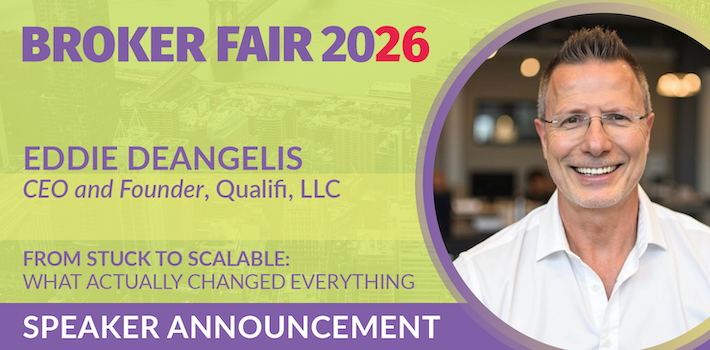
Eddie DeAngelis will be speaking at Broker Fair 2026 in New York City on June 1. DeAngelis owns a high-performing small business finance brokerage.
About QualiFi
QualiFi’s journey is just getting underway and will be extraordinary. We get to push the reset button one more time and apply what we’ve learned from our many successes and failures. Our current mission with QualiFi is two-fold, and we’re inspired to make it happen. We’re determined to take the hassle out of small business financing by building an accessible, affordable #1 client experience for business financing, one client at a time.
Sales Tips and Closing MCA Deals With Sam Kaye on the deBanked Podcast
March 18, 2026If you’ve seen some clips on Instagram between myself and Sam Kaye on how to sell an MCA on the phone, they come from a much wider two hour conversation/interview where we talked exclusively about selling deals. Kaye trains sales floors in the industry. In this podcast, Kaye gets very specific on how to sell and I open it up by mentioning that if salespeople are going to apply certain strategies, it has to be the same strategies that their bosses want them to apply. I call it alignment. Then we get into the weeds and he shares his ways of doing everything. Embed below and Spotify link here.
If you just want the short clips, we’ll continue to post them in little sound bites, but if you’re in the car or going for a 2-hour walk, this is the full audio.
How a Mother-Daughter Broker Shop Persevered and is Positioned for Growth
January 15, 2026Sharpe Capital facilitated nearly $5 million in funding to small businesses across the United States in 2025. Next year, they hope to double it. What makes the company unique is that it operates as a mother-daughter team, one of the very few in the industry to be structured that way. But how Wendy Rivera and her mother, Sonia Alvelo, got there is a story of circumstances and perseverance.
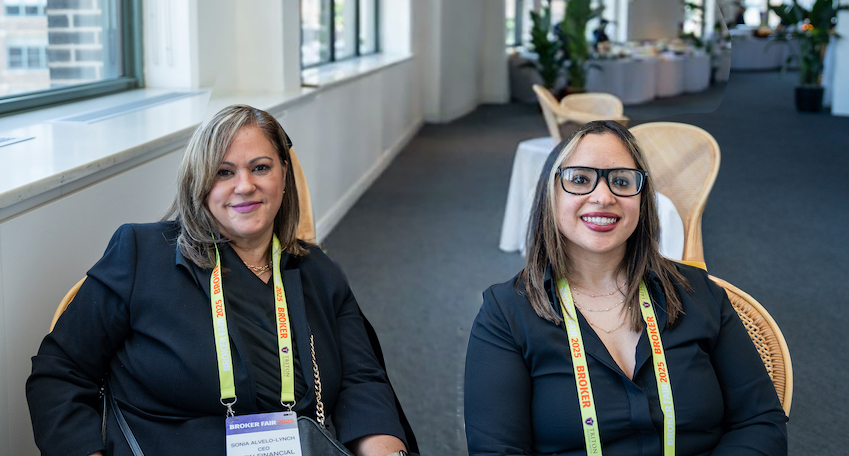
Alvelo is a known entrepreneur in the space through her own small business finance brokerage Latin Financial, but technically she was also associated with another brokerage at the same time, Sharpe Capital. Her business partner and life partner, Brendan Lynch, co-founded Sharpe with her more than a decade ago, but Lynch primarily ran Sharpe while Alvelo ran Latin, sister companies of sorts but with separate operations. The two celebrated a grand opening of a big joint office in Wethersfield, CT in 2022, which was attended by deBanked and a slate of local politicians. The Sharpe team wore green shirts and the Latin team wore blue.
Sadly, Lynch passed away in December 2024 from cancer at only 45 years old, but not before he could finally tie the knot with Alvelo, making her known as Alvelo-Lynch once and for all. Lynch’s last interview with deBanked happened four months before he passed and one of his final messages he had hoped to get out through us was a reminder for people to remember to take care of their health.
In the challenging time afterward, Alvelo took the reins of Sharpe and eventually her daughter, Wendy Rivera, emerged as a key reason the company continues to be successful.
Rivera, Connecticut-born and raised, had originally been working in retail when she became curious about her mother’s and Lynch’s business in 2018. When working for them became a possible next step for Rivera, they didn’t give in to nepotism and made her interview as a candidate just like anyone else. But she turned it around on them.
“They would tell you that I interviewed them in regards to what the company was and everything like that, but I asked the right questions,” Rivera told deBanked. “Everything was moving smoothly, and I decided to move forward.”
It started off as a part-time gig and eventually became full-time. Her role was to bring in deals and work closely under the tutelage of Lynch, who had a natural knack for connecting with people, particularly small business owners.
“They had a special place for him in their hearts,” Rivera said. “Brendan has taught me so much. He pretty much taught me this industry. I’ve worked with him side by side for the past seven-plus years.”
Rivera obviously learned from her mother as well, but Alvelo’s typical Latin Financial client was primarily from within the Spanish-speaking community while Sharpe’s was much more broad. To give some perspective on that, Alvelo, for example, says that today 80% of her entire Latin Financial customer base resides in Puerto Rico.
So Rivera spent her time on Sharpe and now she’s the primary person responsible for its operations. In what was a transitional year fraught with grief and challenges, the two revamped everything to focus on efficiency. Now they’re finally getting back to thinking about how to expand.
Along the way, Rivera realized that relationships in this business have a tremendous impact and can serve as its own form of marketing.
“Honestly, what’s been working for us is word of mouth,” Rivera said when it comes to acquiring customers. “Really. It sounds very old school but it really works. Once you take care of one merchant, they’ll tell their friends or whoever the case may be, and then they’ll reach out to us, and it just keeps growing that way.”
But those referrals wouldn’t come if they didn’t have the right funders in place to help them out. That means they have to know and trust who they are doing business with on the other side. Coincidentally, attending deBanked events, which Rivera has done, has been an eye-opening experience for her in getting to see who they are working with.

“I feel like once you actually meet the person, I don’t even think a phone call will do enough, you get a feel for what kind of person they are, and if they are in the industry for the right reasons,” Rivera said.
And in all those meetings, another thing she’s realized is that being part of a purely mother-daughter team is unique even within the family business segment of the industry which tends to lean toward father-son. But the two talk business just like any other shop: during work, after work, even during dinner they talk about deals.
Though it’s been a lot and Rivera says she’s overdue for a vacation, she says it’s a job she really enjoys.
“If you love numbers, if you love people, if you love helping people, I think it’s definitely a great position to be in,” Rivera said of working in the industry. “But you have to also be in love with the job as well. Because if you’re not in love with it, there’s going to be a lot of things that’ll hold you back.”
The motivation now is just to pick back up and have an even bigger 2026.
“Brendan and my mom had different ways of running their companies, Sharpe and Latin Financial, and so I feel like [Brendan] kind of taught me his kind of ways for Sharpe Capital and also maybe leaving an open door for opportunities down the road as well,” Rivera said. “And now that I’m in that spot, I can see that.”