Business Lending
Shopify Continues to Grow its Merchant Funding Business
May 8, 2025“We continue to grow our capital business and have recently introduced several product innovations that give merchants more choice for how they manage their loans, and how they choose among various loan options,” said Jeff Hoffmeister, CFO of Shopify during the Q1 earnings call.
The company had ~$1.4B in business loan & merchant cash advance receivables on its balance sheet as of March 31, 2025. It purchased & originated $805M worth of business loans in Q1, putting it on pace to surpass the $3B total for all of 2024.
“Shopify Capital is a financing program that offers merchant cash advances and loans to eligible businesses based on the store’s location, history, use and interaction with the Shopify platform,” the company states. It is offered in the US, Australia, Canada, and the UK.
NerdWallet Q1: Small Business Loan Originations Down, AI Agents Are Referring Them Business
May 7, 2025Small business loan originations were down for NerdWallet in Q1 “as underwriting remained tight and trade policy uncertainty dampened demand.” This is not a new development at the company as it has been publicizing a similar sentiment for some time.
The biggest takeaways from NerdWallet’s regular reports, however, are how the company, long reliant on organic Google search listings for much of its online traffic, is weathering the transition from the online search-ranking era to the AI answer-agent era. Analysts have been asking NerdWallet CEO Tim Chen to weigh in on what they’re seeing and how it’s going. Now, in this latest quarter, Chen says that AI actually appears to be referring them business so far.
“I think as we think ahead to channels beyond Google search, for example, I’d say top of mind for us is the factors that have historically driven success in areas like Google Search seem to be carrying over to other AI driven search engines. So it’s early days here, but compared to our competitive set, NerdWallet receives a really high share of referral traffic from AI sources. So I think big picture, the way I think about it is AI, at its best, helps you find a great answer quickly without a bunch of effort or spam. And areas with simple answers, AI is gonna meet that user need really well.”
– Tim Chen, CEO, NerdWallet
deBanked independently prompted both Grok-3 and ChatGPT-4o to make recommendations to shop for a small business loan and both recommended Fundera among its top answers. Fundera was acquired by NerdWallet in 2020. ChatGPT-4o put Fundera in its top 2 and Grok-3 put them in its top 3. AI-agents are becoming more memory-based and personalized so this experiment may produce different results for others.
On search rankings specifically, NerdWallet’s Chen said that it had taken a bit of a haircut for them over the past year, in part because even search engines are also now delivering AI-based answers at the top of the results.
AI is permeating so much that the transcript of the earnings call that deBanked relied upon for this writeup was also prepared and published by AI.
Square Originated $1.59B in Business Loans in Q1
May 2, 2025Square Loans, a subsidiary of Block, originated $1.59B in business loans in Q1, according to the company’s latest earnings report. Despite being the largest online small business lender that deBanked tracks, the company spent most of the quarterly call talking about its new consumer lending product, Cash App Borrow.
Square’s Q1 business loan figures puts them on pace to exceed their total volume in 2024, when they hit $5.7B. The subject of tariffs did not arise on the earnings call at all and Block had an overall positive quarter with $190M in net income.
Enova: SMB Loan Demand and Performance Remains Normal
April 29, 2025Enova originated $1.2B in small business loans in Q1, a 27% increase year-over-year.
Despite noise in the media about economic disruptions, Enova CEO David Fisher said during the earnings call that “We are monitoring both demand and portfolio performance even more closely than normal and continue to see the level of demand we would expect while payment performance remains in line or better than our expectations.”
When asked if the company saw a spike in applications in relation to businesses possibly stocking up on inventory ahead of the new tariff policy, Fisher said they hadn’t seen any spike and that demand has mainly tracked typical seasonal patterns.
The company emphasized more than once that if anything were to change, the quick duration of its small business loans would allow it to react and make adjustments very quickly. As always, Enova reiterated that it does not have much competition in the market, hadn’t seen any new competitive threats in the first quarter, and doesn’t expect to see any changes on the competitive side for the rest of the year.
PayPal’s Business Loan Biz: ‘Looks Pretty Steady Right Now’
April 29, 2025During the Q1 earnings call, PayPal was asked about the state of its business loan and working capital business given the potential disruptions with tariffs and the economy.
“…when you look at just general consumer health, coming into what could be a more uncertain time, is looking pretty healthy and pretty good,” said PayPal CFO Jamie Miller. “And then with respect to SMB, good continued consistent performance there too. And on the merchant lending side, as we monitor that, honestly pretty consistent with what I’d say about consumer charge offs also improving. And obviously we’re monitoring the whole thing very, very carefully, but it looks, looks pretty steady right now.”
Later, an analyst asked the management team: “I’m just wondering if you’ve made any changes to underwriting, or how you would think about changes to underwriting in the face of merchants facing kind of cash flow strains on the back of sort of supply chain dynamics, tariffs specifically, and if you guys have any way of sort of dimensionalizing like what sort of cash flow strains your merchants may experience if tariffs do go into effect in terms of things like importing, importing inventory and things of that nature?”
That yielded this reply from Miller:
“I think it’s difficult to answer the latter part of your question, but if we go back to the merchant lending part of it, this is a portfolio that is actively managed, and it’s something that a year ago when [——] came in and really reconstituted the team, they’re very focused on how we can help our small businesses really navigate growth. And so the portfolio has a couple of different things in it. One is just really helping small businesses with working capital and inventory buy and we monitor that and underwrite it, you know, with an eye towards credit, towards cash flow. And when you look at this, these are things where we’ve got cash sweeps with sales as sales come in. It’s just a very well constructed portfolio from both an underwriting and from a risk management perspective. And the other side of it is PayPal Business Loans, which are cash flow based, they’re typically personally guaranteed. And again, these are things that we monitor, all the different indicators of the portfolio, and we adjust as we go. I mean we did make some adjustments in March to tweak and fine tune and make our underwriting slightly more conservative, but it’s something the team is all over. And I think we can react very quickly in a changing environment.”
Going All In: How Joe Sasson Saw the Opportunity of Being a Broker Early On
April 7, 2025 “For me, the biggest approach to the industry that I took was honoring integrity and transparency to our clients more than anything else.” That’s what Joe Sasson, Chief Sales Officer at Advance Funds Network (AFN), attributes his success to in the small business finance industry. Sasson saw the vision and the potential of this business at a younger age than most of his peers. That’s because he started as a summer intern for AFN right before his freshman year of college at George Washington University, when he was only 18.
“I said I could use some money, obviously, going into school being a freshman, so why not?” Sasson explained. “And then I really enjoyed it that summer. I kind of discovered that sales is kind of a knack for me, and correlates well with the way I like to operate, the way I like to do things. So it kind of just stuck with me.”
The company had a mutually good feeling about his abilities, and they agreed to extend the arrangement, which consisted mostly of making sales calls, even while he was in school. By the time summer rolled around again, they handed him the reins for the entire internship program. The student was now the teacher for 20-25 eager high school juniors and seniors hoping to learn the ropes, an experience he recalls fondly. That was in 2019, and its impact is still felt today since some of those interns are still with AFN. But it was a crossroads for Sasson because his college curriculum required him to be in Washington, D.C., but AFN’s office was in New York. Ultimately, he said his eyes had been opened to the opportunity.
“I saw that our company really had the right values and the right approach to the way we do things,” Sasson said. “Thank G-d I was I was able to kind of recognize that early and that I was working with really good people.”
Sasson transferred to Baruch in New York, a school much closer to AFN. It was a move that paid off since he’s risen up to become part of the C-suite. His day-to-day is managing new business, overseeing dozens of agents, and helping them out wherever he can. That means at any given moment he could be giving advice, helping an agent finish a deal, or on the phone with a lender. Knowing a lender’s box is only part of it, as he says that relationships play an important role in AFN’s success.
Last year, when AFN’s Chief Revenue Officer, Irving Betesh, had earned a spot as one of six finalists to compete in the live inaugural Broker Battle at deBanked CONNECT Miami, it was Sasson who roleplayed with him to practice beforehand, which they did in front of the whole company as both a teaching experience and entertainment. As fate would have it, the roles reversed because it was Sasson himself who ended up on stage in person for Broker Battle 2 this past February, where he secured the runner-up position in a strong matchup after he made it to the championship.
Roleplaying and practice are important at AFN. Sasson said that the company is really good at training new talent, regularly conducts fun motivational contests, and even hosts an annual retreat to get the team out of the office and away from the grind, though sometimes they find themselves having to handle a deal or two on the beach, an unavoidable part of the business even though they definitely try to wind down.
As someone who’s been in the business since before the Covid era, he’s seen a remarkable amount of change. In his opinion, less expensive options, more creative options, and quicker options are now more widely available than when he started. That means he and others have to constantly stay on top of what’s changing and be able to deliver to their clients. That also means knowing what all their lenders are doing, staying on top of AI, monitoring the tariff situation, and more.
Through it all, doing good business with good people seems to be a recurring theme, whether that be the internal team or partners they work with.
“I’ve been doing this for a while now, quite well,” Sasson said. “And I would say, since I started seven years ago, we do a lot of business with a lot of the same people still. So for us, the relationships really do matter more than anything else.”
PayPal Exceeds $30B in Business Loans and Merchant Cash Advances
March 26, 2025 PayPal has officially crossed $30B in merchant cash advance and business loan originations, the company announced.
“Access to capital is consistently one of the top challenges small businesses face as they look to maintain and scale their businesses,” shared Michelle Gill, EVP and GM of SMB and Financial Services at PayPal in an official release. “Traditional business loans are not only difficult to secure for small businesses, but the application process can be challenging and prohibitively time consuming. PayPal’s financing solutions have a streamlined online application process with no lengthy paperwork or extensive credit checks, and approved PayPal loans are funded within minutes. We launched PayPal Working Capital and PayPal Business Loan to serve this important need, and to provide a quick and responsible way to inject much needed capital to help fuel small business growth.”
PayPal had pulled back significantly on originations for a while as can be seen here but ramped back up last fall. For example, PayPal said that global originations had surpassed $25.6B at the end of Q2 2022 across a total of 1.3 million transactions. That means it has added roughly $5B in originations across 100,000 transactions in the span of almost 3 years since they now report 1.4 million total.
“Small businesses have seen tremendous value in PayPal Working Capital and PayPal Business Loan, as both offerings continue to receive remarkable feedback from customers,” the company said. “Additionally, both offerings have achieved Net Promoter Scores of 76 and 85 respectively and our customers renew loans or access our offerings on a repeat basis more than 90% of the time. Businesses also experience an increase in their total PayPal payment volume by 36% after adopting PayPal Working Capital and 16% after taking a PayPal Business Loan.”
How AI is Scaling a Veteran Small Business Financing Brokerage to New Heights
March 19, 2025 “There are [AI] voice systems out there that have just blown me away,” said Cheryl Tibbs, owner of Atlanta-based Commercial Capital Connect. “So we are using those and I’m implementing some in my office in my day to day—we have an AI receptionist that answers the phone, it just frees up time.”
As a broker, Tibbs recognizes the value of being able to answer a potential client anytime, anywhere, but there needs to be time to sleep, train others, and expand as well. And thanks to the advent of actual AI, it’s now become increasingly possible to scale on multiple fronts where it wasn’t before. Tibbs told deBanked that she’s been using AI to duplicate herself across anything she can.
“So we train these models on everything about our business, everything about us, and it can just answer questions, either through chat or having a conversation,” she said.
AI can call leads or qualify a customer through online chat at three in the morning if need be—not theoretically; it’s doing it for her already.
“Some mornings I wake up, I see full conversations between the conversational AI and somebody that filled out a lead form,” she said. “The chat agent has the ability to send them a text message with our full application link, or book them on our calendar.”
But more customers coming in the door means more questions from her team about where to place a deal. She’s got a solution for that, a bot she created named BrokerBuddy that can answer on her behalf when she’s not available to do it herself.
“I trained it on most of the lender guidelines that we work with, so they can just go in and just type a question, you know, ‘hey, BrokerBuddy, I’ve got a customer with a 680 FICO score.’ He says, ‘two years time in business, looking to buy a $40,000 skid steer. What else should I ask him? Which lender in our organization do you think will do this deal?'”
There’s a role for AI to just skip the questions and place a deal all by itself using advanced algorithms, something many tech companies tout these days, but the human nuance is a key component to her service, since any deal could be equipment financing, SBA, or working capital rather than solely one thing. It’s not always immediately obvious which one it’s going to be or what the customer would prefer. Way back in the day, Tibbs started purely with MCAs, back when they could only be done via a credit card machine. Since then she added equipment financing, working capital loans, and SBAs. For a long time now, she’s offered it all. She pairs up customers with the best fit and relies on her knowledge and relationships to know what’s going to work and what’s not.
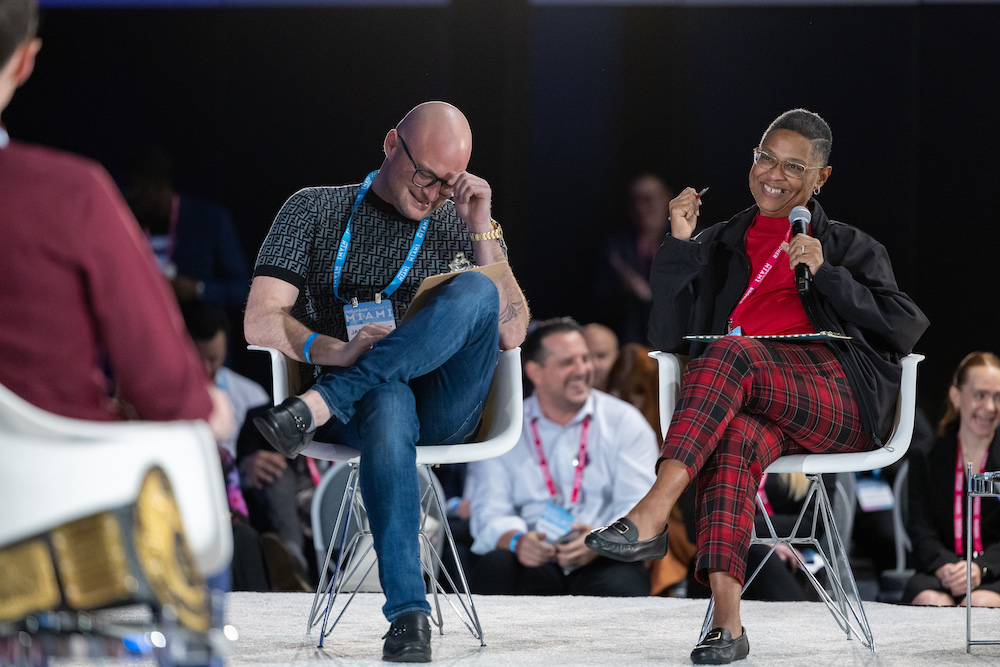
“SBA is a hot button right now and merchants are really excited to know that this is definitely a possibility,” Tibbs said.
One opportunity with SBAs in particular is to consolidate MCAs, which, if the business owners qualify, can have a tremendous impact. Sometimes these business owners find her by seeing her posts online, and they reach out. Maybe it’s her they’ll get right away, or maybe it’s her AI. In any case, all of her experience has long since led other brokers to refer their own business to her, since she has a reputation for being able to get the deals done.
“I’ve been operating as a super broker most of the 20 to 25 years that I’ve been in this alternative space,” she said, “and as a super broker, I’m able to offer my broker partners more stuff than they even thought about. […] I study this stuff. I eat, live, and breathe it.”
While it’s unclear if AI qualifies as alive, her band of automated agents are beginning to breathe the rush of it all right alongside her. So many brokers (and lenders) are diversifying their product sets that her referral business is escalating, and she wouldn’t be able to scale without the assistance.
“Even though we get appointments, if we’re not on the phone with that merchant usually within three to five minutes, sometimes it’s hard to get them back on the phone. And even if they make an appointment, they may not show up. Having that instant engagement it definitely helps.”