Business Lending
The Small Business Finance Industry is BACK
June 21, 2021 The industry is back. I say this while sitting in a Miami hotel, my third such trip to Florida since becoming fully vaccinated against Covid in May.
There’s a lot of action going on. I’ve sat down in multiple broker shops in both New York and Florida and the phones are ringing off the hook.
The demographic of the average customer in the post-covid recovery seems to vary. Some say the credit quality has gotten better, others have said it’s worse. Some merchants have become used to forgiveable loans and low APR financing while others appear willing to take capital at any price just to keep up with the pace of their growth. It’s one of those things where everyone is just trying to adjust to the new normal, even if there’s little consensus as to what that is.
In New York City, the return of packed bars and overflowing restaurants stands in stark contrast to the rows of abandoned stores and For Lease signs that dot the landscapes around them. And yet if one looks past all that, the only reminder that Covid was ever even there is the requirement that one still wear a mask on the subway even if they’re vaccinated.
In Florida, it’s the opposite. I recently got yelled at by a bus driver for wearing a mask in the first place.
The broker shops I’ve visited still had office space that were filled with teams that were more than happy to be occupying them in person. But at the same time, the industry has become extremely popular with the traditional work-from-home crowd.
Leo Kanell’s 7-day marathon challenge on facebook draws in more eager industry participants than I would’ve ever thought possible, an accomplishment I know to be true because I dropped in on him unannounced late one friday night while he was live.
Similarly, Oz Konar, who I did a livestream interview with in person, has trained more than 3,000 brokers in the industry, many who work for themselves from home.
We’ve also been very busy in the last couple months and have met a lot of brand new entrants on both the funding and broker side.
All this activity is setting the stage well for Broker Fair 2021 on December 6 in New York City. It is perfectly timed to discuss the new disclosure law that goes into effect in New York on Jan 1, 2022, one that is so consequential that at least one company has relocated to New Jersey.
What a time to be in the industry!
Mexican Small Business Lender Buys a Bank, Eyes United States
June 18, 2021 Change is happening south of the border. Online lenders and alternative funders are growing across Mexico much the same way as elsewhere. This week, Credijusto, an online small business lender based in Mexico City, acquired Banco Finterra, marking the first time that a fintech has acquired a bank in the country.
According to Reuters, “Credijusto aims to ramp up services for Mexican companies that sell to the United States, and build a business for U.S. companies that do cross-border trade in Mexico and beyond in Latin America.”
Mexico also has more than 6 million small businesses, a market that is effecively 4-6x larger than Canada’s.
Prior to this, Credijusto had already collectively raised $400M from Goldman Sachs, Credit Suisse, Point72 Ventures, New Residential Investment Corp., Kaszek, QED Investors, John Mack, Ignia, Promecap and LIV Capital.
“The acquisition of Banco Finterra seeks to create the first truly digital banking platform for Mexican companies in the future,” commented Allan Apoj, co-CEO of Credijusto. “This transaction marks an important milestone in Mexico and the region, and we are proud to be revolutionizing the future of banking in Latin America.”
Apoj’s partner, co-CEO David Poritz, hinted to Reuters that in a couple of years it may consider the acquisition of an American bank as well.
Earlier this year, Mexico began to allow fintech companies to obtain a Financial Technology Institution license.
Estamos muy orgullosos de revolucionar el futuro de la banca en México con la adquisición de Banco Finterra y de beneficiar así a las empresas a través de productos financieros de nueva generación. Conoce más de este gran logro: https://t.co/pbGBVyo04p pic.twitter.com/A32vaHDOB1
— Credijusto (@credijusto) June 15, 2021
Thrasio Acquires Yardline to Offer E-Commerce Funding
June 16, 2021 Amazon merchant conglomerate Thrasio bought Yardline to incorporate e-commerce finance into the product offering. Thrasio has been active with Yardline since the firm’s initial backing of the company, and is now making Yardline a wholly owned subsidiary.
Yardline Chief Revenue Officer Seth Broman said that historically, e-commerce has been risky with no barrier to entry like traditional brick and mortar shops. Broman added that online stores used to be for supplements, but through Amazon’s third-party marketplace and Shopify’s help, scaling a quality business has become possible.
“Through COVID, the script was flipped,” Broman wrote in a statement. “E-commerce businesses became less risky, and brick-and-mortar businesses suffered the most. It’s also a much smaller universe and harder to target than a brick-and-mortar business.”
Thrasio boasts it is the largest acquirer of Amazon brands globally, and co-founder and co-CEO Carlos Cashman said 40% of brands they approach end up selling. Now, they can help scale those brands.
“Yardline will be an asset in creating more opportunities for these entrepreneurs and offering more sophisticated avenues for growth,” Cashman said in a statement. “They’ve been doing something different in the space—their strategic approach to providing embedded capital across e-commerce marketplaces is unique—and we’re eager to have their technology and proficiency on our team.”
Tomo Matsuo, president of Yardline, will be joining Thrasio’s senior leadership team. “It’s conceivable that every eCommerce-related platform will have FinTech capabilities in the future,” he said in a statement. “And our acquisition by Thrasio demonstrates that.”
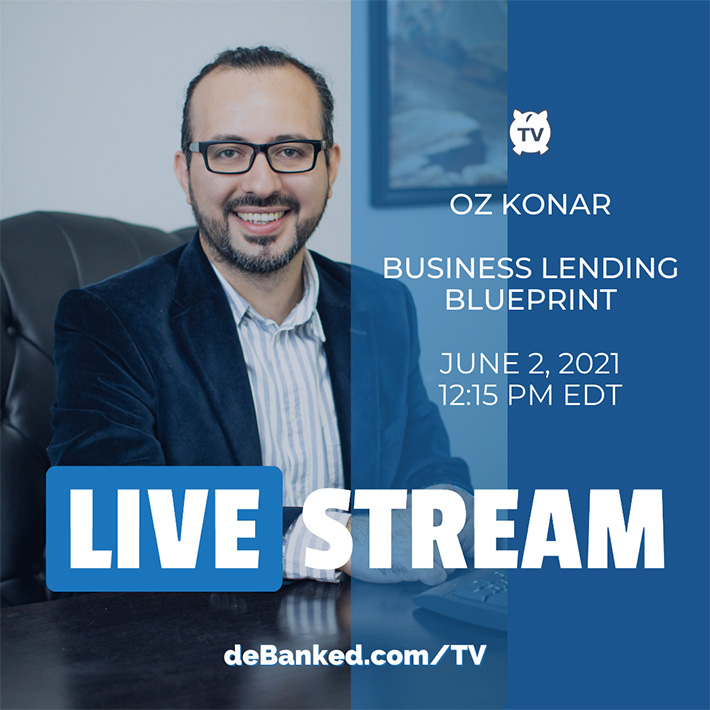
Live Stream With Oz Konar
June 2, 2021I will be speaking with Oz Konar, the founder of Business Lending Blueprint, at 12:15pm ET on deBanked TV.
Konar teaches people how to build successful home-based businesses in the alternative finance industry and has a highly popular youtube channel.
Tune in at 12:15 on deBanked TV.
After Funding Millions, Alt Financier Hosts Funding CEO Challenge
May 25, 2021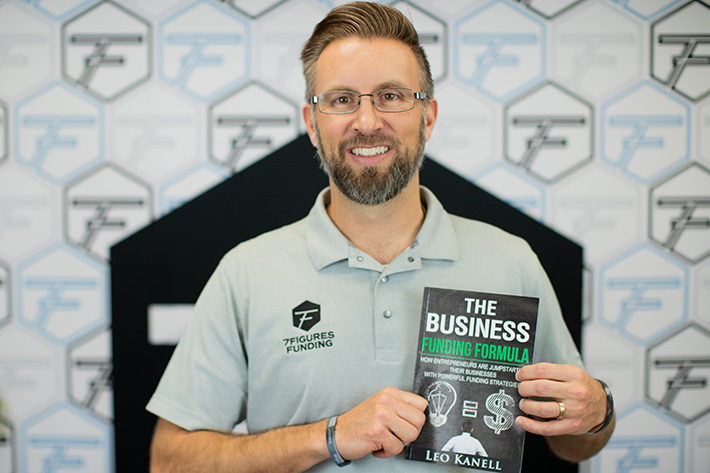 Leo Kanell, a funder from Utah, runs the 7 Day Funding CEO Challenge, a seven-day marathon video livestream of inspirational and educational funding content.
“So how [the challenge works] is basically, we’re looking for communities, and we’re building a community,” Kanell said. “Our focus is how can we help existing loan brokers, and then how can we help people who are looking for an additional stream of income that they can do from home obviously with the pandemic.”
All the action happens in a livestream on Facebook.
“Everybody kept asking ‘we need some training,’ so we built out a custom website for them so that they can build their funding empire from home,” Kanell said.
Many of the brand new market entrants are sales-minded individuals that are interested in working from home. Kanell has a sales mind and a small business funding background. He grew up in a family of nine from a small town in Utah with a population of only 3,000. He knew he would be a salesman when he turned a summer painting business internship into a $60,000 operation. After college, he tried his hand at real estate, but after 2008 he started looking for another industry.
“I started and went ‘Well, I’m gonna need money for that business,'” Kanell said. “I started looking at the different options to get financing for that next business venture, and it was very difficult, especially for a new business, especially if you’re a pre-revenue business or you don’t have a lot of sales and or collateral.”
He realized SMB funding was the business he should be getting into so he jumped in with both feet. From there he veered into a business education program alongside products like business credit cards.
He soon said that he was doing well, but he heard the funding industry calling his name. “Everything pulled me back into funding,” Kanell said and he decided to combine his education system toward loan broker training programs. He said many brokers don’t realize startups and pre-revenue bushiness can qualify for 0% for up to 15 months.
Now, Kanell hosts an industry podcast that features financial industry guests, and alongside funding, he looks forward to building a community of broker and funder education services.
“We’re going to not only get you the best funding guaranteed, but we’re going to educate you and empower you along the way,” Kanell said. “They can work as direct funders and keep 100% of the commission, and that if they want us to do the work you know, we can do splits.”
One on One With Joe Camberato at National Business Capital
May 23, 2021I sat down with Joe Camberato (@GrowByJoe), CEO of National Business Capital in Bohemia, NY. He shared tips about how to run a successful business and gave me a personal tour of his company’s office.
Ebay to Launch Sales-Based SMB Loans in UK
May 13, 2021 Ebay is launching a small business working capital product in the UK, offering sales-based loans to 300k SMBS through YouLend.
The product, called “Capital for eBay Business Sellers,” offers loans repaid through a percentage of daily sales and a lump sum. A year after eBay first ventured into offering merchant payments services, the firm is joining the likes of PayPal, Shopify, and Amazon by offering a business loan product. Loans will vary in size based on sales volumes, from £500 to £1 million, or about $640- $1.3M.
“Capital for eBay Business Sellers is intended to help plug this gap, giving small businesses quick access to a range of financing options,” Murray Lambell, GM of eBay UK, said. “With 300,000 UK small businesses trading on eBay, this proposition will help them reinvest, protect jobs, and succeed, even as the government’s support schemes dry up.”
The application process will take five to ten minutes, the firm attests, landing funds that same day.
“Our focus is on giving leading e-commerce platforms, tech companies, and payment service providers the ability to offer their customers rapid funding through our technology platform,” CCO of YouLend Jakob Pethick said. “We’re delighted to partner with eBay UK to support their business sellers thrive and grow.”
North Carolina Joins States Proposing Commercial Financing Disclosures
May 12, 2021 North Carolina is the latest in a series of states to introduce a commercial financing disclosure bill.
The “Small Business Truth in Financing Act” introduced on May 11th, would cover business loans, factoring, and merchant cash advances.
The language was copy and pasted from bills elsewhere, like the recent one in Connecticut. The “double dipping” term is noticeably absent from this one, however.
The North Carolina bill was introduced by Rep James D. Gailliard (D). If it succeeds in moving forward, it’s written to go into effect on May 1, 2022.