
Business Lending
Lender Or Broker – Do You Know Your Partner?
December 15, 2015I probed the audience here on deBanked a couple of times this year. Back in June 2015, I wanted to know if you knew what you were selling when it came to the merchant cash advance product? In October 2015, I wanted to know if you knew what you were buying when it came to leads versus data? So as we close out 2015 here in December, I wanted to probe the audience of deBanked once more, this time asking: do you know your partner?
THERE’S NO SLOW DOWN COMING (THE NEW ENTRANTS WILL CONTINUE TO RUSH IN)
I’ve been asked by individuals within the industry and those outside of it, on my opinion of when the mass rush of new entrants into the market will slow down. In my opinion, the Year of the Broker will not stop in 2015, but will continue into 2016 and most likely into 2017, when the chickens finally come home to roost for the new entrants, who mostly lack the leveraged networks needed to survive and thrive, and instead are relying on one or more of the following strategies which will no longer be efficient going forward:
- UCCs
- Aged Leads
- Random SIC listing calls
- Random Yellow page calls
- Parking your car down the street and randomly walking into merchant shops
- Stacking behind a 2nd position
 Those who are leveraged with quality strategic partnerships, networks and access to exclusive data records, will be the ones that control the market going forward, while others will fail to remain profitable in this ever changing, integrating and evolving marketplace that we all fight tooth and nail in.
But I must ask you if you know your Partner, as this mass new entrance of players have created many documented cases of brokers having deals stolen, back-doored, commissions not paid, renewal commissions cut-off, and other unscrupulous acts. The vast majority of these documented cases are coming from broker-to-broker relationships, with one broker submitting a file to another broker, but being totally unaware of the fact that they are not working with a “direct” funder or lender.
As we go forward through our changing marketplace, where profits will get tighter, strategic partnerships will be your driving competitive advantage and where access to merchants in general from a “cold-calling” perspective will get more restrictive, you just can no longer afford to be the victim of an unscrupulous act and lose commissions. As a result, going forward, you must indeed know your partner.
THE SEVEN
The following are the seven ways that one could participate in our space:
The Referral: They are not involved in the actual sales process at all, which includes selling rates, collecting paperwork, signatures, etc. All they do is refer a person’s name, telephone number and email address, and might collect an upfront referral fee for doing so. These are usually members of a strategic partnership such as a bank, credit union, credit card processor, accounting firm, insurance firm, etc.
The Sub-Broker: They work as a broker-to-a-broker, going out and doing all of the activity involved with the sales process and submitting the package to a broker, who will then submit it to a couple of funders to “close” the deal. They would then be paid a portion of the commission that the broker gets from the funder or lender once the deal funds, so if the broker gets 6 points, the sub-broker might get 2 or 3 points. Sometimes these individuals (sub-brokers) are willingly signing up for this arrangement, and sometimes they are unwillingly signing up by believing the broker is an actual direct funder or lender, when they are not. This leads to a majority of the issues I’ve identified such as having deals stolen, deals back-doored, commissions not paid, renewal commissions cut-off, and other unscrupulous acts.
The Broker: They go out and do all of the activity involved with the sales process and submit the package to a funder or lender, then manages certain aspects of the closing process such as getting additional signatures, questions answered, stips collected, etc. They would then be paid the commission they set on the deal by marking up the funder or lender’s buy-rate. So if the buy-rate is a 1.12 for a 6 month period, and they marked it up to 1.18, they would be paid 6 points on the deal.
The Syndicate: They would basically do everything a Broker would do, but for some deals they will put some of their own capital resources on the line through syndication, it might be their own equity sources or they might use debt sources such as those from credit card no interest promo deals. The syndication process just allows them to take more money home on the deal.
The Direct Funder/Lender: They have built their own underwriting platform and formulas to lend out either merchant cash advances and/or alternative business loans with a focus on a certain level of profitability and to maintain a certain default rate threshold.
The All-In-One: This is a firm that basically is structured as a direct funder/lender, but they also broker out some deals and on those deals that are brokered out, some of them include the firm syndicating to increase their take home revenue on the deal in particular.
The Investor: This is an equity or debt source that invests capital into a direct funder/lender’s underwriting platform and formula, seeking to capitalize on the high profits that result from a merchant successfully paying back either a merchant cash advance or an alternative business loan.
KNOW A DIRECT FUNDER/LENDER WHEN YOU SEE ONE
When I first started reselling the merchant cash advance and alternative business loan products in late 2009, I noticed that one of the ways to differentiate yourself in the market was to say that you were a “direct funder”, apparently the mentality was that merchants only wanted to talk to the people who could actually do the lending.
Well, I preferred to just admit upfront to merchants that I was a broker, but just explain that the industry is complicated in terms of the pricing models that are present. If you qualify for A+ Paper pricing, you want to make sure you are submitting your package to an A+ Paper lender, otherwise, you might be a merchant with a 700 FICO, clean banks, no liens, and other A+ Paper like qualifications, but might be submitting your package to a funder that will only spit out 6 month offers at 1.35 factor rates. So if you are seeking to work with a direct funder/lender (even if they also syndicate or broker on the side), you just have to know one when you see one, by using some of the following rules of thumb:
- Licensure: Look for some type of state licensure or registration. You can usually find this out by asking the firm their corporate legal name and research this in the state database of where they are incorporated or other states of where they do business.
- Track Record: Look for a proven track record, which means they should have funded at least $10 million in volume and have in business at least 12 – 24 months.
- Fully Staffed: Look for a full office staff, by the firm being very small, this is how your deals end up getting lost, stolen, or the underwriting process drags on for seemingly forever.
- Online Identity: Look for a professionally designed website with a business email address. In addition, look for some type of online press release about the shop opening, a media interview, or news release about an equity or debt financing round. Look up the principals on LinkedIn, and the company should come up on Google as well as other online directory listings including the Better Business Bureau. If you can’t find anything about the company or the principals online in some sort of professional listing and/or publicity based format, I would move on.
THE FINAL WORD
I don’t think there’s a worse feeling one can have, to have gone through the process of spending money to generate a qualified lead, to “close” that lead by getting them to send you an application package, and then to submit the package to your supposed “funder”, only to have the deal stolen and back-doored because your supposed “funder” was nothing but an unscrupulous broker the entire time.
Making sure you select good partners is vital to your survival on this battlefield called “alternative lending”, a battlefield that we fight, scratch, and claw on daily to feed ourselves, our families, and help make the lives of small business owners more efficient than before we got here.
CAN Capital: Beyond Hyperbole
December 11, 2015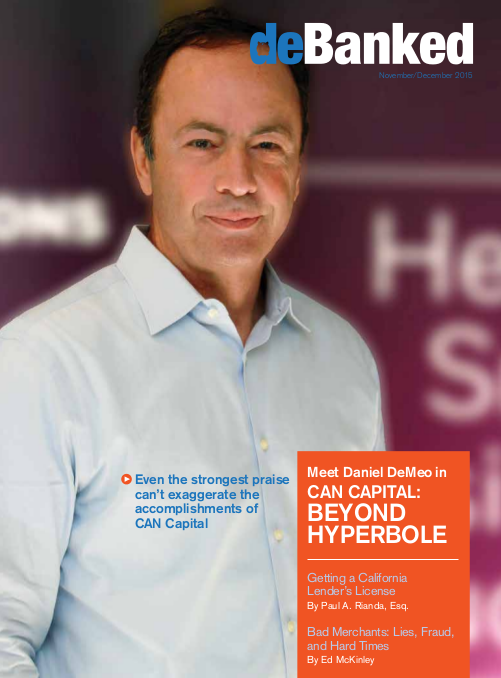 It’s usually risky to say “first,” “largest” or “best,” but CAN Capital invites those superlatives and more.
Asked whether the company’s the biggest in the alternative funding business, CEO Dan DeMeo hedges only a little with qualifiers like “might” or “probably” before proudly announcing that the company has provided access to more than $5.5 billion in working capital through 163,000 fundings to merchants operating in over 540 different kinds of businesses.
Glenn Goldman, the company’s CEO from 2001 to 2013 and now Credibly’s chief executive, doesn’t mince words about his former employer when he calls CAN Capital the biggest and most profitable small business alternative finance company in the U.S.
Cofounder and Chairman Gary Johnson proclaims without hesitation that CAN Capital was the first alternative small business finance company. His wife and cofounder, Barbara Johnson, came up with the idea of the Merchant Cash Advance in 1998 when she had trouble raising funds to promote her business, he said.
CAN Capital developed the first platform to split card receipts between the merchant and funder, and it gave birth to the idea of daily remittances, Johnson continued. Within a few years of its founding the company was turning a profit, another first in alternative finance, he claimed.
The innovation continued from there, according to Andrea L. Petro, executive vice president and division manager of Lender Finance, a division of Wells Fargo Capital Finance. She cited a couple of possible firsts she’s witnessed in her dealings with CAN Capital.
When CAN Capital received a loan from Wells Fargo in 2003, it may have been the first sizeable placement in the alternative finance industry by a major traditional financial institution, Petro said. In 2010, CAN Capital was among the first alternative funders to offer direct loans, she noted.
Petro stopped short of characterizing CAN Capital as the best in the alternative finance business, but she praised the company’s management and lauded its systems for underwriting and monitoring funding. “They continually upgrade their systems, upgrade their software, upgrade their people,” she said.
Calling CAN Capital one of the best comes naturally to Kevin Efrusy, a partner at Accel Partners and a CAN Capital board member. Accel saw opportunity in alternative finance because banks were reluctant to lend at the same time that an explosion of data on small businesses was informing the underwriting process. When Accel sought a position in the industry, it contacted CAN Capital, he said.
“Frankly, CAN Capital didn’t need or want our money,” Efrusy said. “We approached them.” Five years ago, Accel convinced CAN Capital that additional resources could help the company grow, and it bought a stake in the company.
With so many extolling the virtues of CAN Capital, deBanked asked DeMeo for a look at the thinking that underlies the success.
PLOTTING STRATEGY
CAN Capital pursues a strategy that DeMeo visualizes as a honeycomb. In the center cell, he places the objective of “helping small businesses succeed.” The compartmental element above that provides a place for the goal of serving as “the preferred provider of financial solutions to small business,” he said. The company’s cultural values, summarized as “Care, Dare and Deliver,” reside in the compartment below the center cell as table stake underpinnings, he added.
DeMeo also describes the company as driven by four strategic planks: “1) Expand the market, 2) broaden the product set, 3) deepen relationships with customers, and 4) achieve operating excellence,” he said.
What does success look like to the company? To DeMeo, it’s dramatic growth in the number of customers, resulting in increased revenue, a more valuable company and better career opportunities. “Digital automation and customer experience are at the center of those efforts,” he said.
CAN Capital operates with a “huge appetite for ‘test and learn,’” according to DeMeo. “That’s how we keep innovation alive,” he said.
And the result of all that? The company has increased fundings by 29 percent (CAGR) and revenue by 24 percent (CAGR), with corresponding growth in earnings, DeMeo said. It has also grown its digital business by 600 percent since 2014, he noted.
 AT THE WHEEL
DeMeo, the man at the top of CAN Capital, joined the company in 2010 as chief financial officer and became CEO early in 2013. He was previously CFO at 1st Financial Bank, and also served as CFO for JP Morgan Chase’s consumer and small business unit. DeMeo also was chief marketing officer and ran business development head for GE Capital’s consumer card unit. His career began at Citibank, where he held senior roles in marketing and customer analytics.
“I was very fortunate to work for some pedigree companies earlier in my career,” DeMeo said. “Those companies emphasized market based training and development, and I worked with very smart and hardworking people. I also had great experience in unsecured lending.” His formative years left him with great appreciation for “behavioral analytics and the quantitative, information-based approach to business finance.”
Experience convinced him, as a CEO, the importance of attention to the balance sheet and income statement. It’s vital to combine that with innovation and growth orientation, DeMeo said. He seeks to lead, inspire and motivate employees, he emphasized.
DeMeo grew up in Atlantic City, NJ, with parents who valued hard work, education and maximizing opportunity. His wife and three children have supported him in his career despite the long hours and dedication necessary for success.
At CAN Capital DeMeo has faced the challenge of managing the business through internal and external cycles. Running the company often comes down to balancing what customers want with what makes economic sense, he said. “Pigs eat, and hogs get slaughtered,” he maintained. “You can’t get too greedy.”
DeMeo runs the company without the help of a President or Chief Operating Officer. While DeMeo serves as the public face of the company, he also devotes himself to every aspect of operations, he said.
WHAT’S IN A NAME?
Although CAN Capital’s drive for technological innovation and its measured approach to fundings have remained constant, the company has renamed itself several times to fit changing times.
In November 2013, it rebranded itself publicly as CAN Capital, and the company now provides access to business loans through CAN Capital Asset Servicing Inc, and Merchant Cash Advances through CAN Capital Merchant Services.
With the CAN Capital rebranding, it dropped the umbrella name of Capital Access Network. At the same time, it retired the AdvanceMe, New Logic Business Loans and CapTap names.
Most of the company’s old names applied to products or distribution channels, DeMeo said. The company had added them when it presented a new product, such as loans, or introduced a way of going to market, like end-to-end digital technology.
Consolidating the names reflected the company’s decision to put its direct marketing efforts on equal footing with business generated by partner companies, DeMeo said. Having just one name would result in a more efficient approach to building a stronger brand, he noted.
“The opportunity is to create one brand, multiple products and omni channel distribution under one company,” he said. “For a company our size, it would be hard to create brand awareness if you had to put significant promotional support behind every one of those sub brands.”
CAN Connect is a sub-brand that has survived. “That’s not a product name or distribution channel name,” DeMeo said. “It’s the technology suite we use to connect with partners so that we can exchange information in real time.”
CAN Connect is a way to speed up the process and eliminate friction for customers and partners. For example, a partner is able to link their CRM directly into CAN Capital’s decision engine, eliminating manual steps in submitting and generating offers. For partners with a customer-facing portal, CAN Connect enables an offer to be made available in real time to a small business owner, taking advantage of data sharing APIs to tailor the marketing message to fit the prospective customer’s needs.
Attention to detail pays off in repeat business for CAN Capital, in DeMeo’s view. “Almost 70% of our merchants return for another contract,” he said
THE GENESIS
By all accounts, CAN Capital is a company born of necessity. Barbara Johnson, who had the brainstorm that became CAN Capital, was running four Gymboree playgroup franchises in Connecticut and needed funds to finance summertime direct marketing efforts for fall enrollment.
But her company didn’t have much in the way of assets to pledge, so banks weren’t interested in providing funds. Why, she reasoned, couldn’t she just borrow or receive an advance against the credit card receipts she knew would flow in when the kids came back in the autumn? Thus, she gave birth to an industry.
Barbara Johnson and her husband, direct marketing executive Gary Johnson, cofounded the company as Countrywide Business Alliance and put up their own money to build a computerized platform to split card revenue, Gary Johnson said.
Then they persuaded a card processor to partner with them. Once they were operating and had signed their first customer, venture capital began flowing their way to grow the business. These days, the Johnsons remain major shareholders.
“What made it an interesting concept was how huge the market potential was,” Gary Johnson said. “That’s what the attraction still is today.” Although Merchant Cash Advances may now seem commonplace, they were startling at first, he said. “When we first went out in the marketplace, everybody thought it was a crazy idea,” he noted.
The company earned patents on processing related to Merchant Cash Advances and daily remittances, Gary Johnson said. At first, the patents deterred potential competitors from entering the business, but the company was unable to defend the patents successfully in court. Rivals then entered the fray.

Just the same, the company became profitable early on through “deliberate decision-making, having the right people in place and being bigger than everybody else,” he said.
Much of the company’s early business came through firms that provide merchants with transaction services, and that remains the case today, DeMeo said. Many were placing point of sale terminals in stores and restaurants to accept credit cards, and working capital became an upsell or cross-sell, he noted.
The large base of business CAN Capital built with merchant services companies means it will always be an important channel for the company. Recently, new merchant sign-ups have come from more diverse channels, including cobranded and referral partners, and the fast-growing direct marketing channels.
From the beginning, the merchants receiving capital used it to grow their businesses, DeMeo said. “That feeds the whole economic system and creates jobs,” he said.
 TODAY’S NUTS AND BOLTS
Daily remittances give CAN Capital nearly constant insight into how well customers are performing, which enables the company to discover potential issues quickly and take action. Such close monitoring also provides the company with enough information to enable funding opportunities that competitors might pass up, DeMeo said.
“The basis for our decisions is how the business performs and business-specific indicators, such as capacity and consistency, versus looking at the personal credit history of the business owner,” DeMeo noted.
Having that data also helps the company create models it can use to serve other businesses in the same classification, DeMeo said. “It’s poured into machine learning for future decisioning,” he maintained. “It’s a cool concept, right?”
The company’s 450 or so employees work in several locations. Three hundred of the total are attached to the office in Kennesaw, GA, the region where the company first set up operations. To this day, that’s where the company conducts most of its business, DeMeo said.
About 25 employees work in technology and operating support in offices in Salt Lake City because the area offers a strong talent pool and provides the company with additional time zone coverage, DeMeo said.
Some of the company’s former executives came from Western Union, which had a presence in Costa Rica. About a hundred employees are now stationed there, working on technology, maintenance and development. That location also houses back-office redundancy for the company, too.
 On Manhattan’s 14th Street, the company has 30 or so employees, who include digital engineers, marketing and business development teams, the human resources lead, the chief financial officer, the chief legal officer, and the chief executive officer. The company moved its executive office there from Scarsdale, NY to take advantage of the digital boom, he said, adding that, “Google’s right around the corner.”
Compared with most companies in alternative finance, CAN Capital has little venture capital as part of its ownership structure, DeMeo said. “It’s a self-sustaining business. We’re not forced to approach the capital market to cover our burn rate. We’re cash-flow positive.” Competitors have to borrow to fund their growth, he noted.
The company has taken on infusions of debt financing, not equity financing. In the latter, a company is selling part of itself, DeMeo said. “We raised $650 million from a syndicate with five new banks and 10 banks in total.” The company completed a securitization of $200 million the year before, he said.
CAN Capital recently introduced the new TrakLoan product that has no fixed maturity date, with daily payments that are based on a fixed percentage of card receipts. This way, payments ebb and flow with the merchant’s card sales. CAN Capital is also testing “bank-like” installment loans of as much as $500,000 with a payback period of up to four years.
And there’s nowhere to go but up, in the view of CAN Capital executives. With a market of 28 million small American merchants and penetration of between 5 and 10 percent, they see plenty of potential to keep earning superlatives.
CFPB Track Record on Anti-Discrimination Analyses Show Malfeasance
December 11, 2015Congressman David Scott (D), the same congressman that said, “God Bless the online lenders” back in October had some choice words for the Consumer Financial Protection Bureau recently after learning they manipulated data to falsely support evidence of racial bias in lending. According to the Wall Street Journal, Scott called their data “shamefully flawed.”
As explained by the WSJ:
The bureau has been guessing the race and ethnicity of car-loan borrowers based on their last names and addresses—and then suing banks whenever it looks like the people the government guesses are white seem to be getting a better deal than the people it guesses are minorities. This largely fact-free prosecutorial method is the reason a bipartisan House supermajority recently voted to roll back the bureau’s auto-loan rules.
 The House of Representatives responded on November 18th by voting 332-96 in favor of stripping some powers away from the CFPB. In a bill, that hopes to be known as the Reforming CFPB Indirect Auto Financing Guidance Act if it is also passed in the Senate and signed by the President, attacks the CFPB’s guidance of the Equal Credit Opportunity Act as it applies to auto lending.
“Bulletin 2013-02 of the Bureau of Consumer Financial Protection (published March 21, 2013) shall have no force or effect,” the bill states outright.
Bulletin 2013-02 addressed the auto lending industry by saying, “the ECOA makes it illegal for a ‘creditor’ to discriminate in any aspect of a credit transaction because of race, color, religion, national origin, sex, marital status, age, receipt of income from any public assistance program, or the exercise, in good faith, of a right under the Consumer Credit Protection Act.”
The CFPB reviewed loan data as expected to see if there were racial disparities but disturbingly did not actually know the race of the borrowers in many cases. So they guessed, according to the WSJ, by reviewing the last names and addresses of the borrowers. When being shown the results of their guesses against a sample of data for which they actually had racial background data, the CFPB only successfully guessed correctly 54% of the time. Despite being aware of this, the CFPB sued Honda, Fifth Third Bank, and others for discriminatory lending practices. Honda was pressured into settling for $24 million and Fifth Third for $18 million even though the CFPB’s data and methodology were false.
The House bill also requires that the CFPB publicly disclose the methodologies and analyses used to assess discrimination in auto financing, lest they continue to manufacture their own data, draw conclusions based on that, and then extort corporations for tens of millions of dollars through lawsuits, investigations and public shaming.
88 Democrats in the House joined their Republican colleagues in passing this bill.
This kind of blatant malfeasance is especially alarming considering the CFPB is already licking their chops to collect data on small business lending so that they can test it for racial and gender disparities as well.
As small business underwriting is markedly different from the commoditized world of consumer lending, it would be near impossible for a pious, law-abiding, and even omnipotent CFPB to make meaningful determinations. Considering that the CFPB we have acts in a manner as described above, small business lenders have a lot to worry about over the implementation of Dodd Frank’s Section 1071.
Dan DeMeo is deBanked’s November/December Magazine Cover
December 10, 2015Meet Dan DeMeo, his story, and the rise of CAN Capital in this November/December issue of deBanked. Researched and written by Ed McKinley, we’ve got the scoop you haven’t read anywhere else. If you’re not already subscribed to the magazine, you can SIGN UP HERE.
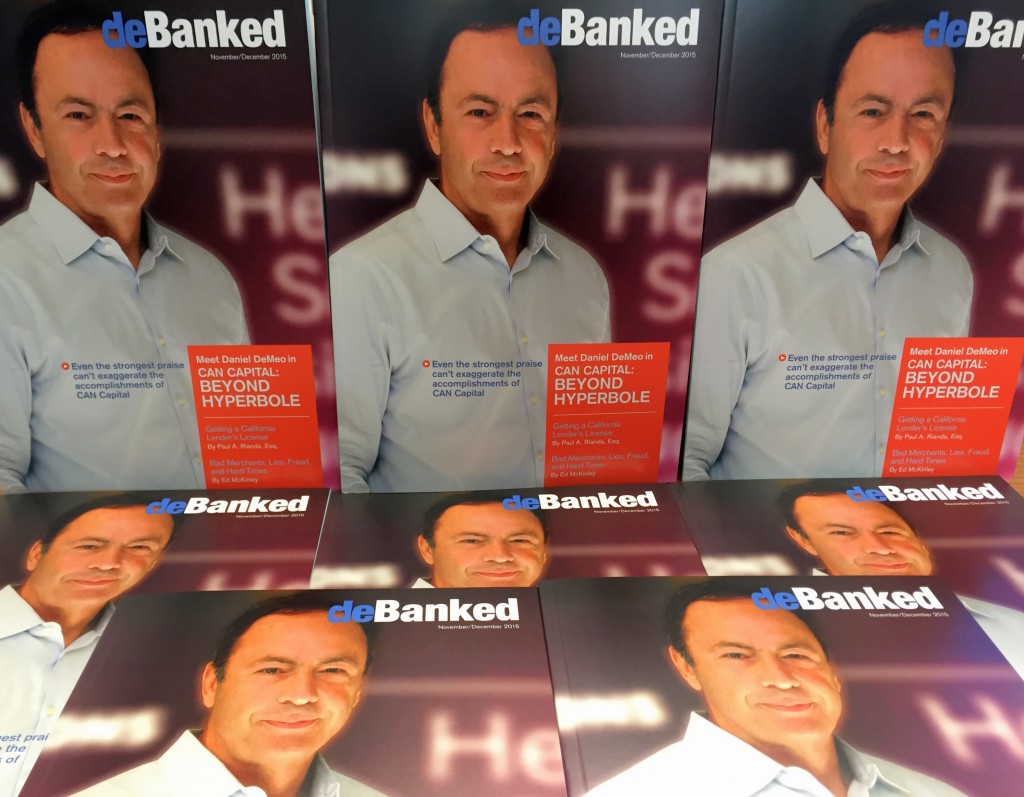
The web-based version will be up on December 11th.
Bad Merchants: Lies, Fraud, and Hard Times
December 4, 2015 Critics seldom tire of bashing alternative finance companies, but bad behavior by merchants on the other side of the funding equation goes largely unreported. Behind a veil of silence, devious funding applicants lie about their circumstances or falsify bank records to “qualify” for advances or loans they can’t or won’t repay. Meanwhile, imposters who don’t even own stores or restaurants apply for working capital and then disappear with the money.
“People advertise on craigslist to help you commit fraud,” declared Scott Williams, managing member at Florida-based Financial Advantage Group LLC, who helped start DataMerch LLC to track wayward funding applicants. “Fraud’s a booming business, and every year the numbers seem to increase.”
Deception’s naturally on the rise as the industry continues to grow, according to funders, industry attorneys and collections experts. But it’s also increasing because technology has made it easy for unscrupulous funding applicants to make themselves appear worthy of funding by doctoring or forging bank statements, observers agreed.
Some fraud-minded merchants buy “novelty” bank statements online for as little as $5 and fill them out electronically, said David Goldin, president and CEO of Capify, a New York-based funder formerly called AmeriMerchant, and president of the SBFA, which in the past was called the North American Merchant Advance Association.
To make matters worse, dishonest brokers sometimes coach merchants on how to create the forgeries or modify legitimate records, Goldin maintained. Funders have gone so far as to hire private investigators to scrutinize brokers, he said.
But savvy funders can avoid bogus bank statements, according to Nicholas Giuliano, a partner at Giuliano, McDonnell & Perrone, a New York law firm that handles collections. Funders can protect themselves by remaining skeptical of bank records supplied by applicants. “If the merchant cash advance company is not getting them directly from the source, they can be fooled,” Giuliano said of obtaining the documents from banks.
Another attorney at the firm, Christopher Murray, noted that many funders insist upon getting the merchant’s user name and password to log on to bank accounts to check for risk. That way, they can see for themselves what’s happening with the merchant.

Besides banking records, funders should beware of other types of false information the can prove difficult to ferret out and even more difficult to prove, Murray said. For example, a merchant who’s nine or ten months behind in the rent could convince a landlord to lie about the situation, he noted. The landlord might be willing to go along with the scam in the hope of recouping some of the back rent from a merchant newly flush with cash.
Merchants can also reduce their payments on cash advances by providing customers with incentives to pay with cash instead of cards or by routing transactions through point of sale terminals that aren’t integrated onto the platform that splits the revenue, said Jamie Polon, a partner at the Great Neck, N.Y.-based law firm of Mavrides, Moyal, Packman & Sadkin, LLP and manager of its Creditors’ Rights Group. A site inspection can sometimes detect the extra terminals used to reduce the funder’s share of revenue, he suggested.
In a ruse they call “the evil twin” around the law offices of Giuliano, McDonnell & Perrone, merchants simply deny applying for the funding or receiving it, Giuliano said. “Suddenly, the transaction goes bad, and they deny they had anything to do with it,” he said. “It was someone who stole the merchant’s identity somehow and then falsified records.”
In other cases, merchants direct their banks not to continue paying an obligation to a funder, or they change to a different bank that’s not aware of the loan or advance, according to Murray. They can also switch to a transaction processor that’s not aware of the revenue split with the funder. Such behavior earns the sobriquet “predatory merchant,” and they’re a real problem for the industry, he said.
Occasionally, merchants decide to stop paying off their loans or advances on the advice of a credit consulting company that markets itself as capable of consolidating debt and lowering payments, Giuliano said. “That’s a growing issue,” agreed Murray. “A lot of these guys are coming from the consumer side of the industry.”
The debt consolidator may even bully creditors to settle for substantially less than the merchant has agreed to pay, Murray continued. Remember that in most cases the merchants hiring those companies to negotiate tend to be in less financial trouble than merchants that file for bankruptcy protection, he advised.
“More often than not, they simply don’t want to pay,” he said of some of the merchants coached by “the credit consultants.” They pay themselves a hundred thousand a year, and everyone else be damned. You continue to see them drive Humvees.”

Merchants sometimes take out a cash advance and immediately use the money to hire a bankruptcy attorney, who tries to lower the amount paid back, Murray continued. However, such cases are becoming rare because bankruptcy judges have almost no tolerance for the practice and because underwriting continues to improve, he noted.
Still, it’s not unheard of for a merchant to sell a business and then apply for working capital, Murray said. In such cases, funders who perform an online search find the applicant’s name still associated with the enterprise he or she formerly owned. Moreover, no one may have filed papers indicating the sale of the business. “That’s a bit more common than one would like,” he said.
In other cases the applicant didn’t even own a business in the first place. “They’re not just fudging numbers – they’re fudging contact information,” said Polon. “It’s a pure bait and switch. There wasn’t even a company. It’s a scheme and it’s stealing money.”
Whatever transgressions the merchants or pseudo-merchants commit, they seldom come up on criminal charges. “It is extremely, extremely rare that you will find a law enforcement agency that cares that a merchant cash advance company or alternative lender has been defrauded,” Murray said. It happens only if a merchant cheats a number of funders and clients, he asserted. “Recently, a guy made it his business to collect fraudulent auto loans,” he continued. “That’s a guy who is doing some time.”
However, funders can take miscreants to court in civil actions. “We’re generally successful in obtaining judgments,” said Giuliano. “Then my question is ‘how do you enforce it?’ You have to find the assets.” About 80 percent of merchants fail to appear in court, Murray added. Funders may have to deal with two sets of attorneys – one to litigate the case and another to enforce the judgment. Even merchants who aren’t appearing in court to meet the charges usually find the wherewithal to hire counsel, he said.
Funders sometimes recover the full amount through litigation but sometimes accept a partial settlement. “Compromise is not uncommon,” noted Giuliano. Settling for less makes more sense when the merchant is struggling financially but hasn’t been malicious, said Murray.
To avoid court, attorneys try to persuade merchants to pay up, said Polon. “My job is to get people on the phone and try to facilitate a resolution,” he said of his work in “pre-litigation efforts,” which also included demand letters advising debtors an attorney was handling the case.
 But it’s even better not to become involved with fraudsters in the first place. That’s why more than 400 funding companies are using commercially available software that detects and reduces incidence of falsified bank records, said a representative of Microbilt, a 37-year-old Kennesaw, Ga.-based consumer reporting agency that has supplied a fraud-detection product for nearly four years.
“Our system logs into their bank account and draws down the various data points, and we run them through 175 algorithms,” he said. “It’s really a tool to automate the process of transferring information from the bank to the lender,” he explained.
The tools note gross income, customer expenditures, loans outstanding, checks returned for non-sufficient funds and other factors. Funders use the portions of the data that apply to their risk models, noted Sean M. Albert, MicroBilt’s senior vice president and chief marketing officer.
Funders pay 25 cents to $1.25 each time they use MicroBilt’s service, with the rate based on how often they use it, Albert said. “They only pay for hits,” he said, noting that they don’t charge if information’s not available. Funders can integrate with the MicroBilt server or use the service online. The company checks to make sure that potential customers actually work in the alternative funding business.
MicroBilt is testing a product that gathers information from a merchant’s credit card processing statement to analyze ability to repay excessive chargebacks reflected in the statements could spell trouble, and seasonality in receipts should show up, he noted.
Additional help in avoiding problem merchants comes from the Small Business Finance Association, which maintains a list of more than 10,000 badly behaving funding applicants, said the SBFA’s David Goldin. The nearly 20 companies that belong to the trade group supply the names.
SBFA members, who pay $3,000 monthly to belong, have access to the list. According to Goldin, the dues make sense because preventing a single case of fraud can offset them for some time, he maintained. Besides, associations in other industries charge as much as $10,000 a month, he added.

Another database of possibly dubious merchants, maintained by DataMerch LLC, became available to funders in July, according to Scott Williams, who started the enterprise with Cody Burgess. It became integrated with the deBanked news feed by early October, causing the number of participating funders to double to a total of about 40, he said. The service is free now, but will carry a fee in the future.
It’s not a blacklist of merchants that should never receive funding again, Williams emphasized. Businesses can return to solvency when circumstances can change, he noted. That’s why it’s wise to regard the database as an underwriting tool. In addition, merchants can in some cases add their side of the story to the listings.
Funding companies directly affected by wayward merchants can contribute names to the list, Williams said. About 2,500 merchants made the list within a few months of its inception, he noted. “We’re super happy with our numbers,” he said of the database’s growth.
Many merchants find themselves in the database because of hard times. Of those who land on the list because of fraud, perhaps 75 percent actually own businesses and about 25 percent are con artists applying for funding for shell companies, Williams said.
So far, only direct funders – not brokers or ISOs – can get access to the database, he continued, noting that DataMerch could rethink the restriction in the future. “We don’t want hearsay from a broker who might not know the full scope of the story,” he said.
DataMerch might grant brokers and ISOs the right to read the list to avoid wasting time pitching deals to substandard merchants, but the company does not intend to enable members of those groups to add merchants to the database, Williams said.
Williams sees a need for the new database because smaller companies can’t afford belonging to the SBFA. The association also tracks deals about to become final, which could prevent double-funding but makes some users uncomfortable because they don’t want to disclose their good merchants, Williams said.
 Although dishonesty’s sometimes a factor, merchants often go into default just because of lean times, Jamie Polon, the attorney, cautioned. A restaurant could close, for example, because of construction or an equipment breakdown. “Were they not serving dinner anymore, or was there something much deeper going on?” he said. Fraud may play a role in 10 percent to 20 percent of the collections cases his law firm sees, he noted. More than 95 percent blame their troubles on a downturn in business, and the rest claim they didn’t understand the contract, he said.
To understand the downturn, it’s important to amass as much information about the merchant as possible, said Mark LeFevre, president and CEO of Kearns, Brinen & Monaghan, a Dover, Del.-based collections agency that works with funders. That information sheds light on a merchant’s ability to repay and could help determine what terms the merchant can meet, he said.
Timeliness matters because the sooner a creditor takes action to collect, the greater the chance of recouping all or most of the obligation, LeFevre maintained. When distress signals arise – such as closing an ACH account or a spate of unreturned phone calls – it’s time to place the merchant with a collections expert, he advised.
LeFevre’s company also traces a troubled merchant’s dwindling assets to help the funder receive a fair share. Funders can sometimes recover all or most of what they pay a collection agency by imposing fees on the merchant, he noted.
Pinning the collection fees to merchants in default makes sense because that’s where the guilt often resides, observers said. It’s part of balancing the bad behavior equation, they agreed.
Funding Circle’s Sam Hodges Comments On OnDeck/JPM Announcement (Video)
December 2, 2015Earlier today, Funding Circle’s Sam Hodges appeared on Bloomberg TV to discuss the new OnDeck/JPMorgan Chase announcement. Hodges said he believes its the first step towards many banks working with marketplace lenders and reminded the panel that in the UK, his company already does that.
He was then asked if such a tight relationship even makes sense given the overwhelming consumer sentiment against banks these days. Watch what the video and how he responds below:
Brokers: Being a Minimalist is Okay
December 1, 2015 I’ve always wondered why being successful has to be tied to the acquisition of high-dollar materialistic toys. And I’ve always wondered why it wasn’t more tied to your level of freedom. Freedom as in, telling the world to go to hell. Being able to do whatever you wanted to do, live where you wanted to live, and enjoy the limited amount of time you had on this planet before you passed away back into whatever cloud you came from.
Let many within our industry tell it (as they seek to build their Mom and Pop Network), success is all about the acquisition of high-dollar materialistic toys in conjunction with delusional compensation promises.
I have criticized some of the motivational sales speeches done within our industry by direct funders, lenders and large broker houses, seeking to recruit those (for their Mom and Pop Network) into our industry from the Burger King drive-thru line, with the dream of making big money, fast. But we all know the reality is that only a small percentage of those that enter our space actually end up having some sort of career longevity, as success in our industry is based more on having strategic leveraged resources, rather than being the mythical smooth talking, walking, charismatic sales machine. The misguided sales motivational enticement speech is coupled with pictures of luxury cars like the Mercedes Benz S-class, along with big houses on the hill.
That marketing message clear, if you come in here and resell our services to merchants out of the Yellow Pages or by using the same UCC data that 100 other brokers are calling on, you will soon be closing deals left and right! You will be making $20,000 a month, enough to be driving that S-Class and living in that house on the hill!
THIS MESSAGE AND MILLENIALS
It’s a very enticing message for a segment of Millennials, like the ones that have attended brand name colleges for $100k on student loans, only to come out and be told that they don’t have enough experience to even qualify for entry level positions. Same goes for the ones forced to work in industries that have nothing to do with their expensive degrees.
“So you mean I can skip that nonsense, sit on a predictive dialer all day calling something referred to as a “UCC record?” they might gleefully ask. “And I can start today? I’m in!” I’m sorry, but it’s mostly a pipe dream.
Sure, there are a few individual brokers making $20,000 a month right now, but the majority making anywhere close to that are only talking about “special” months that they have had, not a consistent two-year span of this activity. Or, they have overrides on a team of individual brokers and this amount of money is usually the gross revenue, which means once you take out their very high cost of operations (using their very expensive mailing or online PPC campaigns), it paints a totally different picture.
CAN SUCCESS = MINIMALISM?
There’s a new movement going on and it’s all about Minimalism. Minimalism is based on living below your means to a point where you can survive and live a quality life on what’s been traditionally seen as “not so much,” without getting yourself deep into debt or requiring significant incomes for a long period of time due to having to sustain your high consumption lifestyle.
I once told you that it was okay to be a piker, and I’m telling you today that it’s okay to be a minimalist.
- It’s okay to not want to lease or purchase that luxury car, putting yourself on the hook for $600 – $900 a month in car payments for 36, 60, 84 or even 120 months.
- It’s okay to not want to purchase that big house, putting yourself on the hook for 20 – 30 years of a $2,000 – $3,000 or so mortgage payment before even bringing in the costs of maintenance, repairs, utilities, furniture, taxes and insurance.
- It’s okay to not want to buy every single new gadget that a technology company releases.
- It’s okay to take staycations rather than vacations.
- It’s okay to cook at home, eat healthy and eat less, rather than eat out all of the time digesting processed foods through the drive-thru or at the most expensive restaurants you can find.
- It’s okay to only buy clothes you are going to actually wear and take care of them, rather than going shopping for new clothes every weekend based solely on emotional needs.
CAN SUCCESS = BEING ABLE TO TELL THE WORLD TO GO TO HELL?
It’s okay to be a Minimalist and live longer, on less.
You will eventually find yourself in a situation to where if you stopped working tomorrow, you would have enough saved in liquid and non-liquid assets to where you can tell the world to go to hell.
- You can tell your boss and fellow staff members to go to hell
- You can tell your materialistic friends to go to hell (because you will stop trying to impress them)
- You can tell your bad surroundings to go to hell (because you’ll be in an area you find peaceful)
That’s how Mr. Money Mustache did it. He did it by incorporating Minimalism as well as efficiently managing his income, expenses and investment accounts, to be able to tell the world at 30 to go to hell.
That’s true freedom, which is true success, which is the ability to not be in shackles to a corporation, due to living a high consumption lifestyle trying to impress people that don’t even like you anyway. True success is being free to leave behind the legacy that you prefer as well as to live the life that you prefer, not the type of life that society pressures you into “signing up for” with 5 year, 10 year, 20 year and 30 year installment terms.
JPMorgan Chase and OnDeck Partner Up
December 1, 2015 Coming soon, when small businesses apply at a Chase bank for a loan under $250,000, there’s a good chance that OnDeck will be doing all the work. That’s because JPMorgan Chase and OnDeck announced a strategic partnership earlier today that is expected to commence in 2016.
A comment earlier in the day by Jamie Dimon hinted that something was coming. “We haven’t announced it yet, we’re going to be doing a thing with one of these peer-to-peer, small-business lenders,” Bloomberg reported.
That caused peer-to-peer lending industry advocates like Peter Renton of LendAcademy to speculate who that might be. He originally bet on Lending Club but posited that it could also be OnDeck, Funding Circle, or Kabbage.
When I asked Lending Club on twitter if they were slated to be JPM’s partner, I received a public reply back from a VP at OnDeck saying that it would in fact be them. By then the news had already been released.
The SEC filing states, “JPM will use the Company’s small business lending platform and the OnDeck Score® to serve its small business customers” and adds that they’re still in the process of building things out and finalizing agreements.
OnDeck (ONDK) which closed at $9.01 before the announcement is expected to soar on the news for the Wednesday open.