Articles by deBanked Staff

New York State Assembly Proposes Online Lending Task Force
June 5, 2017On June 2nd, the New York Assembly drafted its answer to the recent joint-committee hearing on online lending. It’s called Bill A8260, an ACT to establish a task force on online lending institutions. As it’s proposed now, the task force would include individuals from the online lending community, the small business community, the financial services industry, and the consumer protection community that would be appointed by the Assembly, Senate and Governor.
The task force would be required to present a report on the following by April 15, 2018:
(a) an analysis of data received by the department of financial services on the prevalence of these institutions in the state, specifically, how many online lenders are lending to consumers and small businesses in this state;
(b) an analysis of data received by the attorney general and division of consumer affairs regarding the number of complaints, actions and investigations related to online lending institutions;
(c) an examination of the online lending industry and the key participants therein, and an investigation and understanding of the differences in small business and consumer borrowers, lenders and markets, such as the history, business models and practices of online lending institutions including identification of interest rates charged by online lenders;
(d) an examination of how consumers are utilizing online consumer credit to manage existing debt, potentially reduce borrowing costs or access needed funds;
(e) an examination of the existing small business credit gap and small business’ use of credit and credit needs;
(f) identification of alternatives for consumers and small businesses who are unable to access traditional financing and whether new technologies can enhance access to credit;
(g) an examination of whether existing federal and state laws already provide appropriate police powers and regulation of small business and consumer lending by online lending institutions;
(h) an evaluation of the impact of any contemplated or proposed law or regulation on the small business credit gap, including a quantitative analysis of the amount of increased or decreased credit available to small businesses as a result of such law or regulation, including the extent to which access to credit would be affected under the state’s current usury laws;
(i) an analysis of the potential interaction of federal law with any contemplated or proposed state regulation;
(j) an exploration of options for multi-state collaboration to harmonize the laws and regulations of various states related to small business and consumer lending across state borders;
(k) an assessment of best practices for small business and consumer loan disclosures, including current online lending industry efforts to advanced standardized and clear information for borrowers;
(l) an assessment of whether consumer loans and small business loans are treated differently by online lending institutions and if any level of oversight should take such differences into consideration;
(m) an identification of what consumer protections exist to protect consumers in this state from predatory practices of online lending institutions; and
(n) a determination of what new measures, if any, are needed to ensure consumers are protected from deceptive or predatory lending without unduly restricting access to credit.
Once the report is delivered, the task force would be disbanded. The bill is currently in committee.
IOU Financial Reports Q1 Results, Lost $1M
May 31, 2017IOU Financial lent (CAD) $22.1 million in the first quarter of this year, down from $25.4 million over the same period last year. This translated into a $995,085 loss on $4.3 million in revenue.
Their quarterly report said that they will continue to focus on achieving profitability in 2017, much like another company in the space. IOU had a net loss of $4.8 million last year.
IOU had previously disclosed that they were in breach with a third party lender, MidCap Financial, over the consolidated tangible net worth covenant of their agreement. IOU has a $50 million credit facility with MidCap, who granted them a waiver on that breach last month in April. Their latest earnings report, however, states that IOU had now also breached the fixed charge coverage ratio covenant, and that MidCap has just granted them another waiver.
MidCap Financial also just recently approved a credit facility for Fundation, an IOU competitor.
The CFPB’s Small Business Lending RFI Has Already Received Responses
May 28, 2017Three responses to the CFPB’s Request For Information on small business lending have already been submitted and here’s what they say.
Kent Franzen, a career banker, said that the law limiting an underwriter’s access to an applicant’s minority-owned or women-owned business status is “literally impossible.”
“Considering that in every small bank I have worked in or am otherwise familiar with the loan officer is the primary borrower contact, the loan data collector, the primary underwriter, the author of the loan documents, the notary public for collateral documents and the loan servicing agent. This requirement is literally impossible to comply with in a community bank.“
Franzen again in regards to what concerns does he have about the possibility of misinterpretations being drawn by regulators from the collection of data pursuant to Section 1071:
“[…]I am very concerned that the so called disparate impact analysis will be used as a persecution instrument against smaller institutions that present a political expedient target of opportunity. I point out the total absence of new bank charters since Dodd Frank was enacted as proof that the country has already amassed an amount of bank regulation that is slowly choking community banks. The only institutions that thrive under this crushing regulation load are those already too big to fail.”
Jayne Lovig, a loan officer, said this:
“Your request for business lending data collection is duplicating what we are already compliling and submitting to: USDA, SBA, CDFI (Community Development Financial Institutions), OFN (Opportunity Finance Network), and the Microenterprise Census Tracker. Your data collection will compound existing regulatory reporting burdens, and again, DUPLICATES WHAT WE ARE ALREADY PROVIDING TO FEDERAL LENDING AGENCIES. Why explore size standard approaches that are ALREADY defined with EXISTING agency reporting? By coming up with new definitions you will be adding unnecessary confusion. I suggest that since ALL the data you are requesting is ALREADY BEING REPORTED that you interface with the USDA and SBA (who have already “invented the wheel”) and compile the data from them electronically.”
And lastly, 13 trade associations penned a joint letter asking the CFPB to extend the RFI deadline from July 14th to September 12th to allow them adequate time to fully formulate their answers. Those associations are:
American Bankers Association
American Financial Services Association
Consumer Bankers Association
Credit Union National Association
Electronic Transactions Association
Equipment Leasing and Finance Association
Financial Services Roundtable
Independent Community Bankers of America
National Association of Federally-Insured Credit Unions
National Federation of Independent Business
Small Business & Entrepreneurship Council
Truck Renting and Leasing Association
U.S. Chamber of Commerce
Learn more about the purpose of this RFI (which is voluntary) here.
SEC Reported To Be Looking Into CAN Capital and Prosper
May 27, 2017Bloomberg reporter Matt Scully reiterated on Friday that the SEC is looking into CAN Capital “after that firm failed to report to bondholders that some customers’ loans were in default.” That was referencing a previous December inquiry reported back in February. CAN’s $200 Million securitization suffered a rapid amortization event in the second half of 2016, compounding other problems including a reported breach with their Wells Fargo credit facility. The company never quite recovered despite CAN’s Acting CEO, Parris Sanz, telling the WSJ back in January that the problems were akin to changing a flat tire. The previous CEO along with the company’s chief risk officer, chief financial officer, and chief marketing officer have all left.
Bloomberg also reported that online consumer lender Prosper is being probed by the SEC after they disclosed that they had overstated investor returns. The inquiry was said to only be in a preliminary stage.
Update: The inquiry with CAN originated in December but it was not widely reported. The above has been edited to reflect the timing.
Old Woes Continue to Hang Over Lending Club
May 26, 2017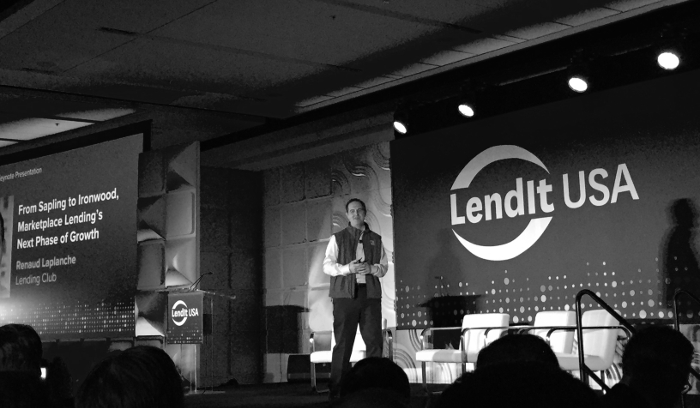 Former Lending Club CEO Renaud Laplanche at LendIt in 2016
A class action lawsuit filed against Lending Club last year isn’t going away. On Thursday, United States District Judge William Alsup denied parts of Lending Club’s motion to dismiss, meaning that the securities fraud case will continue to move forward.
The complaint touched on several issues related to former CEO Renaud Laplanche’s departure, including a conflict of interest he had with a related company named Cirrix, misreported loan volume figures, and manipulated loan data.
In one area of the decision, the judge held that allegations relating to internal controls were adequately pled in that the registration statement represented that disclosure controls and procedures were effective at a reasonable level, when in fact the company represented eighteen months later that internal controls actually suffered from various material weaknesses.
“Reasonable investors would have found it important to know of CEO Laplanche’s prior efforts to drive his company’s performance with artificially initiated loans, and even more importantly, that LendingClub’s internal controls could not effectively curb the artifice,” the judge wrote.
The case # is 3:16-cv-02627-WHA in the Northern District of California. The lead plaintiff is the Water and Power Employees’ Retirement, Disability and Death Plan of the City of Los Angeles.
Lending Club’s stock was down 62% from its IPO price as of Thursday’s close but was up almost 9% on the year, according to the deBanked Tracker.
How P2P Lending’s Evangelist is Faring Now
May 24, 2017Peter Renton, a co-founder of the LendIt Conference and p2p lending investor since 2008, published his latest portfolio performance data on Monday. While he wrote that the downtrend is continuing unabated, he still reports an overall marketplace lending return at 7.73%.
Notably, he reported that one of his Lending Club accounts actually lost money in the first quarter of the year, a first for him, though he is not the only person to experience losses.
New York Legislature Held A Hearing On Online Lending
May 21, 2017Update: The full video of the 6-hour Monday hearing is below:
Update:
The six-hour marathon hearing mainly focused on non-bank fintech companies and their bank partnerships to make loans. Lending Club, for example, was criticized for marketing their business as a “marketplace” when in actuality their loans are issued to consumers by WebBank. Assembly Member Brian Kavanagh had Lending Club representative Richard Neiman explain bit by bit how their model actually works, and inquired why the company felt it was necessary to partner with a bank in Utah rather than just become a licensed lender in the State of New York. Some of the questions, like that one, were pretty good, but others came across as misguided.
Arlen Gelbard, the EVP and General Counsel for Cross River Bank for example, was harangued for supposedly flouting New York laws. Senator Diane Savino asked Gelbard why his company didn’t have a lending license in New York. Gelbard, confused by the question, explained that his company was already a fully regulated state chartered bank and although the bank is based in New Jersey, there is no law that says they have to move to New York or become licensed to lend there.
NY Department of Financial Services Superintendent Maria Vullo made the strangest leap however by suggesting that the State’s civil usury cap be reduced from 16% to 7%. She based that idea on the presumption that a low Fed Funds rate meant that lenders must be making excess interest on the loans they make. She seemed to be unaware that interest rates on loans incorporated default risk, rather than simply than a lender’s cost of capital alone.
At 10AM on Monday, the NY Senate and Assembly will be holding a hearing on the practices of online lending to determine if action is necessary to protect consumers and small businesses.
According to the official notice, the “hearing seeks to explore the current state of online lending, the impact of online lending on consumers and small businesses in New York State, predatory online lending practices which need to be mitigated, and potential regulatory or legislative action which may be needed to address predatory online lending practices.”
Prosper Loaned $585M in Q1, Losses Continued
May 16, 2017Prosper had a net loss of $23.9 million in Q1 on only $30.8 million in revenue, according to the 10-Q they filed Monday. They originated $585.6 million in loans, 90% of which were funded through their Whole Loan Channel, the segment made up of accredited and institutional investors who buy entire loans.
Prosper had 371 full-time employees at the end of Q1 compared to 667 full-time employees at the end of Q1 2017.
The full report can viewed here.
—–
Note: The net loss figure was originally published with an incorrect digit. It has since been corrected