
Articles by deBanked Staff

Clearbanc Raises $300M in a Series B
July 31, 2019
Toronto-based Clearbanc, a company founded on the idea of providing business owners with capital to purchase facebook and instagram ads in exchange for a percentage of their future sales, has raised $300M in a Series B. $50M of it is an equity investment led by Highland Capital. The other $250M will go into a fund that Clearbanc uses to fund small businesses, according to Fortune.
Clearbanc’s payment methodology is reminiscent of merchant cash advances and their factor rates range between 6% and 12.5%. Funding amounts range from $10,000 to $10M and the company is reportedly on track to fund $1 billion to small businesses.
Clearbanc President and co-founder Michele Romanow is a serial entrepreneur that is also a celebrity investor on the TV show series Dragon’s Den. She attributes the idea for Clearbanc to her experience on the show in which entrepreneurs were inappropriately seeking venture capital when it was really a specific type of working capital they needed, funds to advertise on facebook or instagram, for example.
The company was founded in 2015 in Toronto.
Ken Rees, CEO of Elevate, Resigns
July 30, 2019 Ken Rees, the CEO of consumer lending company Elevate, resigned on Monday. The announcement coincided with the release of the company’s Q2 financials in which Rees described the business as performing “extremely well.”
Thus far, in 2019, we have already delivered over $19 million in net income or $0.43 per fully diluted share. We are reaffirming our full year guidance for $25 million to $30 million in net income. This will be more than double the net income we delivered in 2018. Elevate’s bottomline performance was driven by excellent credit quality and very low rates of fraud across all of our products. Additionally, our customer acquisition costs have remained better than target levels. In short, the business is performing extremely well.
And this is why I believe now is a good time for me to step down as CEO. I am very proud of our financial accomplishments since our launch in 2014, but I am even proud of the leadership team here at Elevate. They are all seasoned and dedicated professionals that have been instrumental in the rapid growth of the company and in generating solid profitability over the past two years.
Rees also stepped down as chairman of the board of directors but will a remain a director of the company.
Chief Operating Officer Jason Harvison has been named interim CEO. Harvison joined the quarterly earnings call and said, “First, I couldn’t be more excited about Elevate’s future and believe the company is very well positioned to capitalize on the strategic initiatives put in place over the past year. Secondly, I firmly believe that Elevate is uniquely well-positioned in the market with strong credit quality, improving margins and a measured approach to growth. We are on track for steady profitability in 2019 and beyond.”
A permanent CEO is expected to replace Harvison in his capacity as interim CEO as soon as one is selected.
Elevate had a net income of $5.8M in Q2, up 87% year-over-year.
California DBO Making Progress On Finalizing Rules Required By The New Disclosure Law
July 29, 2019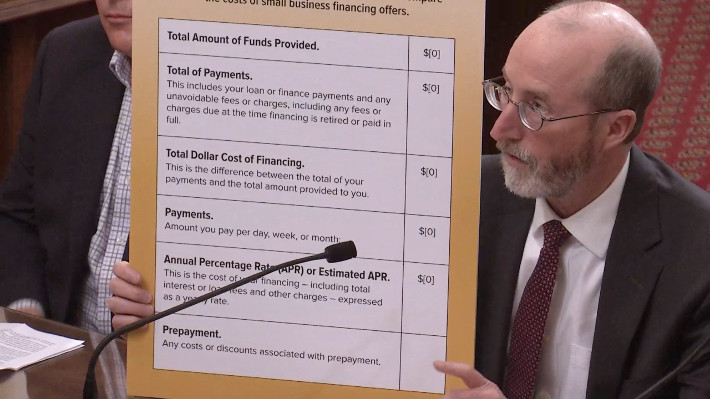 Last October, California Governor Jerry Brown signed a new commercial finance disclosure bill into law. The bill, SB 1235, was a major source of debate in 2018 because of its tricky language to pressure factors and merchant cash advance providers into stating an Annual Percentage Rate on contracts with California businesses. The final version of the bill, however, delegated the final disclosure format requirements to the State’s primary financial regulator, the Department of Business Oversight (DBO).
The DBO then issued a public invitation to comment on how that format should work. They got 34 responses. Among them were Affirm, ApplePie Capital, Electronic Transactions Association, Commercial Finance Coalition, Fora Financial, Equipment Leasing and Finance Association, Innovative Lending Platform Association, International Factoring Association, Kapitus, OnDeck, PayPal, Rapid Finance, Small Business Finance Association, and Square Capital.
On Friday, the DBO published a draft of its rules along with a public invitation to comment further. The 32-page draft can be downloaded here. The opportunity to comment on this version of the rules ends on Sept 9th.
You can review the comments that companies submitted previously here.
PayPal Begins Offering Business Loans in Canada
July 28, 2019 PayPal has extended its popular working capital business loan program to Canada, according to company CEO Dan Schulman.
“This quarter, we began offering our PayPal business loan product to PayPal merchants in Canada, allowing them to access financing to build and sustain their businesses,” he said during the Q2 conference call. “This follows the expansion of our business financing solutions to Germany in Q4 2018 and in Mexico earlier this year in partnership with Mexican lending platform Konfio.”
deBanked ranked PayPal as the leading alternative small business finance company by originations in 2018. They are followed by OnDeck, Kabbage, Square, and Amazon.
Loan Broker Busted In Advance Fee Loan Scam Faces Drug Charges
July 20, 2019Demetrios Boudourakis, who was arrested last month for operating an advance fee loan scheme that allegedly defrauded small business owners nationwide, is also facing federal drug charges. The criminal complaint, filed on June 14th, asks for an arrest warrant for conspiring to distribute controlled substances.
Lending Express Rebrands to Become
July 16, 2019 Lending Express, a company whose CEO was once a master gamer, has rebranded to Become.
“This transition comes at a pivotal point in the company’s growth and highlights its dedication to providing businesses with opportunities to improve fundability, secure funding, and ultimately become more,” a company spokesperson wrote.
According to the company, their online loan marketplace grew from just one lending partner in Australia to over 50 lending partners, operating in both Australia and the US. They’ve facilitated more than $150 million in funding and have over 150K members on their platform to date. Their journey is documented on a blog post published this week.
Star Fundraiser For 1 Global Capital Settles With The SEC
July 15, 2019 Henry J. “Trae” Wieniewitz, III was charged by the SEC on Monday for his role in allegedly selling unregistered securities in two companies, 1 Global Capital (the now defunct merchant cash advance provider) and Woodbridge Group of Companies (a purported real estate lending business revealed to be a $1.2 billion ponzi scheme).
“Wieniewitz and Wieniewitz Financial raised more than $11.4 million and reaped approximately $500,000 in commissions from unlawful sales of Woodbridge securities, and raised more than $53 million and obtained approximately $3 million in commissions from unlawful sales of 1 Global securities,” the SEC stated.
Wieniewitz was not a registered broker-dealer nor associated with a registered broker-dealer.
A settlement was announced simultaneously. “Wieniewitz and Wieniewitz Financial settled the SEC’s charges as to liability without admitting or denying the allegations, and agreed to be subject to injunctions, with the court to determine the amounts of disgorgement, interest, and penalties at a later date,” an SEC statement said.
Wieniewitz was not alone in selling investments in both 1 Global and Woodbridge.
Separately, the owner of Woodbridge and two former directors of the company were recently charged criminally.
No criminal charges have been brought to date in the 1 Global Capital saga. That could change. 1 Global Capital revealed in 2018 that it was being investigated by the US Attorney’s office. That along with the SEC investigation prompted the company to file for bankruptcy. The SEC subsequently brought civil charges.
Documents filed in the SEC case against 1 Global’s former owner, Carl Ruderman, have since revealed that at least one former employee had been approached by the FBI about the operations of 1 Global.
Last month, it appeared Ruderman and the SEC were heading towards a settlement.
One notable fact about 1 Global Capital is that the company participated in the largest merchant cash advance in history at $40 million. That transaction has become a point of significant controversy and litigation. The recipient of those funds, a conglomerate of car dealerships in California, have shut their doors.
Online Lenders Beat Credit Unions, Friends, and Family as Primary Source of Credit
July 14, 20197% of small businesses generating less than $5 million/year in revenue relied on online lenders as their primary source of credit in the last quarter, according to the latest Private Capital Access Index published by Pepperdine Graziado Business School. 3% relied on credit unions as their primary source and 6% relied on friends and family.
Banks were the most popular. 19% relied on large banks as their primary source of credit and 12% relied on community banks.
38% said they didn’t have any source of credit at all.
Sticking with the under $5 million/year segment, 45% of respondents explained that their primary source of credit had become so simply because they were able to qualify for it. 21% said their primary source became so because they couldn’t qualify for any other source.
Meanwhile, merchant cash advances, online business loans, and factors experienced among the lowest reported approval rates for businesses of all sizes. Of those businesses that applied for financing, the success rate in obtaining funds are as follows:
| Financing Type | Success Rate |
| Business credit card | 65% |
| Trade credit | 57% |
| Personal loan | 51% |
| Lease | 48% |
| Bank loan | 41% |
| Online lender | 38% |
| Merchant cash advance | 31% |
| Asset Based Lender | 28% |
| Factor | 23% |
| CDFI/Credit Union | 18% |
While bank loans came in at 41%, revenue was a major determining factor. 88.9% of businesses doing $5 million to $100 million/year in revenue successfully obtained a bank loan while only 31.6% of businesses doing less than $5 million/year in revenue successfully obtained a bank loan.