Archive for 2018
Industry Stock Performance Update
January 21, 2018 Square is the big winner thus far according to the deBanked Online Lender Tracker. The company’s stock price is up 373% since its IPO and already up 22.76% YTD.
OnDeck and Lending Club by contrast are down by more than 70% from their IPOs and down 17.6% and 2.66% YTD respectively.
But the real loser so far in 2018 is Bitcoin. As of this writing, the Coinbase price of BTC is around $11,310, down more than 18% from its 2017 year-end price of $13,860. Bitcoin had previously reached an all-time high of nearly $20,000.
Meanwhile, the S&P 500 is already up 5.11% YTD. That’s about 59x more than what a Marcus Savings account returned over the same period. Marcus is Goldman Sachs’ online lending and retail online banking arm.
Drift Capital Partners Credit Facility Shows Confidence in Fintech
January 20, 2018Drift Capital Partners, LLC, an alternative asset management company, announced a new $50 million credit facility earlier this month. The funds will be used to “expand its portfolio of structured credit solutions to FinTech enabled Non-Bank Financial Services companies and allow them the opportunity to increase lending to ‘main street’ businesses,” a company release said.
Drift previously provided $25 million in financing to McClean-based Breakout Capital.
“Since its inception, Drift has been focused on developing solutions to bridge the chasm between institutional investors and main street businesses and we believe this facility is an important step toward solidifying that connection,” said McLean Wilson, Managing Partner of Drift in a company release.
CFPB Still Has Not Begun Collecting Small Business Loan Complaints
January 20, 2018Two years ago, the Consumer Financial Protection Bureau (CFPB) announced that they planned to collect small business lending complaints. However, there is still no option to complain about a small business loan on their website.
“Subject to an assessment of feasibility, the Bureau’s consumer response team will build the infrastructure to intake and analyze small business lending complaints,” an early 2016 report stated.
Although the CFPB did manage to successfully roll out a small business lending Request For Information (RFI) under former Director Richard Cordray, current acting Director Mick Mulvaney seems to have different plans for the government agency. On January 17th, he called for an introspective RFI, one in which the public can share their input on what the CFPB should be doing.
Given the philosophy of the current leadership, it could be a while before small business lending initiatives are rolled out.
Holiday Bubble Helped Cause (Routine) Crypto Stumble
January 18, 2018 Those cherished-yet awkward-family moments you navigated this holiday may be responsible for Bitcoin’s recent rollercoaster ride.
While that may be painting with a bit of a broad brush, it does appear that that the post New Year’s dip that befell the cryptocurrency world was tied to a festive hype-bubble.
Between Thanksgiving and the December holidays cryptocurrency was a hot topic around the dinner table while people spent extended time with their families, John Omar, head of the Chain Operator blog and cryptocurrency trading course, told deBanked.
Omar explained that not only were those that were already schooled in the ways of crypto-trading discussing their financial gains over apple cider and stuffing, but family and friends who were previously unaware or unfamiliar with the likes of Bitcoin were having their interests piqued.
This spurred a rapid uptick in pricing on the way to to unprecedented gains in Bitcoin and other crypto counterparts.
“No, this is not the end of crypto,” Omar told deBanked. “This is far from the end. What we’re seeing is a price correction after 2 months of unprecedented growth. It’s not even a historic price correction. There have been more dramatic movements. There are a few reasons why the price is correcting at this time: potential regulation from Korea, China and France, and people who bought into cryptocurrencies after the holidays selling off to realize profits.”
Emerson Taymor, founding partner of the strategies firm Philosophie, agrees with Omar’s stance.
“Bitcoin and the market has seen much more significant drops in its past and always rebounded with a vengeance. It is a healthy correction, but far from the end,” he said.
Like Omar, Taymor also attributes the recent drop to “regulatory headwind” overseas.
While he believes that cryptocurrencies best days are not necessarily behind them, there will be losers on the path to determining a clear winner.
“Remember, cryptocurrency is much more than the “stock price,” Taymor said. “We are seeing a fundamental shift in how technology is going to be created. I believe we will have another big run up for the next 6-12 months and then we will have the real bubble bursting. Much like the Dot Com bubble, we will see people lose a lot of money and companies implode like Pets.com and Webvan, but we’ll also discover the next Amazon!”
Standard Chartered Names New Global Leader of Transaction Banking
January 17, 2018 Lisa Robins has been appointed as global head of transaction banking at Standard Chartered, the company announced on Wednesday.
A 38-year veteran of international business, Robins joins the Standard Chartered team from Deutsche Bank, where she had served since 2011. Before this tenure, she spent 23 years with JP Morgan Chase.
“For more than a century, Standard Chartered has been a leading trade bank supporting economic flows across Asia, Africa and the Middle East,” Simon Cooper, CEO, of corporate and institutional banking at the company said via release. “Transaction Banking is in our DNA and is integral to our future. As a banking veteran with deep experience running international transaction and commercial banking across complex markets, Lisa will ensure that the business goes from strength to strength as we deliver our network and innovative solutions to our clients.”
Robins also commented on her new role, stating that she was “excited” to get started as she has been an admirer of her new employer for some time.
“I have admired its many critical strengths like the Bank’s commitment to its global network, diverse talent, breadth of products and market leading platforms,” said the Stanford and Tufts graduate. “I am very much looking forward to leveraging my experience, built over many years across various growth markets, to see how we can further accelerate growth for the business and support the banks’ wide and deep base of clients to become an even stronger competitor in the industry.”
Robins was awarded ‘Transaction Banker of the Year Award’ by The Asset’s Triple A awards and also by The Asian Banker in 2013. In 2016, she was conferred the IBF Fellow award by the Institute of Banking and Finance Singapore which recognizes industry veterans who exemplify thought leadership and commitment to industry development.
CFPB to ‘Reconsider’ Payday Loan Restrictions, is Applauded by CBA
January 17, 2018The Consumer Financial Protection Bureau (CFPB) will be taking a closer look at the Payday Rule.
The legislation, which was finalized in October by former CFPB head Richard Cordray, mandates that lenders must certify that borrowers can afford a loan via background checks before issuing them. Also, the amount of loans to a single customer must be capped.
“January 16, 2018 is the effective date of the Bureau of Consumer Financial Protection’s final rule entitled ‘Payday, Vehicle Title, and Certain High-Cost Installment Loans’” a statement from the CFPB reads. “The Bureau intends to engage in a rulemaking process so that the Bureau may reconsider the Payday Rule.”
Yesterday, the Consumer Bankers Association (CBA) threw their support behind the decision to “reconsider” the restrictions.
“The CFPB’s decision to revisit its small-dollar rule is welcomed news for the millions of American consumers experiencing financial hardship and in need of small-dollar credit,” said CBA president & CEO Richard Hunt via statement.
“Under the current rule, many banks are forced to sit on the sidelines and prevented from offering affordable and popular small-dollar credit options to help meet the needs of their customers. As the CFPB reconsiders this rule, we encourage the Bureau to work with bank regulatory agencies to examine the use of bank offered small-dollar lending products, such as deposit advance products, and ensure any final rule treats all banks equally.”
Should no changes be levied against the Payday Rule, compliance is set to be enforced on August 19th of 2019.
New Legislation boosts SBA Oversight Over 7(a)
January 17, 2018This month, the Small Business 7(a) Lending Oversight and Reform Act of 2018 was put forth by a bipartisan team of lawmakers. If approved, the bill will increase the Small Business Administration’s (SBA) oversight authority over the 7(a) loan program, which aids small businesses and entrepreneurs as they set out to launch or grow their enterprises.
Via press release, the pending legislation was credited with “preserving” the 7(a) loan program by strengthening the SBA’s Office of Credit Risk Management by outlining in statute the responsibilities of the office and the requirements of its director, enhancing SBA’s lender oversight review process, including increasing the office’s enforcement options, requiring SBA to detail its oversight budget and perform a full risk analysis of the program annually and enhancing the organization’s “Credit Elsewhere” test.
“The 7(a) loan program has leveraged billions of dollars to help America’s small businesses thrive,” said Senate Small Business and Entrepreneurship Committee Chairman Jim Risch (R-ID) via the release. “By bolstering the SBA’s oversight office and providing the Administrator with flexibility to increase the program’s maximum lending authority in the event it would be reached, this bill will ensure the strength of the program into the future, guaranteeing that entrepreneurs will have access to the critical capital they need to build and grow their businesses.”
He continued, stating that the “bipartisan and bicameral support for this effort underscores just how important the 7(a) program, and the capital it provides, is to our nation’s small business owners.”
“The House Small Business Committee has a long tradition of working across the aisle to promote opportunity and job growth for America’s small businesses and, central to that effort, is ensuring entrepreneurs can access adequate capital to grow their operations,” said Congresswoman Nydia Velázquez (D-NY) in agreement.
“Since its inception, the 7(a) initiative has provided new and existing ventures with financing to grow and create jobs in local communities,” she added. “Under this legislation, SBA will have more tools to meet small businesses’ needs. I’m particularly pleased the bill includes provisions from my legislation allowing SBA to raise its 7(a) lending cap, so there’s no interruption in the flow of loans to small firms.”
Was This Bitcoin Lender Paying Returns Too Good to Be True?
January 17, 2018 As the rivers flowed red with the blood of crashing cryptocurrencies Tuesday, one company did not survive. BitConnect, a company infamous in the crypto community for paying out obscenely high returns for lending your bitcoins, may have been too good to be true.
BitConnect offered investors the opportunity to make loans on their platform and earn up to 40% interest per month PLUS an additional .25% daily. The seemingly irresistible returns were enough to allow the market cap of their own company cryptocoin (BCC) to soar to more than $2.6 billion by early January.
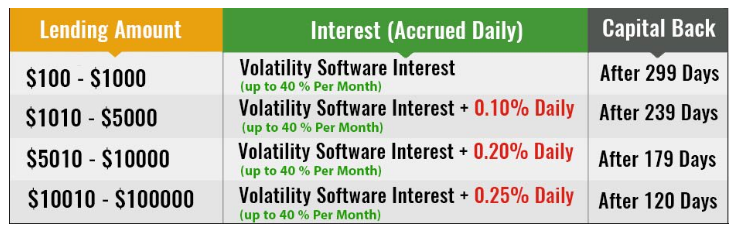
On Tuesday, they announced that their lending service and other segments of their business would be discontinued. Cease and desist orders issued by two states, North Carolina and Texas, are said to have played a role. Texas authorities relied more on the company’s obvious flagrant violations of securities laws while North Carolina alleged that the company’s advertised returns were a red flag for a ponzi scheme.
The BitConnect Coin lost nearly 90% of its value immediately after announcing their closure. Meanwhile, the cryptocurrency markets shed more than $200 billion in market cap the same day, according to Coinmarketcap.com. The value of Ripple (XRP), a coin speculators believe will play a role in the future of banking, was not spared. Its price has dropped by 68% since January 5th.