
Archive for 2018
Shopify’s Funding Automation Key to Its Growth
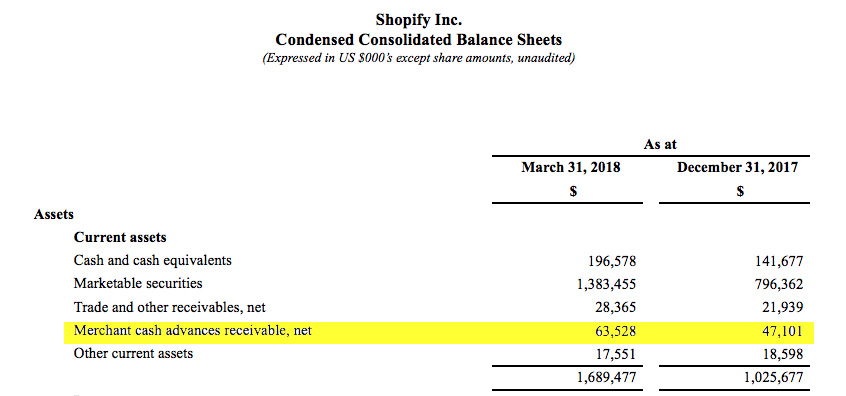
May 2, 2018 Canadian e-commerce company Shopify (NYSE:SHOP) has a business funding arm called Shopify Capital that issued $60.4 million in merchant cash advances in Q1 this year, according to the company’s earnings report yesterday.
The funding operation offers an MCA product exclusively to merchants that are customers of Shopify. The company helps small business owners create online stores, with products ranging from web design to marketing and analytics. Currently, Shopify supports more than 600,000 small businesses worldwide.
Shopify Capital was launched in April 2016, but a company representative said it wasn’t until April 2017 that it started using algorithms 100 percent to automate offers of capital to merchants.
“What Shopify can see is a lot of patterns in a merchant’s [online] store,” a company spokesperson told deBanked. “How engaged is that merchant? What has their GMV (Gross Merchant Volume) been? How spotty is their GMV? How often do they sell? There’s a bunch of different factors that help us predict GMV going forward. And as [our] algorithm gets better and smarter, we are able to get more granular in our offers.”
Many of Shopify Capital’s small business owner clients are new business owners who would not qualify for loans from banks, but need money to expand their businesses.
“Business owners typically spend copious hours putting an application together and funds typically take two to three weeks to receive,” a different Shopify spokesperson said. “Shopify Capital is designed to provide our merchants with timely access to Capital without putting them through additional financial stress…[And] merchants receive financing based on our predictive technology to determine what makes sense for their business in their trajectory.”
Shopify was founded in 2004 and is headquartered in Ottawa, Canada.
Shopify Capital Issued $60.4M in Merchant Cash Advances in Q1
May 1, 2018 Shopify Capital, Shopify’s small business funding arm, issued $60.4 million in merchant cash advances in Q1, according to the company’s earnings report, an increase of more than 300% year-over-year. The company has advanced $230 million to merchants since April 2016.
On the company’s earnings call, Canaccord Genuity equity researcher David Hynes, inquired about the patterns of seasonal demand one could expect for the company’s merchant cash advances.
“So in terms of seasonality on Shopify Capital,” said Shopify COO Harley Finkelstein, “it’s important to note that the use of proceeds for Shopify Capital for most of our merchants tend to be in the realm of inventory or marketing spend, which we quite like, because that leads to more sales, which makes it easier for them to return the capital to us.
“Obviously, there’s the seasonality of capital reflecting the seasonality of retail in general, which is certainly more of a Q4 issue than it is a Q1 issue,” he added.
Canaccord’s Hynes also referred to Shopify’s product as a loan but was corrected by Finkelstein.
“Just keep in mind, these are not loans, these are cash advances, so I want to be very clear about that,” Finkelstein explained.
Shopify is a Canadian e-commerce company headquartered in Ottawa, Ontario. It is also the name of its proprietary e-commerce platform for online stores and retail point-of-sale systems
View the company’s earnings report here
BlueVine Announces $200 Million Credit Facility
May 1, 2018
BlueVine announced today that it has secured a $200 million asset-backed revolving credit facility with Credit Suisse. This will be used to expand its business line of credit product and the company’s customers will now be eligible for a credit line of up to $250,000.
“Capital markets partnerships are critical to our ability to scale and effectively serve our expanding customer base,” said BlueVine CFO Ana Sirbu. “This financing will support our next phase of growth [as] we continue to build a business for the long-term by offering the best working capital financing solutions to business owners.”
The company offers two products – invoice factoring and business lines of credit. The latter was introduced in January 2016 with a maximum credit line of $30,000, Sirbu told deBanked. That maximum soon became $50,000 and has steadily risen. In February, the company increased its business line of credit from $150,000 to $200,000.
Founded in 2013 by CEO Eyal Lifshitz, the company first offered only factoring in March 2014. Now, Sirbu said that the breakdown of its business is about even between its factoring and business line credit offerings.
This is BlueVine’s first facility with Credit Suisse. Not counting this facility, the company had $318 million in funding as of October 2017, according to Crunchbase.
BlueVine is headquartered in Redwood City, CA, with other offices in Jersey City, NJ, New Orleans, LA, and a large office in Tel Aviv, Israel, where most of its Research and Development team is based. Altogether, BlueVine employs about 200 people.
Yellowstone Capital Funded $61 Million in April
May 1, 2018Yellowstone Capital originated $61 million in funding to small businesses in April, according to the company. The year-to-date total now exceeds $200 million.
Yellowstone Capital, which is based in Jersey City, NJ, originated $553 million in 2017.
What You Can Find on the BCFP Consumer Complaint Database
April 30, 2018 Last week, Acting Director of the BCFP Mick Mulvaney told bankers that he had plans to make the agency’s consumer complaints database no longer visible to the public. In light of this, deBanked searched the agency’s complaint database. While there were numerous grievances that consumers reported because they could not fully resolve an issue with a financial service company on their own, we also found a host of questionable entries that leave much to be desired about the underlying issue and resolution sought.
Part of a complaint from last April against Bank of America reads as follows:
“The XXXX XXXX XXXX Police Beat you up XXXX Times and dont file Charges 5 times stays on youre record and you cant get Residency. All Countries murder the XXXX XXXX collect there benefits indefinitely After youre XXXX.”
Another complaint against Wells Fargo from December of last year reads:
“They are lower than pond scum and belong in prison. both XXXX XXXX executive resolution specialist and XXXX XXXX Sr. VP refuse to return my calls.”
And yet another complaint against U.S. Bancorp from July of last year asserts that a certain fraud department is:
“full of shit.”
Others are incomplete, like the following complaint against Experian from earlier this month:
“I’m an authorized user on this account but did not sign up for this on XXXX account.”
Taking the consumer complaints database out of public view could benefit lenders from complaints that have not been fully vetted. A consequence of it being public is that an independent party could paint a picture about a financial company’s behavior by simply tallying the raw number of complaints, regardless of whether those complaints are genuine.
Such a thing has been done. Several months ago, LendEDU published a ranking system of banks by the number of complaints they have received, placing Wells Fargo and Bank of America in the #1 and #2 spots respectively. Time Magazine picked up that story and presented it as “20 Banks That Consumers Loved to Hate in 2017” and ranked the number of complaints to the banks’ total deposits. Minnesota-based TCF Bank was crowned the worst.
Among some of the complaints that deBanked reviewed about TCF Bank did not even appear to be complaints at all. Interspersed with seemingly real grievances were some rather general questions or comments like how to view an account balance, how to access your account information through the mobile app, a purported compliment about the bank’s service that was nonetheless attributed to them as a complaint, and complaints about other companies that did not even mention TCF Bank but nonetheless counted as a complaint against them. All of these counted toward their complaint totals regardless of the content.
Tips For More Successful Marketing
April 30, 2018 In marketing, there’s a basic tenet that it takes seven “touches” within 18 months to prod someone into action.
Nowadays, with customers exposed to thousands of ads a day and across so many channels, it takes several times that in interactions to generate viable sales leads, according to Samantha Berg, a marketing and strategic partnerships executive with 6th Avenue Capital in New York.
That’s why it’s so important for funders, ISOs, brokers and other alternative funding professionals to have a solid marketing and lead-generation strategy that incorporates multiple channels such as search engine optimization, digital ads, direct mail, email and social media. The challenge, of course, is to find the right balance between being invasive and being top of mind, industry professionals say. Here are a few ways tried and true ways to generate warm leads and potential new business:
DON’T DIS DIRECT MAIL
Many marketers have a negative view about the importance of direct mail to consumers. But consumers may be more interested in this medium than you think. Consider a survey of more than a thousand consumers by Yes Lifecycle Marketing, a provider of email and digital marketing services. According to this study, 56 percent of all consumers say they find direct mail influential when researching a purchase. By contrast, a separate survey by Yes Lifecycle Marketing paints a very different picture of how marketers view direct mail; 78 percent of those polled say they believe direct mail is not influential for any age group.
 One good thing about direct mail is that it can be opened at the merchant’s convenience, unlike a phone call which some merchants find annoying, especially since they often get multiple calls a day from numerous funders. With direct mail, even if a business does not need funding immediately, there’s a decent chance the merchant will keep your information on file for future reference, says Glen Faulhaber, vice president of sales at G-Plex Direct Mail Services in Holtsville, N.Y. Sending a follow-up mailing within a week of the first helps you gain additional brand recognition, he says.
Of course, for direct mail to be successful, certain parameters should be followed. For starters, mailings have to be based off good data; meaning the people or businesses you are sending to have a high likelihood of needing funds. Without worthwhile data, you’re basically throwing money out the window, Faulhaber says.
Timing is also important, he says. With direct mail, Faulhaber says you have about five seconds to get someone’s attention, so your message has to be catchy.
MAKE YOUR WEBSITE SHINE
Trey Markel, a software specialist at CentrexSoftware, a customer relationship management software company in Costa Mesa, Calif., says it’s shocking how many funders don’t use their websites to generate leads. Markel, who consults with B2B lenders and MCA providers on marketing strategies using enterprise software, recommends funders spend time working on their website so that it appeals to all types of visitors: those who want to read relevant articles, those who want to watch webcasts and those who want to listen to podcasts.
The idea is for funders to use their website to provide helpful information to merchants that will, in turn, encourage them to seek funding from you. For instance, you might consider hosting monthly webinars on topics such as how businesses can use loaned money to increase their marketing budget. Another topic merchants may find appealing is how to use credit cards to increase customers. “You give them a solution to a problem, and then you give them the money to go afford that solution,” Markel says.
Many funders know how to close a deal, but they fail to understand that the consultative approach over time will gain them even more business, Markel says. “Becoming a trusted information source in the industry is so much more valuable to customers than just being a funder,” he says. The industry needs “professionals who are going to tell you how to solve a problem.”
GET PERSONAL
Jennie Villano, vice president of business development at Kalamata Advisors LLC, says ISOs looking to build their business should attend networking events where small businesses are present. Sounds simple, but many ISOs don’t take advantage of this, meaning a missed opportunity to connect with “people from every facet” including accountants and other business professionals who can be a good source of referrals.
She also recommends ISOs hire at least one professional who is warm, trusting and engaging to visit merchants at their place of business. She recommends they pick places such as local strip malls which have a sizeable number of merchants. If you saw 20 merchants a day and only two funded with you that amounts to 40 extra deals a month, she points out. “Many ISOs would benefit from an extra 40 deals a month,” she says. On top of that, you have additional touchpoints because each of the merchants you visit may tell other businesses about your services, she says.
USE SOCIAL MEDIA
ISOs should also use social media more often than they do now—and not just to find sales help, Villano recommends. She uses it to target ISOs, but in the course of that, she gets inquiries from small businesses. ISOs should be using social media to find small businesses in need of funds. “I just don’t know why they aren’t using it more. It has tremendous reach,” she says.
To be sure, you don’t have to bombard your connections with posts. Once every other week is a good target. Make sure to include your business name and phone number, but posts shouldn’t be a hard sell. “There are ways to stand out and get your message across without appearing pushy or too sales oriented. The two-minute video ‘Cooking with Kalamata Capital’ that went viral in the industry is an example,” she says.
Also remember there are many social media venues. Sometimes funders focus their efforts on LinkedIn, Facebook and, to a lesser extent, Twitter. But Instagram and Pinterest can also be used to target potential customers. Posting aspirational videos or photos in these venues can help encourage businesses to think about ways to fund the things they might need, says Berg of 6th Avenue Capital.
USE EMAIL MARKETING TO YOUR ADVANTAGE
Some funding professionals say text messaging works well for them, though others prefer email for a host of reasons.
For one thing, it’s a “little less intrusive” than a telephone call or a text, Berg says. Also, with email, there’s ample ability to personalize, and you can run analytics to determine helpful metrics such as open rates and click-through rates, for example. You can compare how these metrics change when you tinker slightly with email subject lines or messages.
“We see email as a very viable channel,” she says.
Another advantage of email is that it helps funders and brokers get around the restrictions imposed by the Telephone Consumer Protection Act (TCPA) that has hampered lead generators’ ability to solicit business owners, says Michael O’Hare, president of Blindbid, a B2B lead generation site.
With email, you can direct the prospect to click on a link, which then triggers a phone call from a sales rep. In an environment when cold-calling can result in a lawsuit, email is a viable alternative, says O’Hare, an outspoken opponent of TCPA restrictions for business-related matters.
A growing number of funders are also using or exploring the use of artificial intelligence to help with lead generation, says Matthew Martin, managing director of Silver Bullet Marketing, a provider of trigger lead data.
One company that’s working in this area is AI Assist. Using Conversica, an AI-powered virtual sales assistant, funders can send automated emails to prospects. The automated sales assistant determines whether the prospect is interested, and if so, it alerts a human sales representative. The automated sales assistant can also gather additional information from a lead, such as the best phone number and best time to call. The entire “dialogue” is available for the human sales rep to review.
“AI is not going to make the sale for you, but it’s going to give you enough information to move forward,” Martin says.
 REFINE YOUR LEADS
To generate leads, funders, ISOs and brokers tend to buy banner ads on Google or send an email blast with a link for interested businesses to click on. The link usually directs businesses to an online form that typically asks for their name, telephone number, email and how much money is being requested.
But it doesn’t generate meaningful information about the business or what type of funding product the business is looking for, says O’Hare of Blindbid. These forms don’t typically include critical information such as whether the person has been in business for less than a year, whether he or she has mounds of debt or what kind of funding the business is seeking.
One way to get better, more tailored leads is with “lead quizzes” similar to those used by the online insurance industry, he says. Instead of a basic form, potential leads would be directed to fill out a form that has much more pointed questions about the person, the business and the type of funding sought, he explains. Some questions might be, for instance: Is your credit score over 500? Have you been in business for more than a year? And, what type of funding are you seeking? Based on the merchant’s responses, he or she could be directed to a certain funding product or a specific funder, if you’re an ISO working with multiple providers. The funder could also decide to pass on an opportunity based on a merchant’s answers to the lead quiz.
O’Hare says he doesn’t know of MCA providers currently using this type of form, but it’s one of the things he’s working on as a way to generate better leads for his clients. With the basic forms many funders use today, you get a “lot of garbage,” O’Hare says.
Certainly, there are many ways to market and get leads, but industry professionals say one thing is clear: you can’t rely on one avenue alone. According to Markel of CentrexSoftware, too many in the industry put too much faith in raw data that gets plugged into a phone system dialer. The quality of this data isn’t always the best, which means funding professionals are wasting a lot of time, he says. “There are only so many small businesses in the country and an even smaller amount that are fundable,” he says.
Kabbage Acquires Orchard
April 26, 2018
Following speculation, Kabbage officially announced today that it has entered into a “definitive agreement” to acquire Orchard, a financial technology and analytics company that provides data to lenders and investors.
“I’m most excited about the people [at Orchard] because, while they’ve built this amazing technology, it takes a long time to get the right people in place,” said Kabbage co-founder Kathryn Petralia. “And they’ve built a great culture and great company of talented individuals who I think really understand the industry…and can help us get to where we’re trying to go.”
Kabbage and Orchard have enjoyed a working relationship for some time already, Petralia told deBanked. (Kabbage has been a client of Orchard).
More than 20 employees from New York-based Orchard will move to Kabbage’s New York office, including two of its founders, Matt Burton and David Snitkof. The company was founded in 2013 by Burton and Snitkof, along with Angela Ceresnie and Phil Rosen.
Burton previously worked at Google and Snitkof previously worked at Citigroup and American Express.
“Like most businesses, we often listened to interesting offers, but never found the best fit. Until Kabbage,” Snitkof said of its decision to be acquired by Kabbage. “Everything from their mission, technology focus and culture is aligned with Orchard. [And] there are really interesting innovations we can do together by combining our data science platforms.”

Orchard has a proprietary technology platform that simplifies mass-data analysis and Kabbage has a forecasting and predictive analytics engine that strengthens its automated underwriting platform. Together, they hope to create an even stronger platform that helps small businesses access capital quickly and efficiently.
“Integrating our two data science platforms will take time, but we’re excited for what’s to come,” said Snitkof.
Almost ten years old, this is Kabbage’s first acquisition. Asked if the company is “on a buying spree,” Petralia said no, but also acknowledged that they are now in a position to make acquisitions, like Orchard, that can help them build their business faster, as long the acquisition makes sense.
Founded in 2009, Kabbage is headquartered in Atlanta and has provided over $4 billion to more than 130,000 businesses.
6th Avenue Capital Announces Promotion of Darren Schulman to President
April 26, 2018Former Chief Operating Officer also appointed to company’s Board of Directors along with Chief Executive Officer Christine Chang
 New York City – April 26, 2018 – 6th Avenue Capital, LLC (“6th Avenue Capital”), a leading provider of choice for alternative small business funding, announced today the promotion of Darren Schulman to President, effective immediately. In his new position, Schulman has oversight over originations, underwriting, operations, collections and strategic initiatives. He previously served as Chief Operating Officer, and will continue to report directly to Chief Executive Officer Christine Chang.
The company also announced today that Chang and Schulman have been appointed to the company’s Board of Directors.
“We are extremely fortunate to have a well-respected industry expert and innovator like Darren on our leadership team,” said Chang. “He’s made immeasurable contributions to our strategic direction and growth since joining us last year. I am confident Darren will continue to play a critical role in guiding our business forward in his new position as President.”
Schulman brings two decades of experience in small business financing and additional experience in banking to his new position. He joined 6th Avenue Capital in March 2017. Previously, Schulman served as COO at Capify (formerly AmeriMerchant), a global small business financing company, and President and CFO at MRS Associates, a Business Process Outsourcing (BPO) company specializing in collections. In addition, Schulman was an Executive Vice President at MTB Bank.
“6th Avenue Capital is made up of exceptional individuals who are focused daily on advancing the capital needs of small businesses. I am honored by the promotion and delighted to be joining the Board with Christine,” said Schulman. “Together we will continue to set a strategic course for our company and build on the momentum we’ve established over the past year helping small businesses across the country grow.”
For more information on these updates, or if you’re interested in discussing partnership opportunities with 6th Avenue Capital as an ISO, please contact Marc Seidel at bizsuccess@6thAveCap.com. You can also use that same email address to schedule time to meet with members of the team at the National Association of Equipment Leasing Brokers (NAELB) conference in Las Vegas from April 26 to 28.
About 6th Avenue Capital, LLC
6th Avenue Capital is changing the small business funding landscape by offering a data-driven underwriting process and fast access to capital with variable payment options. 6th Avenue Capital employs a unique blend of industry experts who are committed to the highest operating standards, including high touch service and a policy of direct merchant access to underwriters. For more information, visit www.6thavenuecapital.com or email bizsuccess@6thAveCap.com.
Media Contact
Bill McCue
Indicate Media
bill@indicatemedia.com
718.208.7391