

Sean Murray is the President and Chief Editor of deBanked and the founder of the Broker Fair Conference. Connect with me on LinkedIn or follow me on twitter. You can view all future deBanked events here.
Articles by Sean Murray

Are These The Loans? (That Lending Club Messed Around With in 2009)
June 29, 2016
NSR Invest’s Zach Richheimer thinks he may have found some of the loans that the former Lending Club CEO made to himself and his family members as part of an alleged scheme to inflate the company’s quarterly volume seven years ago.
Granted, this was many years before they went public and the CEO has since resigned anyway, but they’re still worth a look nonetheless.
You can check them out HERE.
In his blog post, Richheimer makes the point that Lending Club’s transparent platform is valuable because of the opportunity afforded to the average investor to examine things like this. While true, the data points used to identify likeness, the credit profile, same borrower location, issue date within days of each other – all for amounts exceeding $20,000 are still speculative. For one, nobody even noticed these similarities for seven years.
On the plus side, Lending Club has been subject to a thorough internal review as of late after the recent scandal and this is the worst case of platform abuse that was found, and it was very long ago back when they were a struggling startup.
In a press release on Tuesday, Lending Club announced changes to their internal process, presumably to avoid something like this from happening ever again.
Over the last seven weeks, Lending Club initiated a comprehensive review of its controls, compliance and governance and has taken actions that included implementing KPMG best practice recommendations; increasing testing of data changes; increasing compliance and oversight resources; aligning business and control functions into a better risk management structure; and retraining employees on code of conduct and ethics and reinforcing the importance of a high compliance culture.
Scott Sanborn, the company’s temporary CEO, was upgraded to permanent CEO.
Alternative Funders Continue to Look Down Under
June 29, 2016 Add CapRock Services to the growing list of US-based small business funders that have joined the scene in Australia.
CapRock has formed Sprout Funding as part of a joint venture with Sydney-based family office Huntwick Holdings. Together, they will provide small businesses with loans or revenue-based MCA products up to $100,000.
What’s truly unique is that CapRock will actually be underwriting the deals from their Dallas-based office. And they hope to fund $20 million in two key Australian markets in their first year. Luke Schmille, CapRock’s CEO, told the Dallas Business Journal that he believes the Australian market is very similar to the US. “70 percent of the population is employed by small to medium sized businesses,” he said.
Other funders in Australia that have US-backing include Capify, Prospa via Strategic Funding Source, Kikka Capital via Kabbage, and OnDeck.
Last Fall, John de Bree, the managing director of Capify’s Sydney-based office, told deBanked that he was surprised of the American interest in Australia. “The American market’s 15 times the size of ours,” he said.
One of his competitors, Lachlan Heussler, managing director of Spotcap Australia, was not so shocked. “This is a market that will evolve over time, and we think the opportunity is enormous,” he said.
In an email, CapRock’s Schmille, wrote that they were excited about the expansion abroad.
Madden v Midland Won’t Be Heard By The US Supreme Court
June 27, 2016
The US Supreme Court has decided not to hear the case of Saliha Madden v Midland Funding.
This was to be expected after US Solicitor General Donald Verrilli filed a devastating brief last month on behalf of the United States government that argued the US Court of Appeals for the Second Circuit was incorrect in its ruling. There is “no circuit split on the question presented,” he wrote, and “the parties did not present key aspects of the preemption analysis” to the lower courts.
Vincent Basulto, a partner at Richards Kibbe & Orbe LLP in New York, said “While it is not expected that other circuits will adopt the reasoning of the Second Circuit, in part due to the arguments made by the Solicitor General, the appellate decision stands as good law in NY. The case will return to the district court for further consideration of other issues and there is reason to believe that the outcome there may be favorable for the financial services industry due to a choice of law issue which remains to be decided.”
US Solicitor General Verrilli resigned three days before the Supreme Court’s decision, but his brief on the case will likely be cited for years to come.
“For the foreseeable future,” Basulto added, “parties can be expected to structure their arrangements in an attempt to distinguish the Madden decision from their transaction, though it is not clear how best to do that.”
Merchant Cash Advance is Not a Loan in Hong Kong
June 26, 2016
It’s not just the New York Supreme Court system upholding the sanctity of merchant cash advances where future receivables are sold for cash up front. In Hong Kong, Global Merchant Funding Limited was charged criminally by the Secretary for Justice for conducting business as a money lender without a license.
The Secretary argued that the Merchant Cash Advance contract was really just a loan in disguise. The court disagreed and dismissed the charges. Government prosecutors appealed the decision to the Court of First Instance, where the future of the product in Hong Kong hung in the balance.
The issue, according to the judiciary brief was one of categorization: whether the relevant transactions should be categorized as loans or as purchases of receivables under the Money Lenders Ordinance.
As a criminal case, the Court reviewed the matter seriously, acknowledging that there could be a chilling effect on commercial activity if the verdict were to be overturned and the defendant found guilty.
The prosecution argued that such receivables purchased did not actually exist:
“The Purchased Amount does not represent a debt due from any customer or other third party, including the credit card processor, but is an amount in respect of which the merchant is the only primary obligor and the guarantees given to GMF are guarantees of the merchant’s own liability and not are guarantees for the performance of any debt or obligation that has been sold.”
The court rejected this argument on the basis that such receivables were not defined by the agreement as the prosecution tried to define them:
The expression “Purchased Amount” is defined as “The total amount of the Future Receivables sold by the [merchant] to [GMF]” to be “collected by [GMF] through the deduction of a specified percentage of the [merchant’s] periodic batch settlements from the [Processor]”. […] The receivables consisting of credit card settlement payments to be made by the Processor, are assignable choses in action. In consideration of the Purchase Price received, the merchant bound itself irrevocably to instruct the Processor to pay to GMF directly the Split Settlement amounts upon processing each batch settlement until GMF had collected sums totaling the Purchased Amount. Such instruction was duly given by the merchant. This constituted an equitable assignment of the relevant sums which took effect as and when they came into existence.
Ultimately, the Court decided that even if the economic outcome of the transaction was not distinguishable from a loan with interest, it was not a loan in legal substance and effect and is therefore not covered by the Money Lenders Ordinance.
For these reasons the Secretary’s appeal was dismissed, but the prosecution appealed it even further.
In May 2016, in the Court of Final Appeal, Global Merchant Funding Limited’s contract was once again upheld as not a loan.
The Court held that the MLO’s definition of a “loan” to include “every agreement (whatever its terms or form may be) which is in substance or effect a loan of money” must be understood to be referring to an agreement which has the legal substance or effect of a loan and not an agreement with such an economic or commercial substance or effect. The Courts will only look beyond the agreement between the parties when the agreement is a sham, which was not the case in this appeal.
So decided, merchant cash advances structured in such a way as these contracts are not loans in Hong Kong.
The Unsung Disruption in Online Lending – Stacking, Litigation and Questionable Debt Negotiators
June 22, 2016
Give a small business two options, a low APR 3-year business loan and a short term loan with a high factor rate, and you’ll find advocates for each product arguing over which is better and why. We’ve been led to believe that it’s one versus the other, that one is good and one is bad, and that’s all there is to the story. Entire business models have been developed along the lines of this thinking, algorithms deployed and merchants funded, along with narratives framed in the mainstream media about why one system is superior to others.
But to hear the men and women in the phone rooms tell it, when given a choice between one funding option or the other, small businesses are often choosing both at the same time. Reuters said that stacking is the latest threat to online lenders, and in many ways they’re right. The practice isn’t new of course, the tendency for merchants to take on multiple layers of capital (often times in breach of other contracts) has been a central cause of tension between funding companies for the last few years. But the reason the story is bubbling over into traditional news media now as the latest threat, is because opponents of stacking assumed that the practice would be eradicated by now. There was this false sense of hope that government agents in black suits would show up one day unannounced after hearing that a merchant had taken a third advance or loan despite having not yet satisfied the obligations of the previous two. And when that didn’t happen, some of the models heralded as better for the merchant started to show cracks. What happens to the forecasts when the merchants priced ever so perfectly for a low rate long term loan go and take three or four short term loans almost immediately after? Back in October, Capify CEO David Goldin argued that long dated receivables were already dangerous to a lender regardless because the economy could turn south. “You’re done. You’re dead. You can’t save those boats. They are too far out to sea,” he told deBanked.
Sue everyone?
When it comes to disruption, nothing has changed the game as much as stacking, and companies must prepare for the likelihood that it could be around forever. That means forming a long-term business model that is equipped to deal with this practice. Several lawsuits have been waged in an attempt to generate case law to deter it, including one filed last year in Delaware by RapidAdvance against a rival. Patrick Siegfried, assistant general counsel of RapidAdvance told the Wall Street Journal last fall, “we’re doing it to establish the precedent,” he said. “This kind of thing is happening more and more.” At the time, a motion to dismiss the case entirely was pending. RapidAdvance since won that motion but only by a hair and with a judge that was very reluctant to move the case forward.
Last October, MyBusinessLoan.com, LLC, also known as Dealstruck, sued five companies at once, a mix of lenders and merchant cash advance companies after one of their borrowers defaulted, allegedly because of actions carried out by the co-defendants. They were greeted with several motions to dismiss for failure to state a claim.
Even if these funding companies don’t win, simply letting the world know that they’ll sue rivals for stacking can act as a deterrent. But it’s an expensive tactic, especially when some defendants are more than happy to litigate the claims. Litigation is definitely an underrated cost of doing business for online lenders and merchant cash advance companies. In one recent case, a merchant challenged the legitimacy of a contract with Platinum Rapid Funding Group, a company whom they sold a portion of their future receivables to. The merchant asked the judge to recharacterize the contract to a loan so that they could try to use a criminal usury defense. The judge refused in a well-written decision that called the merchant’s attempt to do that “unwarranted speculation.” But even with the precedent of a favorable ruling, countless merchants have attempted to come up with strategies to wriggle their way out of their agreements, sometimes with ample legal counsel at their side.
Debt negotiators and questionable characters
Stacking has become a cost of doing business, but something else is creeping in as well. An entire cottage industry of “debt negotiators” has set their sights on online lenders and merchant cash advance companies, and at times these self-professed business experts don’t even realize there’s a difference between the two. One MCA funder told debanked earlier this week that a merchant in default claimed to be represented by Second Wind Consultants, a debt restructuring firm that lists one Don Todrin as the CEO on their website. Not mentioned among Todrin’s accolades is that he is a disbarred attorney who pled guilty to federal bank fraud charges in 1994, according to an old report by the Boston Globe, after he filed at least nine false financial statements to acquire $1.4 million in loans.
Another purported debt negotiation firm, who has the irked the ire of merchant cash advance companies, is apparently trying to assert affiliation to a native American tribe and invoke tribal immunity in response to lawsuits against them, according to court filings in New York State.
And only three weeks ago, an attempted class action against a merchant cash advance company failed because each named class representative had waived its right to participate in a class action in exchange for business financing. The initial action, before being moved to federal court, was brought by a merchant represented by an attorney who had just been reinstated to practice law, following a long suspension for pleading guilty to identity theft.
On top of it all, there are merchants themselves that act in bad faith, with some preying on the perceived vulnerabilities of an online-only experience. In the November/December 2015 issue of deBanked Magazine, attorney Jamie Polon said some applicants don’t even own businesses at all, they just pretend to. “They’re not just fudging numbers – they’re fudging contact information,” he told deBanked. “It’s a pure bait and switch. There wasn’t even a company. It’s a scheme and it’s stealing money.”
Weeding out bad merchants is a job for the underwriting department but for the good merchants seemingly deserving of those 3-5 year loan programs, the future is not as easy to predict as it once was. They might stack regardless, no matter how favorable the terms are. And given that government agent ninjas aren’t likely to drop down from the sky to stop them any time soon, many funding companies are faced with hard choices. Are the initial forecasts still valid? Is it economically feasible to turn the client away for additional funds because they breached their original agreement, all while the cost to acquire that customer in the first place was really high? Do you sue your rivals, make them look bad in the press, or lobby for regulations that will hurt them? How do you handle the new breed of debt negotiators who use the same UCC lead lists as lenders and brokers?
Sure, things like marketing costs are going up and the capital markets are less inviting than they used to be. But once loans and deals are funded, making sure those agreements are lived up to can take time, resources, and undoubtedly a lot of lawyers. And realistically, these issues aren’t likely to change any time soon. Help, in whatever relief form some are hoping for, is not on the way. How’s that for disruption?
Business Finance Companies Visit Capitol Hill
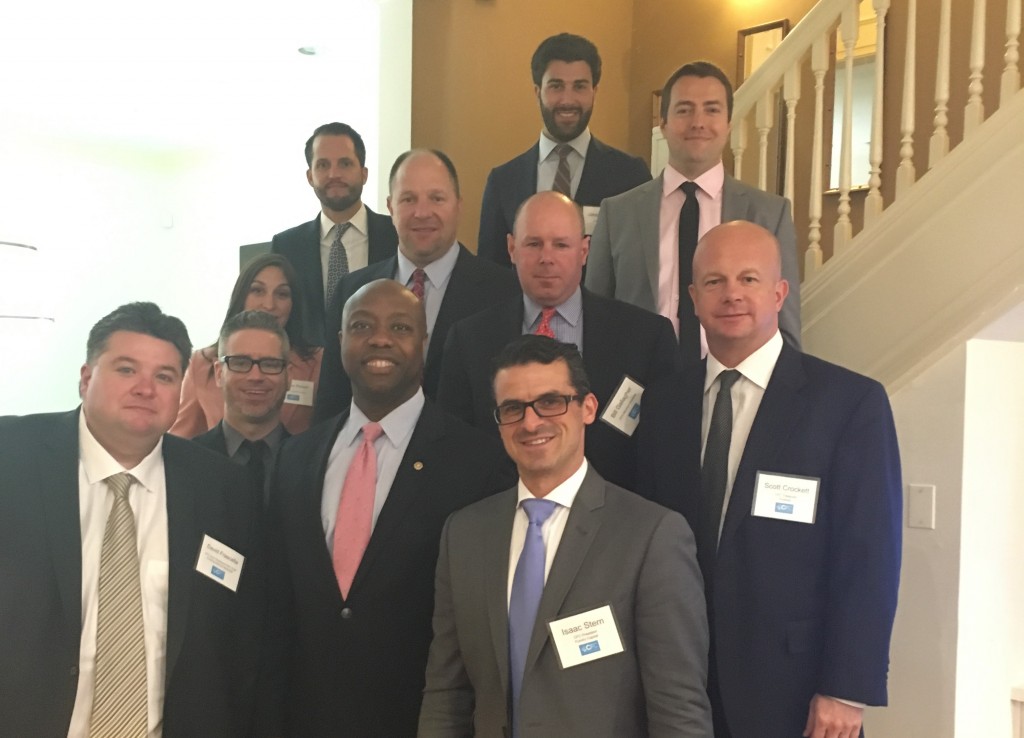
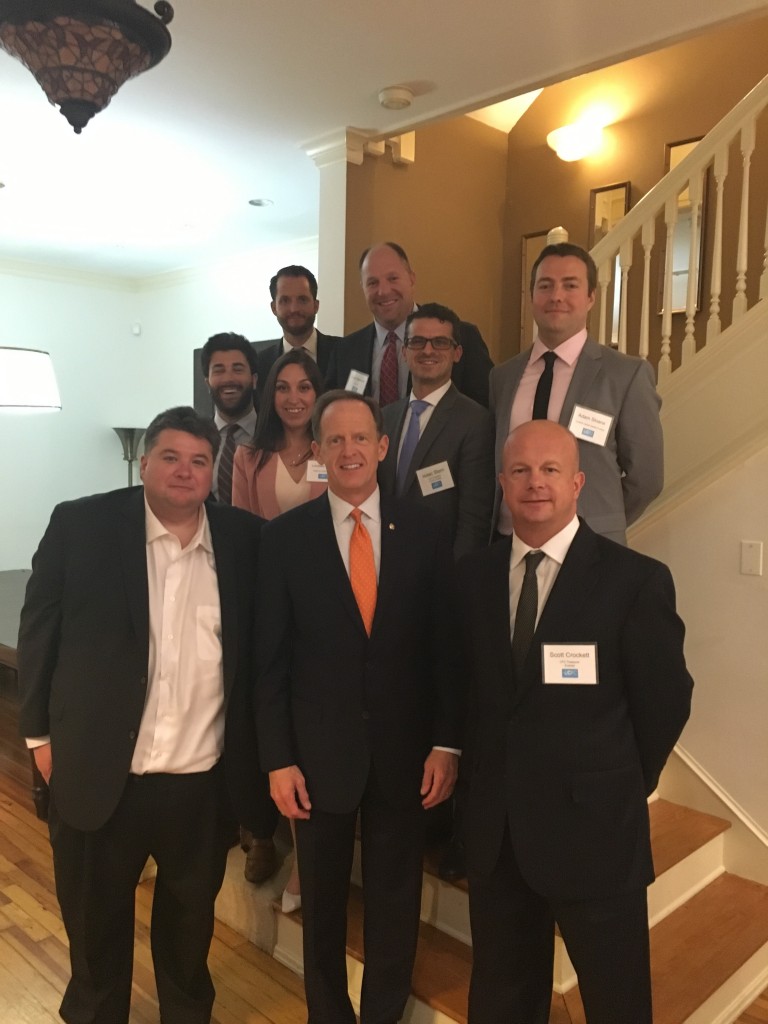
June 17, 2016 Scores of companies providing working capital to small businesses descended on Capitol Hill in early May to educate policymakers about the benefits they provide to the economy. Among them was the Coalition for Responsible Business Finance (CRBF), the Electronic Transactions Association (ETA) and the Commercial Finance Coalition (CFC).
The inability of banks to satisfy the demands of small businesses is not new, nor is it a problem purely borne out of the recession, data indicates. That’s partially why the Small Business Administration (SBA) exists, according to a 2014 report co-authored by former SBA Administrator Karen Mills.
“If the market will give a small business a loan, there is no need for taxpayer support,” the report states. “However, there are small businesses for which the bank would like to make a loan but that business may not meet the bank’s standard credit criteria.” That occurs so often that the SBA actually had to temporarily suspend guarantees last year because they had reached their limit.
“The SBA has a portfolio of over $100 billion of loans that lenders would not make without credit support,” according to Mills’ report. If that number looks big, it’s because it’s comprised mainly of loans to the larger end of the small business spectrum. Smaller businesses or businesses with smaller needs anyway, continue to be underserved. The average 7(a) loan guaranteed by the SBA in fiscal year 2015 for example was $371,628. Compare that to the $20,000 – $35,000 average deal size reported by some members of the CFC.
“Small firms were hit harder than large firms during the crisis, with the smallest firms hit the hardest,” Mills’ report states, but it adds that small businesses have been responsible for adding two out of every three net new jobs since 2010.
Tom Sullivan, who leads the CRBF, emphasized to deBanked that job creation plays a crucial role in what their organization represents and stressed that it was very important to get the input of small business owners when policymakers consider new regulations.
The CFC meanwhile, estimates that aggregate funding between its members have preserved at least 1 million jobs. And OnDeck, who was on the Hill with the ETA, announced late last year that their first $3 billion in loans have generated an estimated $11 billion in US economic impact and actually created 74,000 jobs.
While the schedules and agendas of each group were different, the CFC reportedly met with nearly two-dozen House and Senate members or their staff in a single day.



Skintech? Fintech Lenders in China Accept Nude Photos As Collateral
June 14, 2016 Some online lenders in China are taking an invasive application process to a whole new level, according to People’s Daily, a Chinese state-owned newspaper. To increase the likelihood of repayment, applicants may be required to upload a nude photo of themselves while holding an ID card, along with contact information for their friends and family members. And if they don’t pay, they’ll threaten to distribute it to all of them accordingly.
People’s Daily wrote that the borrowers tend to be educated university students and they are willing participants to these harsh terms if it means they can get the loan they seek. After all, they actually have to take the photos and upload them to the lender in the first place. Insiders reportedly said that naked IOUs have been a practice for a long time.
A reporter for Sixth Tone, a hip media company overseen by the Chinese government, was able to find a student lender online during their journalistic investigation that indeed requested a nude photo and family contact information. The ability to actually repay the loan was not assessed by the lender.
Fu Jian, a lawyer at Yulong Law Firm based in Zhengzhou that was interviewed by Sixth Tone said that the use of a naked photo as collateral is not forbidden by law, even if it does raise ethical questions. Were the photo to be leaked, only then would the law have been broken. “The online lending industry is like a food chain with some huge financial groups on the top, followed by the platforms, then the middlemen,” Fu said to Sixth Tone. “Students, sadly, are just the prey.”
The highly predatory practice is obviously carried out by unscrupulous players and is not representative of the fintech industry in China.
Jason Reddish Talks Business Lending On Cleveland Radio
June 14, 2016Total Merchant Resources CEO Jason Reddish talked all things lending on AM 1490 in Cleveland, Ohio recently, including much about the alternative business financing industry. Have a listen below:
Reddish was also kind enough to give a shout out to deBanked at about 9 and a half minutes in.
Reddish and his business partner Val Pinkhasov made a splash in the industry after their appearance on ABC’s Shark Tank in 2013.