Articles by deBanked Staff

PayPal Pulls Back on MCAs and Business Loans
November 2, 2023PayPal’s merchant cash advance and small business loan originations in 2023 are down significantly from 2022. The company revealed that it had only purchased $1.3B in merchant receivables for the first 9 months of this year versus $2.3B over the same period last year.
In the earnings call, Acting CFO Gabrielle Rabinovitch said that the company is maintaining a “tightened origination strategy for the PayPal business loans portfolio.”
Charge-offs are up. “The increase in the charge-offs for the nine months ended September 30, 2023 compared to the same period of the prior year was due to the expansion of acceptable risk parameters in 2022, which resulted in a deterioration of the overall credit quality of loans outstanding,” the company disclosed.
Two Commercial Financing Bills Introduced in Pennsylvania
October 28, 2023 Add Pennsylvania to the list of states with commercial financing bills. Last week, Representative Kristine C. Howard introduced HB1791 and HB1972, which would outlaw Confessions of Judgment provisions in contracts and require mandatory disclosures to businesses respectively. In the latter, commercial financing providers would be required to disclose the total amount of funds provided, the total dollar cost of the financing, the term or estimated term, the payment method/frequency, prepayment policy, and APR.
The bills were expected. Rep. Howard pledged to introduce them back in February when she circulated a memo titled “Protecting Small Businesses from Predatory Lending.“
Enova Discussed Its Q3 Performance, Its View on the Small Business Loan Market
October 24, 2023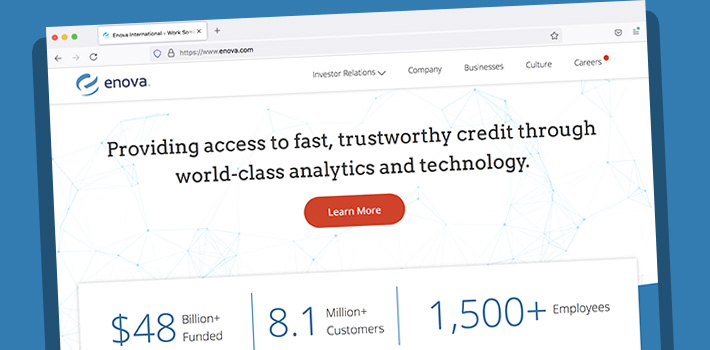 Enova originated $783M in small business loans in Q3, which is up from $770M in Q1 and $712M in Q2. Overall company profitability was slightly down but mainly because they increased marketing spend later in the quarter in which there was not enough time to also experience the corresponding revenue increase.
Enova also recorded some slightly higher-than-expected chargeoffs that came from their 2nd half 2022 smb loan vintages.
“As you would expect, our underwriting models adjusted based on this data and vintages since January of this year are back in line with our expectations,” said Enova CEO David Fisher on the earnings call. “But since there is a 9 to 12-month emergence period for charge-offs in our small business products, charge-offs from those second half 2022 vintages were at their peak in Q3 of this year.”
Given the current interest rate environment, the call drew out some insightful information about the small business loan market. Bullet points below:
- “…while prime and super prime borrowers are facing higher interest expense due to the increase in the Fed funds rate, we have not raised our pricing.” – Fisher
- “I think the competitive environment is still pretty benign, like we’ve been talking about for a while. Nothing new on the small business side. I think we’ve seen, as we talked about, competitors struggle with liquidity, also a couple move more towards the prime space in SMB.” – Fisher
- “On the small business side, still a lot coming through the wholesale channel through ISOs, but we continue to grow our direct channel. It’s a very fast-growing channel for us” – Fisher
- “So if the consumer falls on their face, small businesses are in big trouble. We saw that during COVID, but if the consumer is still spending and doing well, the small businesses tend to be a big beneficiary of that incremental spend.” – Fisher
- “While there’s a lot of uncertainty in the economy today, both internal and external data lead us to believe that both our consumer and small business customers are navigating it well.” – Fisher
- “Inflation continues to moderate, while the labor market and wage growth continue to be very strong.” – Fisher
- “To be clear, Enova overall is in great shape, and we’re feeling good about Q4 and next year.” – Fisher
NetSuite Introduces NetSuite Capital
October 22, 2023 NetSuite announced a series of new product innovations last week, including one named NetSuite Capital. NetSuite Capital is an embedded service that allows NetSuite customers to “accelerate payments and increase working capital by reviewing, pricing, and submitting invoices from accounts receivable for immediate payment.”
NetSuite’s market is large. Over 25,000 businesses use it to process $1 trillion in invoices annually.
The technology that makes NetSuite Capital possible is powered by Raistone, a b2b finance payments company that has landed big partnerships including Mastercard, SAP, C2FO, and more. According to Raistone, “4 million companies submit and receive $6 trillion in invoices annually.”
NetSuite is a cloud ERP system that was acquired by Oracle in 2016. Unlike Quickbooks which is mainly an accounting software for small-to-midsize businesses, NetSuite is primarily for larger businesses that are looking for an all-in-one ERP solution.
Whoa, That’s a Lot of Bad EIDL Loans
October 19, 2023 When the SBA revealed it had charged off $220M worth of covid-related EIDL funds before the first payment on any of those loans was even due, it suggested that things were not going to go well. Payments on just the earliest issued loans started at the end of last year and by March the SBA made a shocking disclosure. $62 billion worth of loans were already delinquent. This number is all the more alarming when put into the perspective that there were only $380B in EIDL funds loaned total. That means that 16% went bad straight out of the gate.
Oh, and this number is growing and the SBA is feeling overwhelmed to the point where they’re not even trying to collect on many loans.
“…the SBA had already decided that it would not take the most aggressive actions possible to pursue borrowers who received loans worth $100,000 or less,” the Washington Post reported.
This strategy has not been well received by Office of Inspector General Hannibal Ware. In a letter Ware wrote to SBA Administrator Isabella Guzman on September 29, he said, “SBA’s decision to cease collections risks violating the Debt Collection Improvement Act of 1996, which prohibits ending collections on fraudulent, false, or misrepresented claims, because SBA OIG and other oversight agencies are continuing to work on identifying COVID-19 EIDL fraud that may not have been identified by the agency. It is also unclear whether SBA plans to end active collections on loans for borrowers who received multiple COVID-19 EIDLs of $100,000 or less that, when combined, exceed $100,000.”
Unlike PPP loans, which if not forgiven had to be repaid in full within two years, the EIDL program extended very generous terms with a 30 year repayment schedule.
The OIG has asked the SBA to evaluate the possibility of selling a portion of its EIDL debt to maximize the return to taxpayers.
ISO Arrested by FBI
October 18, 2023 A merchant processing ISO was arrested by federal agents this week for his alleged role in a business loan fraud scheme. Paul Paredes, who owns J&E Business Consulting LLC in Rochester, NY, allegedly used the identities of his merchant processing clients to obtain business loans for himself.
“Small businesses provide J&E with their financial information, such as the owner’s identifying information, including driver’s license, social security number, and email, as well as bank account information,” the Assistant US Attorney said.
According to the complaint, between May and November 2022, Paredes fraudulently submitted approximately 42 loan applications using the identities of approximately 31 individuals, enabling him to obtain millions of dollars. He used the money to pay off one victim, pay other loan companies, and he used it on personal expenses such as credit cards, travel, and vehicles.
Paredes is also facing a related civil lawsuit over the matter. According to public records, his company has also used and defaulted on several merchant cash advances from as far back as 2016 to as recent as this year.
“Although a comprehensive analysis of all known accounts has not yet been completed, the financial transactions in the [bank] accounts appear to be consistent with Paredes laundering the fraudulent loan proceeds obtained from the lender companies, which are proceeds of a Specified Unlawful Activity, namely wire fraud, in a similar fashion to a ‘Ponzi scheme’ and inconsistent with the operations of a legitimate business enterprise,” an FBI agent said in an affidavit.
Massachusetts Legislators Propose Small Business Lending Data Collection
October 16, 2023 Legislators in Massachusetts are proposing a set of requirements designed to monitor small business lending in a manner that is similar to the CFPB.
In a set of parallel bills that mostly say the same thing (S.234, S.1986 H.2997), they call for the Division of Banks to require “the collection of small business lending data from all lenders, including online lenders, and small businesses on an annual basis.”
It also said that the regulations would include:
(1) the establishment of a central depository of the collection and analysis of small business lending data, to include, but not be limited to the following: lending and banking institutions’ average annual percent rates, default rates, and fees.
(2) procedures for the solicitation and acceptance of reports regarding small businesses’ incidents of predatory lending practices.
(3) procedures for assessing the credibility and accuracy of reports of small business lending data from lending institutions.
Although this was proposed back in February it has since shifted back into the conversation in the state. The next hearing on the bill will take place on October 19. It can be found under the category of “An Act to promote inclusive entrepreneurship and economic justice.”
NY Appellate Division Rules One Funder’s Contract Crossed Loan Threshold
October 12, 2023While New York’s Appellate Division has previously decided what’s not usury when it comes to MCA transactions, the Second Department has now ruled what is.
On Wednesday, the Court issued its decision in Crystal Springs Capital, Inc v. Big Thicket Coin, LLC et al, a case that had otherwise started out as a routine breach of contract action related to the purchase of future receivables in the New York Supreme Court back in September of 2020. When defendants never appeared, the plaintiff obtained a default judgment eleven months later. That sparked a response from the defendants who then sought to vacate it on several grounds, including by arguing that the underlying agreement was really a criminally usurious loan. The Court rejected the argument for several reasons, citing that the “reconciliation language in the Agreement is nonillusory” and stating plainly that “a merchant cash advance agreement is not a loan and therefore its terms are not usurious.” Vacatur denied. Defendants appealed.
Given the history in New York (1st Dept, 4th Dept, etc.), the case was hardly news, until now.
In the new Decision & Order, the Court said that “the defendants established that the agreement constituted a criminally usurious loan.” In support of that outcome, the Court said that the plaintiff was “under no obligation” to reconcile the payments and that the full uncollected purchased amount plus all fees were due in default even if the business declared bankruptcy. (View contract at issue here)
“Together, these terms established that the agreement was a loan, pursuant to which repayment was absolute, rather than a purchase of future receipts under which repayment was contingent upon the Big Thicket defendants’ actual sales,” the Court said. “The plaintiff does not dispute that the agreement effected an annual interest rate exceeding the criminally usurious threshold of 25%.”