Small Business
Law to Reduce Debit Card Fees to Retailers Has Opposite Effect
December 12, 2011We’ve had many negative things to say about the debit card reform law that went into effect a few months ago (AKA the Durbin Amendment). We’ve repeatedly made claims that retailers won’t participate in the savings but for the few that do, those savings won’t be passed on to the consumer.
According to a recent article in the Wall Street Journal, something much worse is happening; Debit card fees are going up!
“Jason Scherr had a lot on his mind the day after he opened his fifth Think Coffee shop in Manhattan last week. The fan was blowing too hard, the classical music was playing a little too loudly—and he was trying to figure out how to get more customers to pay with cash.
Manhattan coffee-shop owner Jason Scherr says his debit-card fees are higher since the Dodd-Frank law.
A new law that was supposed to reduce costs for merchants that accept debit cards has instead sent Mr. Scherr’s monthly processing bills much higher and forced him to reassess the way he does business.
“My choice is to raise prices, discount for cash or get an ATM,” says Mr. Scherr, a lawyer who has been in the coffee-shop business for more than a decade.
Just two months after one of the most controversial parts of the Dodd-Frank financial-overhaul law was enacted, some merchants and consumers are starting to pay the price.
Many business owners who sell low-priced goods like coffee and candy bars now are paying higher rates—not lower—when their customers use debit cards for transactions that are less than roughly $10.
That is because credit-card companies used to give merchants discounts on debit-card fees they pay on small transactions. But the Dodd-Frank Act placed an overall cap on the fees, and the banking industry has responded by eliminating the discounts.
“There will be some unhappy parties, as there always is when the government gets in the way of the free-market system,” says Chris McWilton, president of U.S. markets forMasterCard Inc. He said the company decided that it couldn’t sustain the discounts under the new rate model because the old rates had essentially subsidized the small-ticket discounts.
Merchants now are trying to offset their higher rates by raising prices, encouraging customers to pay in cash or dropping card payments altogether.”
Read the full article at WSJ.com
Occupy Main Street?
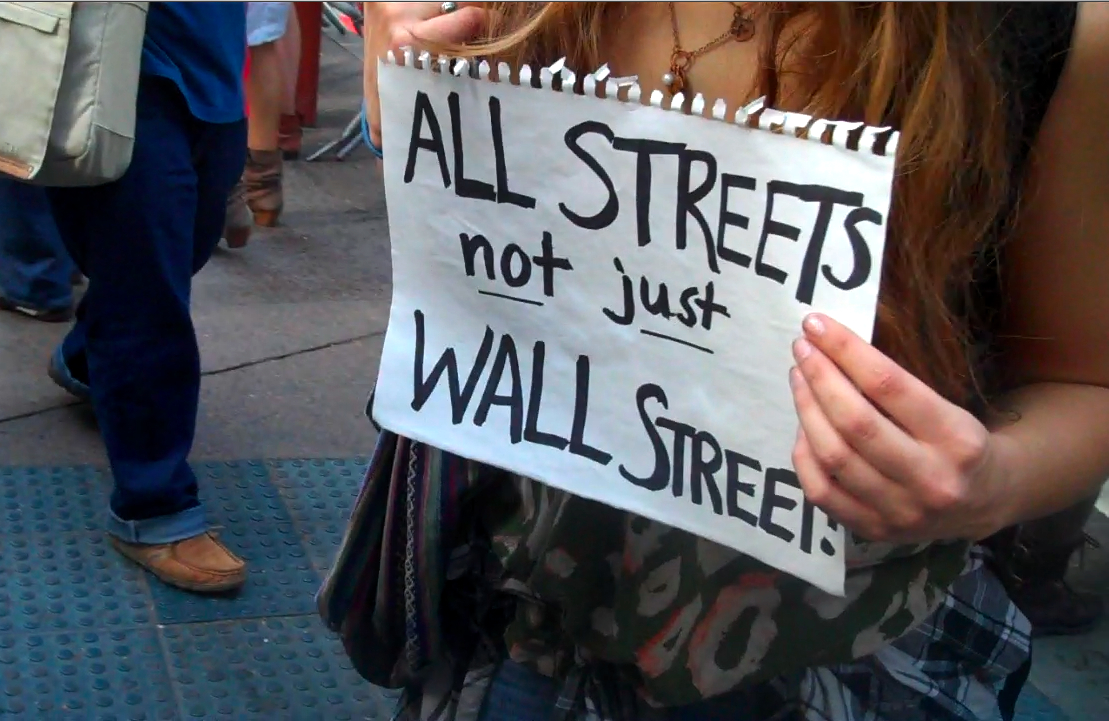
October 10, 2011 We didn’t protest… but we decided to see who was. Nowhere in the strange crowd did we find outraged business owners. Could the occupiers of Wall St. also be fighting against Main St.?
Wall St. bankers might have a lot of money, but small businesses employ the most jobs in America. Chances are if you are unemployed, unhappy, or overworked, it will ultimately be Main St. that will save you. But for time being, nobody is hiring. Business owners are pointing the fingers at banks, citing the lack of loans has stalled expansion. Excuses, excuses…
Wall St. might have perverted capitalism to enrich themselves, but Main St. has done just the opposite lately. When presented with an opportunity, thousands of businesses are unwilling to take the risk. “We’re just holding on for right now,” is a phrase we hear way too often from Mom and Pop shops.
We posed this question to an unnamed ‘Occupy Wall St.’ protester today:
MPR: “If we gave you $10 today, could you turn it into $20? “
PROTESTER: “Hell, I could turn it into $100. You can make money on a lot of stuff going on down here.”
Capitalism lives… It’s the drive and execution that enables someone with $1 to turn it into $2, $5, or $100 in a marketplace. It’s an intuition that Americans are born with, even those with anarchistic tendencies yelling in protest against it.
But something has happened to our beloved Main St.
Opportunities to grow are being passed up, and with that the ability to hire more workers. The rich get richer by investing their capital and taking risk. In a competitive marketplace, we must always seek out ways to grow, expand, and improve. “Holding on” is not a strategy, at least not one that will lead to hiring. Stability does not prepare you for downturns, nor will it make you rich in the long term. Stability is actually the beginning of a long road that will one day lead you to being mad at those who got rich.
The math is simple. If you turn $1 into $1.10 everyday, while somebody else turns $1 into $2, expect yourself to be very poor by comparison 20 years from now. Whether you have a small retail store or a national franchise, don’t let your guard down, take chances, think big, and elbow your way to the top 1%. You’ll create a lot of jobs on the way.
Once you’re ready to turn $1 into $2, don’t worry about the lack of bank loans, Merchant Cash Advance providers will offer you $1 in return for $1.30. You net the profits and can redo it as often as you like. Naysayers will tell you it’s expensive and it would be if you didn’t invest the dollar. Rebuilding the economy begins with small business. Show them growth, show them jobs, show them how you were born to turn one dollar into two…
deBanked
http://www.merchantprocessingresouce.com
Learn about Merchant Cash Advance Here
Some video clips we took while we were at the Wall St. protest:
SBA Lending Statistics for Major Programs (as of 9/23/2011)
September 29, 2011This report provides statistics on Year to Date (YTD) SBA Business Loan Approval Activity comparisons for Fiscal Years 2009, 2010, and 2011 for the period ending 09/23/2011.
You Can’t Spend Your Way to Prosperity
September 8, 2011If ever there were proof that the government can’t spend its way to prosperity or job creation, this would have to be it:
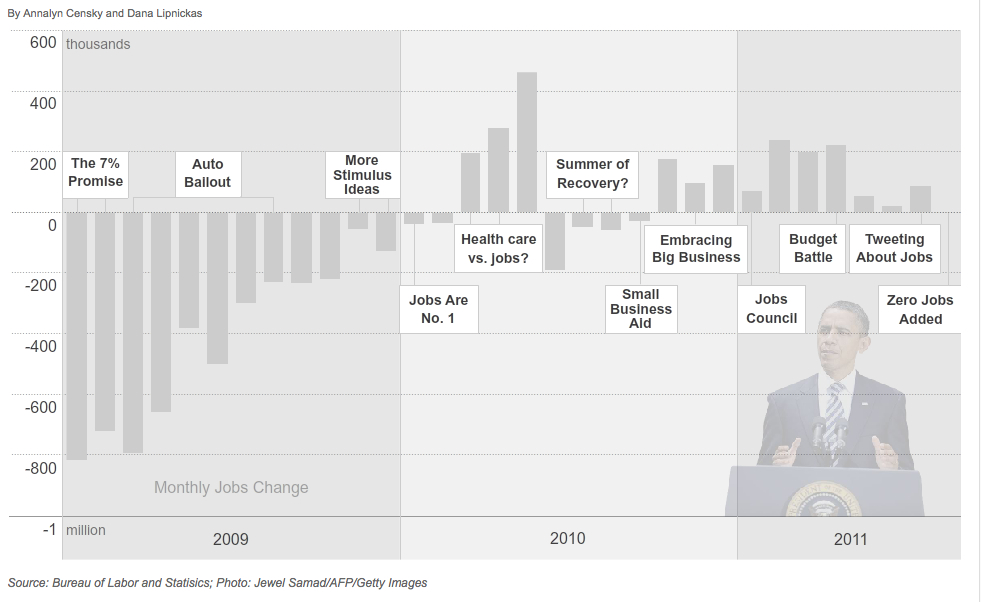
Click the link to view the original chart on CNN so you can use the interactive features:
http://money.cnn.com/news/economy/storysupplement/obama_jobs_timeline/
What Recovery? Small Businesses are Still Suffering
August 23, 2011
Experts claim the economy is getting better, but average Americans have yet to claim the same. According to the March Discover Small Business Watch Survey, 54% of small business owners said the U.S. economy is getting worse. The sentiment seems to fly in the face of the stock market’s surge forward, as well as a declining unemployment rate. As of the latest March jobs report, unemployment ticked an inch downward to 8.8%. Sadly, the official unemployment rate does not count individuals that have been unemployed for an extended period of time or have given up looking for work altogether, traits that characterize many of the ACTUAL unemployed in this country. (Find out who the labor force consists of)
The unemployment rating system loses accuracy in prolonged recessions and therefore 8.8% is not valid, nor worth comparing to previous months. In an Interview with Reuters, Bill Cheney, the Chief Economist at John Hancock Financial Services stated, “It is always possible that as the job market improves, people will start looking again and the unemployment rate could go up.” That being said, the one true measure of the economy is the voice of the people.
As a member of the U.S. Chamber of Commerce, the Merchant Cash Advance Resource is constantly tuned in to the issues of small business owners. And guess what? We’re not hearing much positive feedback there either. The lending and capital markets continue to be a pressing factor, but federal, state, and local government regulations are stymieing innovation and expansion as well. From the Chamber, “With increasing uncertainty and government barriers threatening America’s economic recovery–Congressional leaders are reaching out to business owners to hear what is hindering their growth and what can be done to remove barriers.” (Watch the videos and interviews here)
In the face of discouraging news, access to capital is slowly making a comeback but not from the banks. Alternative financial firms providing a product known as a Merchant Cash Advance will buy your future credit card sale receivables in exchange for a big chunk of cash today. Different from a loan and becoming widely accepted, businesses all over the country are taking advantage of the most innovative form of financing available. In a true level playing field, ‘mom and pop’ shops are just as eligible as the major franchises to receive up to $250,000.
Next month, the experts could claim an unemployment rate of 0%. So long as the statistics fail to reflect reality, it becomes more frustrating for Americans who continue to live through a recession that never actually ended. High unemployment, scarce capital, and job killing regulations still plague commerce. We’re not experts ourselves, but if 54% of business owners testify that things are getting worse, they probably are. With the Dow at a 52 week high, now is a great time to sell…
– The Merchant Cash Advance Resource
Credit Card for Business Owners? Forget it!
August 23, 2011Posted on April 4, 2011 at 9:59 PM
“Anyone that owns a small business is automatically declined,” revealed an inside source at a major credit card issuing bank. A friend of ours that we’ll call Dave (name changed), is an underwriter in charge of approving credit card applications. We were discussing tighter credit standards for consumers, an issue we felt to be of little relevance to business credit, until it got interesting.
According to Dave, and the bank doesn’t make this information public, small business owners and the self-employed are issued automatic declines for cards. “Just to get a simple credit card?”, we asked. Dave explained that their data indicates consumers are less risky than the self-employed. We dug deeper and were told his:
- Employed consumers are more likely to have a fixed budget and steady income.
- Business owners experience continuous ups and downs. During a down, they are more likely to supply their employees with their steady paychecks and skip out on the credit card payment until cash flow improves. If they did it the other way around, they would lose their employees and the business wouldn’t last.
- Employed consumers are better equipped to prove their income since they have verifiable documents such as W-2s or paystubs.
- Business owners are less able to verify their income, more likely to show losses on their tax returns, and less willing disclose their true financial status. Though this may serve them well come tax time, it works against them on credit applications.
But that shouldn’t discourage small business owners from applying. Dave concedes they’ll consider extending credit to businesses open longer than 20 years so long as the applicant has above 720 credit. Ouch!
The Ugly Face of Business Credit Cards
So if you don’t make the cut, or even if you do, credit cards aren’t so attractive these days anyway. The Credit Card Act of 2009 made major changes for consumers but NONE for businesses. In an article by creditcards.com, titled “10 ways business credit cards are different“, is a list of many dangers to look out for. If you’re a business owner, these are the pitfalls:
- A teaser rate can be as short as 6 months, 3 months, or even 1 day. That attractive 2% rate can be increased on a whim as soon as you sign up or start using the card.
- There is no minimum amount of time to notify you of a payment due. Consumers are required to receive their bill at least 21 days in advance of the payment due date. For business owners, you might not get the bill until the day before!
- Your due date can change every month. Don’t get too comfortable paying on the 30th every month, your card company can switch it up to throw you off and entrap you with late fees.
- There are no late fee penalty limits.
- Payments are applied to the balance with the lowest interest rate first, instead of to the highest interest rate like consumer cards.
- The business owners are usually personally liable for the business card’s debt.
What’s the Alternative?
It’s bad news galore but there’s light at the end of the tunnel. A unique financial product known as a Merchant Cash Advance (MCA) offers all the positive features of a credit card and spits out the negative. Any business that accepts credit/debit card payments from their customers is eligible. Different than a loan, a MCA provider purchases the future card revenues of the business in exchange for a lump sum of cash today. The benefits and differences are truly astounding.
- Good credit is not necessary.
- Funds can be received in under a week. (You can barely get a credit card that quick)
- A business can qualify with as little as 3 months in business.
- The “rate” or the cost of the funds can’t change. Once the cost of funds has been established and executed, it remains the same. The balance does not increase with time nor is there any element of interest.
- Because the balance is only reduced by withholding a percentage of card sales, less funds are withheld in slow periods, and more in strong periods. This tackles the issue of business ups and downs.
- There are usually no personal guarantees.
- Additional funds can be made available before the balance has been reduced to zero.
- Personal income does not need to be verified, just the monthly credit/debit card sales volume.
- Your credit can’t be negatively affected since it is not a loan.
Becoming a First Choice Option
A Merchant Cash Advance is not a last resort method of financing and is quickly becoming a first choice pick in the business world. Certainly better than business credit cards, they also rank better than SBA Loans. [SBA Loan vs. Merchant Cash Advance]
Before you fill out that credit card application, just remember what our friend Dave said. “You’re automatically declined.” Say goodbye to the card issuing naysayers and SBA Loan ploys. The lending system is too far broken to be aggravated about it anymore. If your business needs capital, you can simply sell your future card sales in exchange for cash today. Check out the true direct funding sources in our directory and walk away with flexible financing your business can depend on.
– The Merchant Cash Advance Resource
I want my credit card sales now! Why the delay?
August 23, 2011
One of our readers e-mailed us wondering why there was a delay from the point of the sales transaction to the time the proceeds are deposited into his bank account.
An Excerpt:
I’m curious if there is any imaginable justification for processors/merchant banks delaying card payment to merchants over the weekend. My thursday sales are deposited on Monday, Friday’s on Tuesday — four day’s float.
I don’t actually follow your blog regularly, so if you got the inclination to write about this, an email would be much appreciated so I don’t miss it.
Thx,
Steve
======================
Hi Steve,
Don’t blame your processor/merchant bank. They are merely 1 party out of many involved in a single transaction. We’ll divide this into 7 categories for the purpose of this explanation:
- Customer
- Customer’s card issuing bank
- Business
- Business’s merchant processor
- Business’s checking account bank
- The acquiring bank
- The payment network
- A customer comes into your store with a MasterCard credit card he got from Bank of America. He makes a purchase for $500.
- Your merchant processor passes that up to the Acquiring bank they are sponsored by. (An acquiring bank is the bank that allows them to be a payment processor. They have the permit to use the MasterCard and Visa Networks.)
- The acquiring bank uses the MasterCard network to trace the payment to Bank of America. They will then find out from Bank of America if the card information is valid, if the account is active, if there is a freeze on the account, whether or not they are under their spending limit, and then request for it to be approved. Bank of America will then reject or accept the transaction and notify the acquiring bank, who will then pass it along to your merchant processor.
- Your merchant processor will then determine if the sale was processed in a manner that is allowable by your merchant account contract. Is $500 a normal sized transaction or suspiciously high? How often have you charged this customer? Did you swipe his card or key in the numbers? Is the way you did it considered normal for your business type? Did it prompt for a zip code when you entered the info and if so, did you get the answer right or wrong? All these factors are considered by your merchant processor before approving the sale. Most of it happens by computer, but some by human audit.

- Once the transaction is approved by all parties, they initiate a wire. Only Federal Reserve wires are instant and they cost a lot of money to send. So rather your merchant processor transfers your sales via the Automated Clearing House (ACH). Those sales never post the same day and the time they post to your account the following day depends completely on what time your bank chooses to accept the wire. Your bank has the ability to accept or reject incoming wire transfers. How large is this incoming transfer? Has there been suspicious activity on the account? Is the customer’s account seriously overdrawn with unpaid outstanding fees? This is decided mostly by computer but also by people. Once approved, that original $500 sale is finally available for you to spend.
So don’t fault your merchant processor. They’re at the mercy of the payment network and banking systems. That being said, next day deposit DOES exist but not everyone can offer it. If the acquiring bank that allows you to accept card payments is also the same bank where you keep your business checking account, then chances are you will already have next day deposit by default.
In regards to the weekend being included in the delay time. If the banks are closed, then the banks are closed. There is nothing you can do about that. That’s the American banking system. Hope that helps!
– deBanked