

Sean Murray is the President and Chief Editor of deBanked and the founder of the Broker Fair Conference. Connect with me on LinkedIn or follow me on twitter. You can view all future deBanked events here.
Articles by Sean Murray

Merchant Cash Advance Animation
August 23, 2011
Very amateur but worth sharing. I think a better phrase might’ve been “Inflate your profits with a Merchant Cash Advance” since the terminal inflates. Hopefully your computer can handle a 1.4 megabyte animated image.

Take Your Rewards Card and Get Out of My Store
August 23, 2011
2010 has been a wild ride for the payment network giants and card issuing banks. On the one hand, The Wall Street Reform and Consumer Protection Act that went into effect July 21, made significant improvements to card acceptance policies for merchants(summary here). Businesses may now legally offer discounts to customers willing to pay in cash. In the past, business owners have argued that card interchange fees reduce profit margins and therefore they should have the right to incentivize cash payments. This argument won the hearts of lawmakers and is now law.
On the other hand, the U.S. Justice department filed antitrust lawsuits against card behemoths Visa, MasterCard, and American Express on October 4th for anticompetive practices. It broaches the same issue, the ability for merchants to incentivize discounts for cash. Visa and MasterCard settled immediately, citing mainly that the lawsuit sought to challenge policies that had already been changed. They did however agree to expand on a merchant’s right to incentivize discounts, including (and most shocking) their right to discourage the use of a rewards card by a consumer. A direct quote from Visa’s press release on the subject “As part of the settlement, Visa will allow U.S. merchants to offer discounts or other incentives to steer customers to a particular form of payment including to a specific network brand or to any card product, such as a “non-reward” Visa credit card.”
The ramifications of this settlement are earth shaking. A retailer still can’t discriminate amongst card issuing banks and everyone would agree that’s fair. For instance a business can’t choose to only accept Bank of America Visa cards and not accept HSBC visa cards. The problem is that customer John Doe has a rewards card that pays him 1% Cash Back on all purchases. When he makes a $100 purchase, the $1 is credited to him by the bank that issued him the card. Most consumers don’t realize that cost is passed on to the business, who is then essentially being charged an additional 1% in their interchange fees to pay for John Doe’s reward.
Business owners made the case that they should have the right to offer a discount for cash or as it now becomes clear, the right to tell their customer not to use a rewards card.
I use my rewards credit card everywhere I go, and I tend to fall in the obnoxious category of consumers that whip it out just to buy a $1 cup of coffee. Until recently, any retailer enforcing a credit card sales minimum was in breach of policy and subject to termination for card acceptance altogether. Many retailers took the risk anyway. That policy was abolished in the Wall Street Act in July. Businesses now have the right to set a minimum. Having worked in the payments industry for several years, it was a necessary and long overdue step.
The average individual transaction cost is 20 cents, which excludes the interchange rate. A $1 cup of coffee would generate a loss of 23 cents in card fees alone, therein making the sale moot for the retailer. Consumer card behavior is difficult to change. I still try to use my card for coffee for example, regardless of the impact.
Larger ticket items are certain to create a consumer uproar. Here’s the problem:
John Doe goes to Best Buy and pays $100 for DVDs on his regular Visa card. Next in line is myself and I try to purchase the same DVDs with my 1% Cash Back rewards card. The cashier tells me I can either:
A. Pay $101 with my rewards card
B. Use a non-rewards card and pay $100 like John Doe did
C. Pay $98 in cash
While it is great to have options, my non-rewards card is reserved only for emergencies and I don’t have that much cash in my wallet. While it’s only a $1 difference, I’d like to pay the same amount as the previous customer. After all that $1 “cash back” isn’t immediately credited to my bank account, it’s stored as account points which will accrue over time and eventually pay me a reward. As far as I can tell the previous customer was using the same rectangular piece of plastic as me. Why should my personal private rewards contract with my bank now interfere with my ability buy products at the same price as other people?
The cashier argues that the retail price of the DVDs are $101 and $1 off is essentially the discount for using a non-rewards card. The consumer in me doesn’t seem to agree and the fictional Best Buy in this scenario would have a discrimination lawsuit on their hands.

As a card payments veteran, I find this discretion beneficial to the business, but as a consumer I find it intrusive and discriminatory. I would not like cashiers to inspect for reward program clues every time I use my card. If the signatures match, I’d like to pay the same price as every other customer.
My bank recently offered a limited-time-only 3% Cash Back program. I can only imagine what would happen when you actually try to use it. “Hey you, get out my store!” The new rewards card these days is the card that rewards you with a discount for not using a rewards card. Thank you Justice Department and Congress for making every day ‘opposite day.’
And to the first retailer that tells me they have the right to charge me more for using a Cash Back card, I’ll see you in court.
Electronic Payments Industry changing Forever – All Points Bulletin!
August 23, 2011Electronic Payments Industry Changing Forever – ALL POINTS BULLETIN
Posted on December 17, 2010 at 8:36 PM
Attention business owners and to all those employed in the merchant processing and Merchant Cash Advance industry. The world is changing and not at the ‘global warming will one day kill us all’ pace. It’s happening right now. Remember that little thing called the Wall Street Reform and Consumer Protection Act that passed in July? There was a little itty bitty part in there that we so happened to broadcast and critique in detail on our site, known as the Durbin Ammendment. Take a look the law’s summary, particularly #3. On the evening of December 16th, the Federal Reserve Board delivered an early Christmas present to all the debit card networks and big banks. The gift contained the government’s proposed debit card fee changes, or as some bank executives might tell you, “they mailed us 10 sticks of dynamite.” If you’re serious about this business, read through the 176 page document that every news agency is trying to sum up in 3 paragraphs.
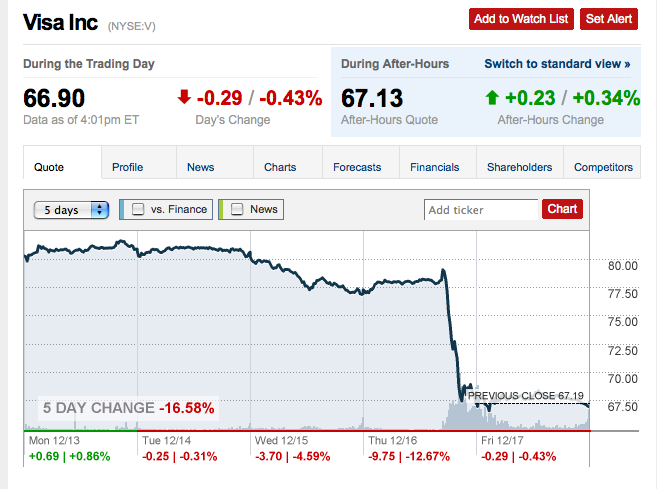
Visa’s stock plunged on the news
Debit cards accounted for 35% of all non-cash transactions in 2009. The proposed changes seek to cap the fee charged for accepting a debit card to a maximum of 12 cents. According to the report issued by the Board, here’s what businesses are paying now:
“Networks reported that debit and prepaid interchange fees totaled $16.2 billion in 2009. The average interchange fee for all debit transactions was 44 cents per transaction, or 1.14 percent of the transaction amount. The average interchange fee for a signature debit transaction was 56 cents, or 1.53 percent of the transaction amount. The average interchange fee for a PIN debit transaction was significantly lower than that of a signature debit transaction, at 23 cents per transaction, or 0.56 percent of the transaction amount. Prepaid card interchange fees were similar to those of signature debit, averaging 50 cents per transaction, or 1.53 percent of the transaction amount.”
Debit interchange fees have always been assessed as a percentage of the sales amount. The larger the transaction size, the higher the fee. Debit cards are most frequently used for smaller purchases but a flat cap on transaction fees regardless of transaction size is a game changer. Now twist this with the fact that interchange fees are almost disappearing altogether and one needn’t think too hard about the unintended consequences.
MasterCard issued a statement immediately. “Experience demonstrates that consumers, not banks or payments networks are the biggest losers as a result of this regulation,” said Noah Hanft, MasterCard’s general counsel. “This type of price control is misguided and anti-competitive, and in the end is harmful to consumers.” Visa hasn’t provided any useful feedback at this time but has openly condemned the report.
The Board acknowledges that some card issuers can’t even cover their own costs with the 12 cent transaction fee in effect. This Board’s direct response to this dilemma is that they simply don’t care. “An issuer with costs above the cap would not receive interchange fees to cover those higher costs. As a result, a high-cost issuer would have an incentive to reduce its costs in order to avoid a penalty.”
Thank you Federal Reserve for the feeble minded, anti-capitalistic solution. “Just lower your costs or we’ll fine you.” The outrage is warranted because the proposal isn’t really a proposal at all. This is the new order granted to the government after the passage of the Wall Street Act back in July. The payment networks and banks may comment on this proposal but effective July 21, 2011, this simply becomes law.
This is the equivalent to forcing all the businesses in America to lower their retail prices under penalty of law as the solution to dealing with consumers whining about the recession.
Additionally, the Board constantly refers to the life cycle of a debit sale to being a 4 party transaction. There is:
* The bank that issued the card to the customer
* The customer
* The business that the customer shops at and uses the debit card
* The acquiring bank that the business uses to accept debit cards
The payment networks are what allow the acquiring banks to communciate with the banks that issued the debit cards. The networks have costs associated with their service, infrastructure, and overhead. The 12 cents per transaction is the combined total that can be charged between both the acquiring bank, payment network, and issuing bank. There’s not a whole lot to go around.
While the Federal Reserve and congress are patting themselves on the back and high fiving eachother for saving the economy (by sticking it to the big banks), the end result will be the loss of millions of jobs, the elimination of debit cards, an increase in other bank fees, the end of all debit rewards programs, the end of electronic payments quality, the end of electronic payments assurance, and the collapse of the free market economy. Give me a high five. Not!
Here’s what will happen and why:
* The Board ignores or does not understand the electronic payments industry business model. The debit card business is not a 4 party transaction. The acquiring bank party encompasses multiple layers and parties in itself. Acquiring bank —> Payment Processor —> Indepedent Sales Office —> Sales Agents. Debit transaction costs are marked up at each level to create a competitive marketplace. The electronic payments industry employs millions of people. With a 12 cent cap and no markup abiliity, those millions of workers will lose their jobs overnight.The majority of this business is commission based, with processors and sales agents directly taking home solely what’s generated on the markup of debit/credit fees of their clients.This is probaby the most blatent and incredibly obvious oversight. There can be no competitive market because costs are fixed and there can be no sales because there is no money for anyone to earn on markups. National unemployment will rise several percent over the course of a few months.
* Rewards debit cards can no longer exist. Card issuing banks currently pay their customers rewards by charging businesses more for accepting a rewards card transaction. Since a bank no longer has that ability, rewards cards can no longer exist.
* Debit cards become a moot point for banks. With no profit incentive to put them in the hands of customers and no ability to compete on price, there is no incentive for debit networks or cards to continue.
* Quality, fraud protection, and assurance will suffer. Banks whose own costs are higher than the imposed cap face fines by the Federal Reserve unless they cut costs. Therefore the government is not only incentivizing poor quality, but in fact making it mandatory.
* Ever hear of too big to fail? This industry is too big to be messing with. These are the actual national and international money networks through which trillions of dollars move through every day. Mandating poor quality, eliminating all competition, and removing profit incentives will de-evolutionize the flow of money altogether.
The Board will review and allow comments through March 31st, at which point this industry will meet its maker. Yes, it’s that’s serious.
-deBanked
https://debanked.com
Do I Need a New Terminal to get a Merchant Cash Advance?
August 23, 2011Posted on December 19, 2010 at 6:50 PM
This past July, 2010 the Payment Card Industry Security Standards Council phased out yet another batch of credit card terminals. This has made the last 6 months a tad bit challenging for resellers of the Merchant Cash Advance(MCA) financial product. Non-compliant machines have often times caused delays in what is supposed to be a quick process.
By far and away the biggest complaint by MCA reps has been the push-back by their clients to upgrade equipment. Many merchants have been using the same credit card machine for years with no problems. This challenge is perpetuated by credit card processors that ignorantly let their clients process with non-compliant machines despite the risks. So when a MCA rep comes along and informs a business owner that their equipment violates PCI Standards, you can imagine the skeptical reaction.
Business owners should be aware that PCI Standards compliance is not something to be brushed aside. If your business is responsible for just one data breach of card holder data, the financial penalties will put you out of business. This will be no ones fault but your own. We recently added a section to our site which mirrors the basic information on pcisecuritystandards.org. That information can be found here: https://debanked.com/pcicompliance.htm
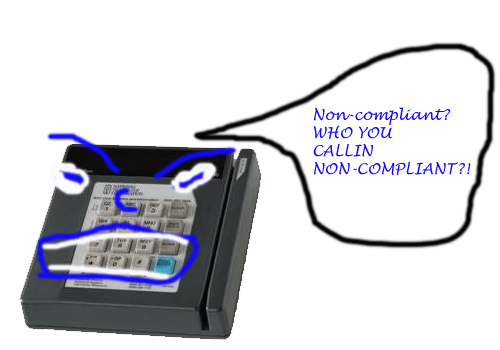
Possessing a non-compliant machine does not give your current processor or your MCA rep the right to gouge you with the cost of a brand new one. There are options available to avoid paying hundreds of dollars upfront.
* Have your processor take possession of your old machine and replace with a new one for free
* Have your processor let you borrow a new machine for a low monthly fee
* Have your processor give you a free one in return for a contract extension
* Have your processor set you up with a lease through a 3rd party
Good luck and safe processing!
https://debanked.com
Consumers Can Help Businesses Saves on their Credit Card Processing
August 23, 2011
Attention business owners and to all those employed in the merchant processing and Merchant Cash Advance industry. The world is changing and not at the ‘global warming will one day kill us all’ pace. It’s happening right now. Remember that little thing called the Wall Street Reform and Consumer Protection Act that passed in July? There was a little itty bitty part in there that we so happened to broadcast and critique in detail on our site, known as the Durbin Ammendment. Take a look the law’s summary, particularly #3. On the evening of December 16th, the Federal Reserve Board delivered an early Christmas present to all the debit card networks and big banks. The gift contained the government’s proposed debit card fee changes, or as some bank executives might tell you, “they mailed us 10 sticks of dynamite.” If you’re serious about this business, read through the 176 page document that every news agency is trying to sum up in 3 paragraphs.
Visa’s stock plunged on the news
Debit cards accounted for 35% of all non-cash transactions in 2009. The proposed changes seek to cap the fee charged for accepting a debit card to a maximum of 12 cents. According to the report issued by the Board, here’s what businesses are paying now:
“Networks reported that debit and prepaid interchange fees totaled $16.2 billion in 2009. The average interchange fee for all debit transactions was 44 cents per transaction, or 1.14 percent of the transaction amount. The average interchange fee for a signature debit transaction was 56 cents, or 1.53 percent of the transaction amount. The average interchange fee for a PIN debit transaction was significantly lower than that of a signature debit transaction, at 23 cents per transaction, or 0.56 percent of the transaction amount. Prepaid card interchange fees were similar to those of signature debit, averaging 50 cents per transaction, or 1.53 percent of the transaction amount.”
Debit interchange fees have always been assessed as a percentage of the sales amount. The larger the transaction size, the higher the fee. Debit cards are most frequently used for smaller purchases but a flat cap on transaction fees regardless of transaction size is a game changer. Now twist this with the fact that interchange fees are almost disappearing altogether and one needn’t think too hard about the unintended consequences.
MasterCard issued a statement immediately. “Experience demonstrates that consumers, not banks or payments networks are the biggest losers as a result of this regulation,” said Noah Hanft, MasterCard’s general counsel. “This type of price control is misguided and anti-competitive, and in the end is harmful to consumers.” Visa hasn’t provided any useful feedback at this time but has openly condemned the report.
The Board acknowledges that some card issuers can’t even cover their own costs with the 12 cent transaction fee in effect. This Board’s direct response to this dilemma is that they simply don’t care. “An issuer with costs above the cap would not receive interchange fees to cover those higher costs. As a result, a high-cost issuer would have an incentive to reduce its costs in order to avoid a penalty.“
Thank you Federal Reserve for the feeble minded, anti-capitalistic solution. “Just lower your costs or we’ll fine you.” The outrage is warranted because the proposal isn’t really a proposal at all. This is the new order granted to the government after the passage of the Wall Street Act back in July. The payment networks and banks may comment on this proposal but effective July 21, 2011, this simply becomes law.
This is the equivalent to forcing all the businesses in America to lower their retail prices under penalty of law as the solution to dealing with consumers whining about the recession.
Additionally, the Board constantly refers to the life cycle of a debit sale to being a 4 party transaction. There is:
- The bank that issued the card to the customer
- The customer
- The business that the customer shops at and uses the debit card
- The acquiring bank that the business uses to accept debit cards
The payment networks are what allow the acquiring banks to communciate with the banks that issued the debit cards. The networks have costs associated with their service, infrastructure, and overhead. The 12 cents per transaction is the combined total that can be charged between both the acquiring bank, payment network, and issuing bank. There’s not a whole lot to go around.
While the Federal Reserve and congress are patting themselves on the back and high fiving eachother for saving the economy (by sticking it to the big banks), the end result will be the loss of millions of jobs, the elimination of debit cards, an increase in other bank fees, the end of all debit rewards programs, the end of electronic payments quality, the end of electronic payments assurance, and the collapse of the free market economy. Give me a high five. Not!
Here’s what will happen and why:
- The Board ignores or does not understand the electronic payments industry business model. The debit card business is not a 4 party transaction. The acquiring bank party encompasses multiple layers and parties in itself. Acquiring bank —> Payment Processor —> Indepedent Sales Office —> Sales Agents. Debit transaction costs are marked up at each level to create a competitive marketplace. The electronic payments industry employs millions of people. With a 12 cent cap and no markup abiliity, those millions of workers will lose their jobs overnight.The majority of this business is commission based, with processors and sales agents directly taking home solely what’s generated on the markup of debit/credit fees of their clients.This is probaby the most blatent and incredibly obvious oversight. There can be no competitive market because costs are fixed and there can be no sales because there is no money for anyone to earn on markups. National unemployment will rise several percent over the course of a few months.
- Rewards debit cards can no longer exist. Card issuing banks currently pay their customers rewards by charging businesses more for accepting a rewards card transaction. Since a bank no longer has that ability, rewards cards can no longer exist.
- Debit cards become a moot point for banks. With no profit incentive to put them in the hands of customers and no ability to compete on price, there is no incentive for debit networks or cards to continue.
- Quality, fraud protection, and assurance will suffer. Banks whose own costs are higher than the imposed cap face fines by the Federal Reserve unless they cut costs. Therefore the government is not only incentivizing poor quality, but in fact making it mandatory.
- Ever hear of too big to fail? This industry is too big to be messing with. These are the actual national and international money networks through which trillions of dollars move through every day. Mandating poor quality, eliminating all competition, and removing profit incentives will de-evolutionize the flow of money altogether.
The Board will review and allow comments through March 31st, at which point this industry will meet its maker. Yes, it’s that’s serious.
-deBanked