

Sean Murray is the President and Chief Editor of deBanked and the founder of the Broker Fair Conference. Connect with me on LinkedIn or follow me on twitter. You can view all future deBanked events here.
Articles by Sean Murray

Summary of New 2010 Americans with Disabilities Act ATM Standards
August 23, 2011
Wondering when the local ATM machine would finally accomodate your needs? There is good news for you!
 On July 26, 2010, on the 20th anniversary of the Americans with Disabilities Act (ADA), the Department of Justice announced rules updating the ADA standards governing the construction and alteration of facilities, including places of public accommodation, commercial facilities and state and local government facilities.
The new standards adopt guidelines established by the Access Board, an independent federal agency that develops and maintains design criteria to ensure access for people with disabilities.
New standards include new technical specifications for speech output guidance, keypad controls, display screens and Braille instructions for impaired consumers.
DOWNLOAD THE FULL 7 PAGE PDF FILE SUMMARY HERE
BY FIRST DATA AND STAR
Who Are You Really Dealing With?
August 23, 2011
A long time ago, I did what every man has to do at some point in their lives (hopefully only once), plan my own wedding. Once the reception hall was booked, I assumed the job was 90% complete. My wife proved that theory wrong and before I knew it, we found ourselves in a wedding vendor tornado. Which photographer was best?…which florist…which DJ…caterer, limo company, hotels, theme, invitations, and honeymoon? But finding the best was only the beginning. Not everyone was available for our special day, nor was everyone in our price range. Even worse, some of our top choices had reputations for being late or not showing up at all.
It was tough to determine who was genuine and dependable. Some of our phone calls would go unreturned for days and others would hide large fees in their contract that they hoped we wouldn’t find. As a consumer, it was an experience I’ll never forget. I was thankful to have most sales presentations face to face and can only imagine how much more difficult it would’ve been to choose over the phone.
And that’s just it… a very large percentage of financial transactions are conducted over the phone and internet. For the Merchant Cash Advance industry, it’s upwards of 90%. Rate shopping can be done at light speed but the warning signs of a bad vendor are harder to spot. Anyone can tell you what you want to hear, but consumers should use the internet to fill in the blanks.
Researching the company helps but it certainly can’t hurt to check up on your salesman too. Believe it or not, bad people can work for good companies. Inexperienced people can too. The Merchant Cash Advance Resource is offering some advice for business owners. Go on Google, Bing, or Yahoo and search any or all of the following:
- The company’s name
- The company’s name (followed by) reviews
- The 1-800 #
- Your salesman’s direct phone #
- Your salesman’s name
- Your saleman’s name (followed by) the company’s name
- Your salesman’s e-mail address
Some additional sites are:
- The Better Business Bureau (www.BBB.org)
- LinkedIn (www.LinkedIn.com) Find the professional profile of your salesman and view their experience
Need help interpreting the data? Here are some signs this vendor may not be for you:
=========================================================

=========================================================
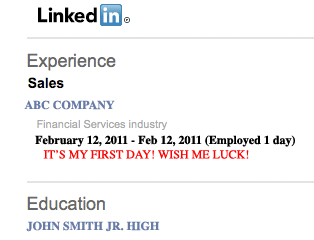
The salesman that tells you how much experience they have in the business comes up with this:
=========================================================
Don’t take any of this the wrong way. The Merchant Cash Advance business has been around for a long time. Most firms perform background checks on their employees and provide them with the proper training. Regardless, any transaction that requires the handling of social security information and bank statements should warrant a little due diligence. This advice applies to banks, insurance companies, stock brokers, and investment funds.
My wedding vendors were fantastic and the time spent chasing the best overall deal (reliability, experience, reputation, price) rather than choosing on price alone was worth it. I hope business owners use the same approach when obtaining working capital.
-The Merchant Cash Advance Resource
By: One of our individual contributors
Behind on Rent? It May be Too Late to Obtain a Merchant Cash Advance
August 23, 2011
There are numerous uses for a Merchant Cash Advance(MCA) but catching up on rent payments isn’t one of them. Growing a business can strain cash flow. Stretching out payment terms with vendors, overdraft charges, and pulling funds out of a personal account can tend to be part of normal operations. As long as this is ‘business as usual’, MCA Providers are readily available to provide funds.
Stretching out payments is one thing, but not making them at all is another. An underwriter shared this with us. “A restaurant in Arizona had been putting up consistent sales figures 6 months in a row, but they never had more than $100 in the business account. This would’ve been fine except they hadn’t paid their food supplier in 5 months. Before we could even make a decision on the account, the food supplier cut them off and filed suit against them. They had to close 3 days later.” There is a very clear line that defines what’s sustainable and what isn’t.
That particular MCA provider did not have a policy to conduct references with suppliers and had narrowly avoided what would’ve been an immediate default. When we mentioned that to the underwriter, he stated, “Well we do check to make sure they’re current on rent payments.”
That is one underwriting factor that is industry wide, the requirement to be current on business property rent payments. See… there’s a slight little issue that can impede a MCA provider from receiving their purchased sales, and that is if the business is kicked out by the landlord. Being current on payments isn’t scrutinized to the extreme, but rather put into the context of risk.
Making a payment on the 10th, when it was actually due on the 5th might make your landlord cranky but if you’ve been there long enough, there’s probably not any danger. Being one month late can also be accepted by an underwriter so long as the rent payment amount is not excessive. Tips from the underwriter, “If you pay $7,000 a month in rent and you are willing to take $6,000 in funding, we’re going to know most of that is going towards rent and wonder how you will be able to make the following month’s payment on your own.” On the other hand, some business owners have been at a certain location for so long or are so big, that being 30 days behind is business as usual. “If the business has been there 20 years and they make payments a month or two late every time, there really isn’t any indication of a negative situation. Also we’ve seen huge clubs that generate $400,000 a month but are sloppy with their books. These are the kind of businesses that will go 1-2 months without paying and then write out a check for the balance when they get around to it. It can freak out the landlord but as long as they bring in the cash, they’re not going anywhere.”
A general consensus in the industry is that being past due by 2 months and more enhances the risk significantly. Anyone can have a slow season or a bad month but there comes a point when the numbers stop making sense. If 2 months rent is $10,000 and a business sells $13,500 of their future sales today to obtain that $10,000, they’ll be caught up for now. But if the revenue being generated per month doesn’t increase, then they won’t be able to make the following month’s rent payment again. Therein lies the problem because not only is there another rent payment due but a percentage of their sales are going back to the MCA provider, amplifying the strain.

This isn’t to say that MCAs make problems worse, any type of funding would. You could give this same business a $10,000 loan with 0% interest payable in installments over 5 years and they would face the same dilemma. Unless sales improve significantly, there is nothing that can be done for them. Every business experiences a vulnerable phase but if it doesn’t make it over the hump, it’s probably time to call it quits.
Unfortunately, underwriters have encountered the late rent issue plenty of times in the past few years. These are businesses that were affected by the recession and have been on the decline for a long, long time. There are usually other factors that indicate financial stress by this point, such as poor credit. Our underwriting friend shared, “It’s tough to see that some businesses are 2 – 7 months behind on rent and are reaching out for anything at this point. If we approve them, we’re looking at a probable loss. We have applicants assume that since our funds are more expensive than a bank, we’ll pretty much tolerate any level of risk. That’s totally not the case at all. Unlike SBA loans, we have no government guarantees on defaults. We have to answer to private investors at the end of the day.”
MCA providers are only interested in transactions where both parties benefit. Acquisition and overhead costs are so high, that their model only works if they forge long term relationships with clients. There are some simple ways to start this off: Use the funds to buy bulk orders of inventory, advertise, upgrade equipment, make repairs, hire new employees, or open a 2nd location. This is the model that has propelled Merchant Cash Advance to the forefront of the small business world. It’s easy, it’s fast, and it makes sense for both parties. But there is one way to ensure a long term relationship does not happen and that’s if the front door is padlocked. Behind on rent? It’s probably too late…
-The Merchant Cash Advance Resource
http://www.merchantcashadvanceresource.com
Image Copyrighted (c) 123RF Photos
Debit Card Costs May be Put on the Consumer: Don’t Make Us Pay
August 23, 2011Originally published on February 18, 2011.
 Back on December 17th, 2010, we published an article outlining the alarming terms of Debit Card Fee Reform. If you haven’t read up on what’s happened, the Federal Reserve has imposed a pricing cap on the cost a retailer pays to do debit card transactions. It’s scheduled to go into effect in July, 2011. The cap is so severe, that it would no longer be financially viable for banks to continue issuing them.
There is of course one solution that would allow banks to continue debit processing and that’s to push the transaction costs to the other party involved, the consumer. This would mean that as a result of the Wall Street Reform Act, consumers will be paying more than ever. How’s that for unintended consequences!
Some people aren’t happy so we’ll cut to the chase and let you know that we found a special gem of an organization, www.dontmakeuspay.org. This website is providing users with up to date information on the new debit card reform law, as well as the proper tools to speak out to politicians. They provide a prewritten letter and automatically address it to the U.S. Senators and Representatives in your state. The full language of it is below:
“As your constituent, I am writing to urge you to stop the debit card interchange rule before it harms debit card users like me.
The only beneficiaries of this harmful rule are retailers, who will take home an additional $14 billion in profits – and consumers will be left to deal with the consequences. The rule does not require that retailers pass along even one penny of their savings to customers. Meanwhile, banks, forced to lose money on debit interchange transactions, will be forced to compensate by increasing fees for deposit customers.
The fact is that retailers receive tremendous benefits when they accept debit cards for payment, including higher sales, lower costs and guaranteed payment. That’s why millions of retailers have chosen to accept debit cards – and that number is growing.
In effect, consumers like me will end up paying for a payments system that provides retailers with extraordinary value.
I don’t want to be forced to pay higher fees, give up my rewards, and lose my free checking account – just so retailers can have an extra $14 billion in profits.
Congress should be in the business of protecting consumers, not forcing us to pay for the costs of giant retailers.
Please repeal this harmful rule before it’s too late.”
We are of course in favor of small business, but it is unlikely that they will reap the supposed benefits either. This is a lose-lose-lose-lose deal. (I think we forgot another ‘lose’ or two). If you’re in favor, sign the letter!
We’ll keep you updated on the developments of this law.
-deBanked
Image Copyrighted by: 123RF
Square Eliminates 15% Transaction Fee
August 23, 2011
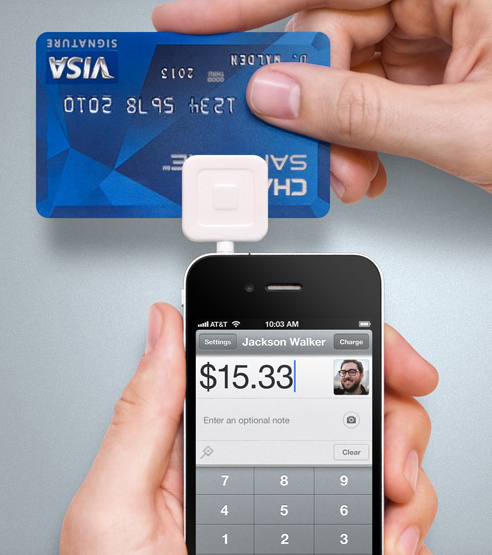
According to their Twitter Feed, Square, the iPhone, Android, and iPad Card Reader has announced the removal of the 15 cent transaction fee. The card swipe rate will remain at 2.75%. For low ticket, high volume businesses, this will significantly improve margins.
About
Square is a revolutionary service that enables anyone to accept credit cards anywhere. Square offers an easy to use, free credit card reader that plugs into a phone or iPad. It’s simple to sign up. There is no extra equipment, complicated contracts, monthly fees or merchant account required.
Co-founded by Jim McKelvey and Jack Dorsey in 2009, the company is headquartered in San Francisco with additional offices in Saint Louis and New York City. They can be found at: www.squareup.com
– deBanked