
Articles by deBanked Staff

Recent M&A Activity in the Space
April 17, 2025There’s been quite a bit of M&A activity in the small business finance industry over the last 6 months. Here’s a list of some of the more notable deals:
10/25/24 – Kapitus Acquires Ten Oaks Commercial Capital and Launches Equipment Financing Arm
1/7/25 – eCapital Acquires LSQ to Expand Technology Solutions and Strengthen Market Leadership
4/1/25 – NMEF Acquires Pawnee, Marking a Significant Milestone of Growth and Industry Leadership
4/8/25 – Onset Financial Acquires Channel Forming One of the Largest Independent Equipment Finance Lenders
4/15/25 – Pipe Acquires Glean.ai
Will the CFPB’s Small Business Data Collection Rules Change?
April 4, 2025On April 3, the CFPB filed papers agreeing with the Revenue Based Finance Coalition’s (RBFC) request to stay the litigation between them over coverage of the Small Business Lending Rule. As it last stood, a federal court was leaning toward the CFPB’s side that the 888 pages of data collection rules should apply to MCAs despite them not being loans.
As to why the CFPB would agree to a stay, the agency explained that it may now be tweaking the rules at issue.
“New leadership has been assessing the Final Rule and the issues that this case presents to determine the CFPB’s position. CFPB’s new leadership has directed staff to initiate a new Section 1071 rulemaking. The CFPB anticipates issuing a Notice of Proposed Rulemaking as expeditiously as reasonably possible. Because the anticipated rulemaking process may moot or otherwise resolve this litigation, holding this matter in abeyance would conserve the Court’s resources.”
– CFPB in its response to the Motion to Stay
“The CFPB respectfully proposes submitting periodic status reports every 90 days during the pendency of the rulemaking and will promptly inform the Court when the rulemaking process is complete,” the Agency stated. “Within 30 days of the issuance of a final rule, the CFPB proposes that the parties confer and notify the Court of whether and how they wish to proceed.”
The small business data collection rules are scheduled to go into effect in July.
Debt Relief Scammer Charged Criminally With Wire Fraud
April 3, 2025Edward William Rennick III, a known debt relief scammer previously barred from the debt relief industry by the FTC, continued on with his scheme for years after the ban. He is now charged criminally with wire fraud conspiracy.
According to the US Attorney for the Middle District of Florida, Rennick and others engaged in a scheme to defraud consumers by instructing them to stop paying their creditors and to make fixed monthly payments to the entities they controlled instead, all under the guise of consolidating their debts. These consumers were told that all of the diverted funds would go into an escrow account and be used to pay off their debts. Instead, much of those funds were misappropriated by members of the conspiracy for personal use.
You can view the US Attorney’s charges here.
James Webster to Speak at Broker Fair 2025
March 31, 2025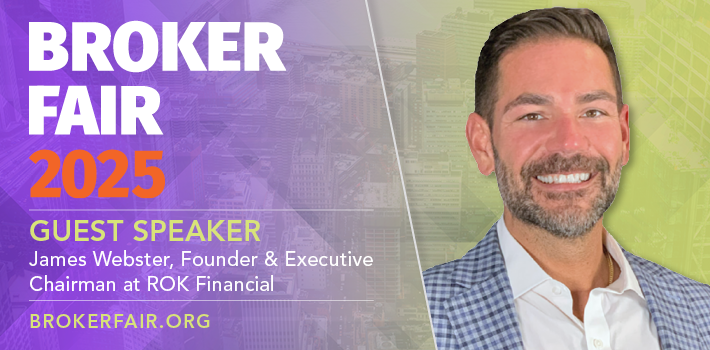
James Webster, Founder and Executive Chairman of ROK Financial, will be a guest speaker at Broker Fair in New York City on May 19th.
James brings a passionate and innovative mindset to the businesses he and his company help grow on a daily basis. Since the age of 18, James has managed multiple sales floors, which allowed him to develop a strong business understanding and a passion for small business.
With nearly two decades of experience in financing and commercial lending, James and his team have helped thousands of business owners secure nearly $2 Billion in business financing, created thousands of new relationships with partners and strengthened their lender relationships, making them a true leader within the landscape. James and the team pride themselves on helping businesses identify their strengths and weaknesses, as well as educate them on the ways they can build on their successes by creating perpetual opportunities with business financing.
In addition to his role at ROK, James sits as the co-chairman of the Small Business Financing Association Broker Council, a non-profit advocacy organization dedicated to ensuring that small businesses can access financing solutions that are clear, secure, and fair. In this role, James establishes responsible and transparent practices for alternative lending brokers while also educating policymakers and regulators about the technology-driven platforms that have emerged in the small business lending market.
James was born and raised on Long Island where he currently lives with his wife, Melissa, and their two children, Lilyanna and Jameson. He is an active member of the Long Island community and feels a special connection to local businesses. Philanthropy plays a big role in James’ personal and business life. ROK’s main philanthropic initiative includes donating 50 meals for every deal that funds with ROK Financial, with the hope of helping end hunger in America.
When not at the office, You will either find James on a golf course or enjoying his other interests such as skiing, fishing, boating, traveling, live sporting & music events but, most of all, spending time with his family!
Role-playing and The Value of Practicing Sales Calls
March 31, 2025deBanked asked several brokers over the past month about the value of role-playing with colleagues to prepare for real life sales engagements. Below are some excerpts of what they said.
 Cheryl Tibbs, Commercial Capital Connect: “Before my broker life, I was a call center supervisor, so just really familiar with call centers making cold calls and that type of thing. So it’s very important [to role play], I think you have to practice. You don’t want to read a script, you don’t want to sound robotic, but you want to be engaged enough where you can have a good conversation with people without having to really think about it.”
Is there a point where practice is no longer necessary?
“Our industry changes day-to-day, little by little, things are changing. So I think it’s just always incumbent upon us to sharpen our skills. That means practicing at least once a week.”
 Josh Feinberg, Everlasting Capital: “Role-playing is like stretching before going for a run. It makes it possible for you to be fast on your feet and really be able to have the answers when you’re talking to a, let’s just say, a construction company that does equipment financing, and they’ve financed all of their equipment. A lot of times they’re going to be more knowledgeable about the equipment financing and leasing product than a lot of the brokers that are going to be talking to them in regards to it.”
Is this something you do with your own reps?
“Yes, especially when someone is newer or starting out, role playing is essential to even a point just like on Equipping The Dream, we need to make sure that we’re call-coaching too. While we’re listening to them on the phone we’re in their ear telling them what to say, just to have them get used to it. And then we do a bunch of different role playing…we’ve done it hundreds and thousands of times over the years”
 Adam Oster, Canyongate Financial: “We have a set list of questions: understanding the merchants needs and building that relationship. And if I know somebody’s really good but they’re not doing well, then we’ll go back and say, ‘Hey, let’s role play. Because there’s something—you’re too complacent, you’re missing something, or you’re not listening to the customer.’ So role play is very important.”
How does this take place?
“If they’re here locally, we’ll do it in-house a lot of times. I’ve got a couple people—one in California, one in Austin, Texas, so we have to do it over the phone. And if somebody’s thriving, I’ll ask them, ‘What are you doing? What are you saying to your dealerships or your customers that are helping you get deals?'”
Register for Broker Fair 2025 – May 19 – NYC
March 28, 2025
Broker Fair 2025 returns in May. Here’s what you need to know:
Book Your Room at ModernHaus SoHo. Us this link to get our special room rate.
Preshow Party ModernHaus rooftop at JIMMY May 18, 7-9pm
Conference May 19, 9-5pm
Register for the Preshow and Conference here
Contact us here to become a sponsor or email events@debanked.com.
Prosper Marketplace Originated $2.2B in Consumer Loans in 2024
March 28, 2025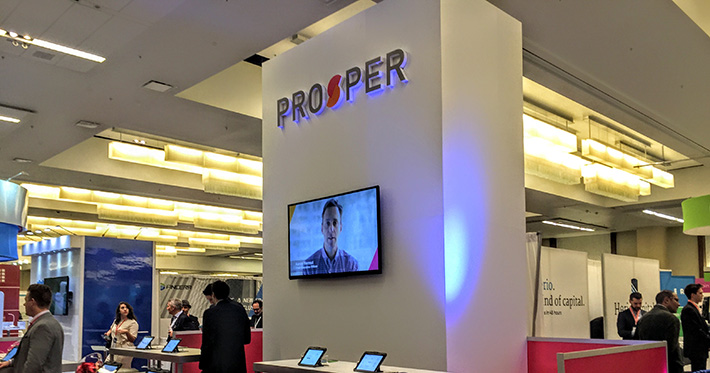 Prosper Marketplace, the last vestige of the P2P lending era, put up a repeat origination performance in 2024 vs 2023. The company originated $2.2B in consumer loans in 2024 and in 2023. That number had hit $3.3B in 2022 as part of the post-covid boom and had come in at only $1.9B in 2021.
Only 7% of its originations in 2024 were from the “note channel” aka the peer-to-peer platform.
“We have incurred operating losses in prior years and may continue to incur net losses in the future,” the company disclosed in its annual report. “For the years ended December 31, 2024 and 2023, we incurred net losses of $54.1 million and $106.5 million, respectively. Additionally, from our inception through December 31, 2024, we have had an accumulated deficit of $644.2 million. We believe our liquidity needs for the next twelve months, and for the foreseeable future beyond that period, can be met through transaction fees, servicing fees, net interest income, other revenue, proceeds from sales of loans and securitizations, realized gains from the Credit Card portfolio and Cash and Cash Equivalents.”
Prosper used to compete against LendingClub as a peer-to-peer investment platform. LendingClub, however, discontinued its peer-to-peer business five years ago when it acquired Radius Bank.
Small Business Truth in Lending Bill Under Consideration in Maryland
March 27, 2025The “Small Business Truth in Lending” Bill introduced in Maryland on January 24, 2025, is continuing to advance through the state’s legislature. Among the finer details in the bill is an APR disclosure requirement on commercial finance transactions. The bill has attracted testimony from various organizations including the Responsible Business Lending Coalition, Revenue Based Finance Coalition, Innovative Lending Platform Association, Electronic Transactions Association, Rapid Finance, the Maryland Transportation Builders and Materials Association, and the Maryland Bankers Association. The majority have argued against the bill’s APR requirement. The combined testimonies are available here.
The bill’s path can be followed here.