Articles by deBanked Staff

Judge Orders Accused Scammer Saul Shalev to Remain in Jail During Trial
March 13, 2026Saul Shalev, the individual accused of masterminding the small business finance industry’s long running mysterious fraud, had his motion to be released on home confinement while awaiting trial denied.
“As I explained on the record at the hearing, the following factors weighed in favor of Shalev’s detention: Shalev has previously fled the country when facing lesser charges in 2019, suggesting he may have more incentive to do so in this case, given the more serious penalties he faces. Although Shalev has strong family ties to New York, those ties were insufficient to keep him from fleeing the country previously, and insufficient to induce his return for more than six years. Moreover, Shalev did not return of his own volition but was apprehended on a vacation in Spain. At the time of his arrest in Spain, Shalev maintained an expensive apartment in Dubai. It does not appear that Shalev was employed after 2021. Shalev has outstanding warrants in New York and New Jersey, a history of failing to appear in court, and a history of actions to evade law enforcement. In addition, the criminal complaint and affidavit in this case, along with further evidence obtained at the time of arrest, suggest strong evidence supporting the charged offenses in this case.
Under these circumstances, I concluded that the significant bond package proposed by Shalev, along with conditions including GPS monitoring and home incarceration, are simply insufficient to reasonably assure that Shalev will appear at trial.”
TomoCredit Sues Fintech Journalist
March 10, 2026TomoCredit, a company that identifies itself as “a software company providing a suite of software solutions designed to support financial literacy,” has filed a lawsuit against a fintech journalist named Jason Mikula for defamation and libel. Mikula operates Business Fintech Weekly, a widely read newsletter in the fintech space. TomoCredit alleges it has suffered damages as a result of statements that Mikula published online about the company.
Mikula shared news of the lawsuit online.
TomoCredit is also facing a lawsuit of its own. Two months ago, a class action lawsuit alleged the company had engaged in negligent misrepresentation and other claims related to its business.
California Bill Asserts Businesses Generating Up to $18 Million/Year in Sales Need Consumer Protections
March 10, 2026California’s AB2116 is proposing to amend the state’s Consumer Financial Protection Law and declare that small businesses generating less than $18 million a year in revenue be considered a consumer for the purpose of consumer financial protections.
“Small business” means a business entity organized for profit with annual gross receipts of no more than sixteen million dollars ($16,000,000) or the annual gross receipt level as biennially adjusted by the Department of General Services in accordance with Section 14837 of the Government Code, whichever is greater.-AB2116
The DGS alternative, when applied to the “whichever is greater” test, currently sits at $18 million, making that the current applicable baseline for what is small.
“Small business owners are often similarly situated as consumers with regards to their sophistication and bargaining power relative to providers of financial services and products,” the bill says. “Many of the rationales supporting legal protections for consumers apply also to small business owners. Small businesses have a better chance to survive and grow if they are able to access safe and effective financial products and are protected from unfair, deceptive, or abusive practices when accessing financial products and services.”
For comparison’s sake, deBanked tracked one online small business lender that originated $200 million in business loans that generated just $14.3M in revenue. Per the bill, this lender would also be presumed an unsophisticated consumer that is unable to bargain on financial service products without consumer protections.
Lending Tree: “The merchant cash advance market is a strong market that is growing”
March 3, 2026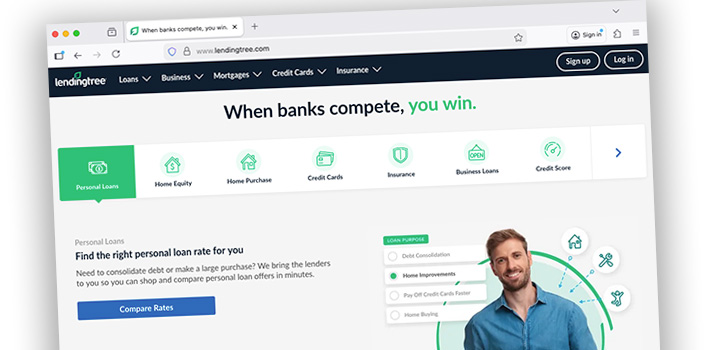 “The merchant cash advance market is a strong market that is growing,” said Lending Tree CFO Jason Bengel during the company’s Q4 earnings call.
Small business financing has become an increasing priority for the financial services referral platform.
“…we have continually invested in additions to our small business concierge sales force, allowing us as well as lenders on the network, to help a greater number of business owners find the best loan options for them while guiding them through the often complex process of completing their application through to funding,” said Lending Tree CEO Scott Peyree.
Though Lending Tree is considered a platform, they describe themselves as a business loan broker, one with a name that helps lenders reach merchants they would otherwise never be able to connect with.
“A lot of our small business lenders, for example, they do not even write direct to merchant,” Peyree said. “They write loans through brokers like us. Deep API logged-in access for us to get their loan information, these consumers do not even know that these companies exist, outside of talking to us to get a loan.”
Lending Tree: LLM Referrals Are Very “High-Intent Consumers”
March 3, 2026During Lending Tree’s Q4 earnings call, CEO Scott Peyree echoed the same conclusion on LLMs that was uttered by rival NerdWallet, that LLM referrals convert better than normal search referrals.
“There are a number of fronts we are working on there,” said Peyree. “There is obviously the SEO front where you are getting referenced by the LLMs, driving consumers to our site. We continue to focus on that and it continues to grow. It is very high-intent consumers, as I have mentioned on previous calls. I would say, materially, it is still a pretty small percentage of our overall consumer base, but it is continuing to grow.”
Lending Tree hinted that there was an opportunity to capture more LLM traffic through paid LLM advertising going forward but that they couldn’t say to what extent yet for 2026.
“Some of the LLMs, ChatGPT being an example, are looking to start testing some advertising, which we are excited about participating in,” Peyree said.
Trigger Leads Law to Go Into Effect March 4, 2026
March 3, 2026On March 4, the national “trigger leads” law will go into effect.
Scott Peyree, the CEO of Lending Tree, recently shared this explanation of trigger leads on the company’s Q4 earnings call.
“For those that do not know the trigger leads, the very basic version of that is when, for example, we develop a lead and sell to our mortgage providers and then they do a hard credit pull to provide a firm offer to the consumers, the credit bureaus will trigger them—this is what they call trigger leads—to sell it off to a bunch of third-party buyers that we have no association with, our clients have no association with.
It is basically saying, ‘hey, this consumer just got a hard pull on their credit from a mortgage company, so maybe you might want to call them.’ It turns into a really horrible consumer experience where they are about to close a mortgage, and then all of a sudden, they are getting another 50 or 60 calls from who knows who. Long story short, Congress passed a bill that basically said that can no longer happen, and that is coming in.”
– Scott Peyree, CEO, Lending Tree
NerdWallet: LLM Referrals Convert Much Better, Licensing Regulations A Barrier to AI Shopping Takeover
March 3, 2026“…in terms of what we’re seeing on our side, the conversion rates on that LLM referral traffic are much higher and growing rapidly,” said NerdWallet CEO Tim Chen during the Q4 earnings call. “People, I think, are searching more both on traditional search engines as well as LLMs.”
NerdWallet had taken a hit on organic search traffic throughout 2025 due to search engines like Google adjusting organic search layouts and rankings but they’ve made up for the lost business by a combination of paid marketing and referrals coming in from AI. Although the AI LLM traffic isn’t enough to replace the loss in organic search traffic, those referrals are said to have a much better conversion rate. The LLMs themselves aren’t a threat to replace the entire shopping experience, however, because of existing regulations.
“I mean I think if you think about the scenario where you’re trying to do some form of agentic shopping or LLMs are trying to get more integrated, there’s kind of 2 obstacles you really need to think about,” said Chen.
So the first is regulatory. For example, you can’t get an insurance quote from someone without an insurance license. And so if you look across, for example, credit, insurance, mortgages and investing, they require licensing where institutions need deterministic and compliant outputs, not probabilistic answers.”
NerdWallet is a platform that connects consumers and SMBs with financial products.
Quickbooks Capital: Another $1.3B Funded to Merchants, Has Protective Moat from AI
March 2, 2026Intuit’s Quickbooks Capital originated $1.3B in business loans to its customers for its fiscal Q2 2026. The number was a repeat of the previous quarter but still puts them on a trajectory to surpass yet another rival (Shopify Capital) on originations in 2026.
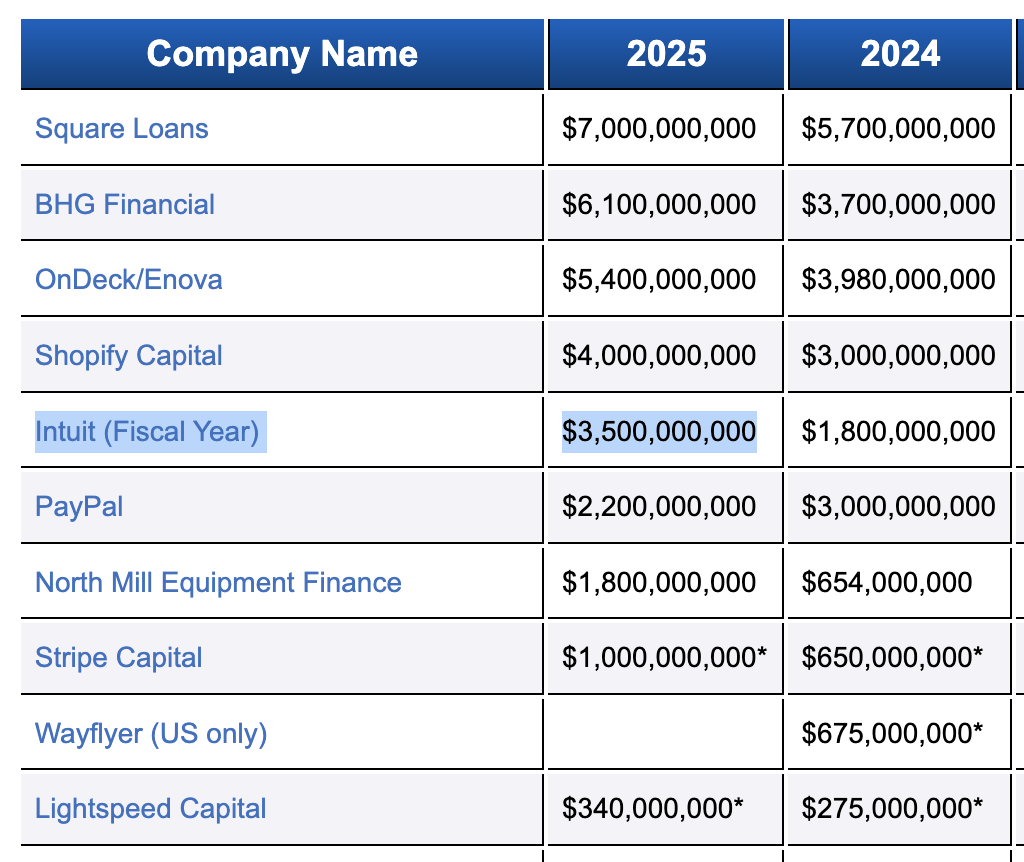
Quickbooks users are presented a “button” in their Quickbooks software to obtain funding.
“We are switching that conversation from being a sales pitch to helping address a customer need,” said Intuit CFO Sandeep Singh Aujla during the latest quarterly earnings call. “As an example, our customer could have a payroll due tomorrow, but the invoice is not going to get paid till next week. With a click of a button, they can access the Capital loans. Payroll is done. The employees are paid. Employees are happy. Next week when the customers pay the invoices, the agent automatically pays down the debt.”
When an analyst raised a concern about their partnership with LLMs, Intuit said there was nothing to worry about because their data is not shared with the LLMs.
“Our moat comes from being the core of the flow of funds, whether it is access to capital, whether it is hours worked by the employees, whether it is money flow—that is not being touched by these LLMs,” said Aujla.