Articles by deBanked Staff

Congressman Tom MacArthur Visits CFG Merchant Solutions’ NYC Office
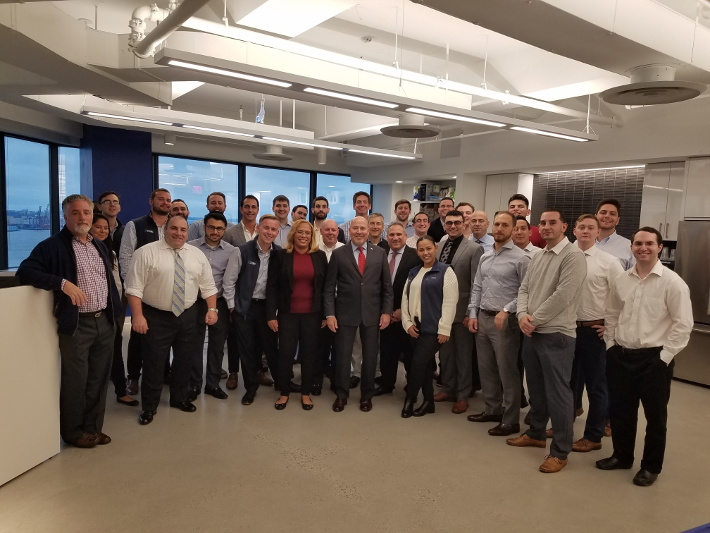
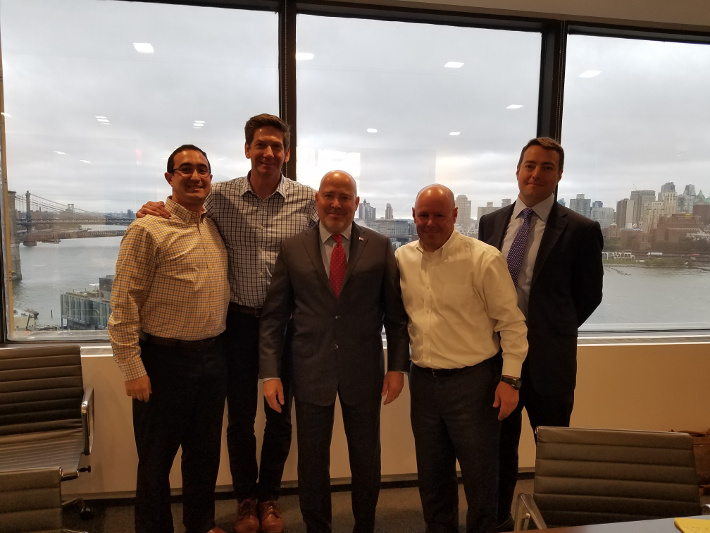
October 15, 2018United States Representative Tom MacArthur, who represents New Jersey’s 3rd District, visited the NYC office of CFG Merchant Solutions on Monday. MacArthur has been in office since 2014.
CFG Merchant Solutions moved into the 180 Maiden Lane office earlier this year. The company is a member of the Commercial Finance Coalition (CFC). Adam Sloane of Cresthill Capital, another CFC member, was also in attendance.
NJ Legislature Aims to Classify Merchant Cash Advance as a Loan in New Disclosure Bill
October 15, 2018 S2262 in New Jersey, a bill to require disclosures in small business lending, was amended this afternoon to define merchant cash advances as small business loans for the purposes of disclosure.
Banks and equipment leasing companies are exempt from the bill.
You can listen to the hearing here. Debate on S2262 begins at the 6 minute, 12 second mark.
The bill’s author (image at right) is Democratic Senator Troy Singleton who represents New Jersey’s 7th legislative district.
Testifying on Monday’s hearing against the bill were Kate Fisher of the Commercial Finance Coalition and PJ Hoffman of the Electronic Transactions Association.
New Jersey Moves to Regulate Small Business Loan Disclosures and Brokers
October 15, 2018 A committee within the New Jersey State Senate convened today at 1:30pm to discuss S2262, a new small business loan disclosure bill. Similar to SB1235 in California, this bill would require all of the following on small business loan contracts less than $100,000:
The APR(This was removed during the committee hearing)- The annualized interest rate
- The finance charge
- The maximum credit limit available
- The payment schedule
- A list of all broker fees and a description of the broker’s relationship with the lender and any conflicts of interest the broker may have
- These terms must be presented before a business accepts a loan
In addition, any change to the terms that would significantly affect the responsibilities or obligations of the small business concern under the loan must be noticed 45 days in advance.
During the hearing, the bill was amended to define merchant cash advances as small business loans. Kate Fisher of Hudson Cook, LLP who represented the Commercial Finance Coalition (CFC) during the hearing, strongly opposed that amendment. The CFC is a trade association representing small business lending and MCA companies.
Also testifying against it was PJ Hoffman of the Electronic Transactions Association. Other Trade groups are gearing up to oppose the bill as well, deBanked has learned.
The bill was voted through the committee and will continue to move forward.
Kate Fisher’s testimony has been transcribed below:
Senator Pou and committee members: Thank you for the opportunity to present testimony today regarding business loan disclosures.
My name is Kate Fisher and I am here today on behalf of the Commercial Finance Coalition, a group of responsible finance companies that provide capital to small and medium-sized businesses through innovative methods. I also am an attorney who helps providers of commercial financing comply with state and federal law.
The Commercial Finance Coalition supports efforts to make business financing more transparent.
The problem is the proposed amendment would define a merchant cash advance as a loan. A merchant cash advance is not a loan.
We all know how a loan works – the lender advances money and the borrower promises to pay it back.
A merchant cash advance is a factoring transaction, in which a business sells a percentage of its future receivables at a discount.
Take for example, a pizza shop. The pizza oven breaks and the owner needs cash to replace it.
In a loan, the pizza shop borrows the money and promises to pay the money back to the lender with interest.
In a merchant cash advance, the pizza shop sells its future receivables to a merchant cash advance company. In exchange for the money to buy that pizza oven, the merchant cash advance company will take 10% of each dollar the pizza shop makes.
If the pizza shop’s sales go down, it will pay less. If the pizza shop’s sales go up, it will pay more. And if the pizza shop is damaged by a hurricane and has to close for repairs, it will pay nothing until it can reopen its doors.
This uncertainty of repayment is why a merchant cash advance is not a loan – the pizza shop in our example, only pays if it sells pizza. Courts have overwhelmingly agreed that a merchant cash advance is not a loan. To quote a recent court decision:
“Receivables purchasing is an accepted form of business transaction, and is not a loan.”
Because a merchant cash advance is not a loan, and there is no fixed payment term, requiring an APR or annual interest rate disclosure would be misleading. For a small business looking for financing, these types of disclosures would only add confusion.
I’m very optimistic that New Jersey can lead the way in providing businesses with disclosures that are helpful – and not misleading.
Thank you.
ISO Pretending to be Funder May Be Sent to Jail
October 14, 2018A New York Supreme Court judge ordered on Thursday that Long Island-based ISO JTT Funding either be fined or sent to prison if it does not comply with a previous restraining order obtained by NYC-based funder Accel Capital.
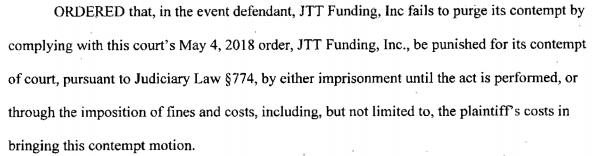
Accel alleges that JTT funding has been impersonating it through correspondence and on contracts, a scheme that was outed when merchants claimed they had been duped into sending thousands of dollars upfront to JTT (disguised as Accel) to obtain a loan yet never received one. Accel responded by suing JTT and obtained a restraining order on default when the defendant failed to respond.
According to the Financial Times, JTT Funding is owned by Queens-born mixed martial arts fighter Jim “The Tyrant” Boudourakis. In his October 2017 interview with the publication, Boudourakis said, “There was a learning curve, going from being a fighter to a salesman. But I’m good with people.” FT also reported that his company had 18 full-time salespeople and was funding $4 – $5 million per month.
In an unrelated suit, JTT Funding is accused of forging a confession of judgment.
The Accel Capital suit can be found in the New York Supreme Court under Index Number: 153447/2018
Capital Stack Hit With Class Action Lawsuit
October 10, 2018A class action lawsuit brought by former employees of Capital Stack, LLC was filed in federal court on Tuesday for damages resulting from alleged labor law violations. David Rubin, Brian Stulman, eProdigy ACH, LLC, and eProdigy Operations, LLC are also among the named defendants. Capital Stack is a merchant cash advance company based in New York.
The 22-page complaint lays out seven claims including failure to pay the minimum wage required by New York Labor Law.
The suit can be downloaded here.
The case is 1:18-cv-09230 in New York Southern District Court.
Ascentium Capital Hits Milestone
October 9, 2018Ascentium Capital announced yesterday that it had surpassed $2 billion in managed assets during the third quarter of this year. It also had a 22 percent increase in funded volume over the same period last year. Altogether, the company has provided businesses with over $4 billion.
“We had another strong quarter of growth with performance driven by the diversity of our equipment vendors and repeat business efforts,” said Ascentium Capital CEO Tom Depping. “Due to the strong demand for our offering, we continue to expand our direct sales division with recruitment efforts for our offices in Texas, California and New Hampshire as well as expansion of our vendor-specialized sales personnel in Arizona, Michigan and across the nation.”
As a direct lender, Ascentium Capital provides equipment financing, leasing and small business loans, among other products. Ascentium Capital is backed by investment firm Warburg Pincus LLC, among others, and is headquartered in Kingwood, Texas.
Everest Business Funding is a Sponsor of deBanked CONNECT – San Diego
October 3, 2018Everest Business Funding is a sponsor of deBanked CONNECT San Diego. The half-day event for funders, lenders, brokers and industry professionals is being held at the Andaz on October 4th!


Funding Metrics is a Sponsor of deBanked CONNECT – San Diego
October 3, 2018Funding Metrics is a sponsor of deBanked CONNECT San Diego. The half-day event for funders, lenders, brokers and industry professionals is being held at the Andaz on October 4th!