Largest Merchant Cash Advance in History Ends in Default
September 27, 2011 Six months ago, news headlines publicized just how far the Merchant Cash Advance (MCA) product had reached. Once the ‘Plan B’ option for retail businesses in need of capital, the sale of future card payments was utilized to finance a project at a Las Vegas casino. And it was no small figure. New York based Strategic Funding Source (SFS) in collaboration with Vion, shelled out $3.147 Million in return for $4.092 Million of the Las Vegas Mob exhibits’s future sales. That’s a cost factor of 1.30, a price that typifies the average MCA deal.
While SFS was given high praise from their peers, some began to speculate if transactions that large were practical. After all, the costly financing of a MCA is priced in accordance with the risk of default, not in accordance with big profits for the financier. When your portfolio is in great shape, it can be easy to forget what the pitfalls are. And since the MCA industry paraded the Las Vegas Mob exhibit as the $4 Million deal that changed everything, we’re eerily reminded of the words by Jeff Mitelman, the CEO of AdvanceIt who was quoted two years ago as asking: “How prepared are you to lose $4 million dollars?”
We won’t pretend to know what led to the downfall of the Las Vegas Mob exhibit or why it went south so quickly. SFS could potentially lose 98% of their investment, a hit that will surely change their outlook on doing large deals in the future. The VegasInc article alleges gross mismanagement and fraud, factors that are difficult to foresee in the course of underwriting.
Industry message boards have been abuzz with comments on the default, with some competitors of SFS being accused of kicking a man while he’s down. “you ought to do smart funding, not just showing off your Balls,” one broker fired off at them. SFS has a stellar reputation and is one of the most knowledgeable firms in the MCA space. We have no doubt they inspected the merits of the deal backwards, forwards, and upside down. But nothing is perfect.
The default is expected to attract attention of the news media, leaving many to wonder how this transaction will be interpreted under the public eye. We assert that it will put to rest any criticism the MCA product has ever received about high costs.
Risk vs. Reward
Back in March when the deal was written, an outsider could claim that SFS just had an easy million handed to them. This view clashes with the Risk vs. Reward philosophy that MCA providers hold dear. To the MCA providers, the question was never “how can I make an easy million?” but rather, “how prepared am I to lose $4 Million?”
Any business that can’t get a bank loan, can’t get one for a reason. There’s a measurable value of risk that’s not worth taking. MCA providers fill the gap but compensate to offset defaults. There’s a term for something like this. It’s called a Happy Medium.
Merchant Cash Advance is the happy medium financing option for small businesses. And for the immediate future it is likely to stay within the small business niche. We all know now what can happen when the concept is applied to a multi-million dollar project. The outcome was not so happy and the loss not so medium.
But it will all even out in the end…
– Merchant Processing Resource
Funding Floodgates Reopen
September 20, 2011If you’re a business owner, it’s time to get ’em while they’re ~HOT! Small business funding is BACK and more available than they’ve been in years. And guess what? Because we’re just a news site, we’ve got no reason to douse you with a cheesy sales pitch. There’s a lot of money out there right now and that’s the truth.
Merchant Cash Advance (MCA) continues to dominate the alternative financing market but a few new options are changing the landscape. You might call them ‘alternatives to the alternatives’, deals that are based on MCA but have all the bells and whistles of a loan; Fixed time frame, a payment schedule, and even personal guarantees! The underwriting criteria generally requires a set of recent healthy bank statements and semi decent credit credit (yes, your credit still matters) to qualify. Beyond that, it’s up to the individual lender to present their respective checklist of closing documentation. This usually includes some combination of a business property lease, applicant ID card, business permit, and a recent tax return. That’s it. Oh, and the wait time? Expect a week long process if you’re quick on the draw with paperwork.
Two years ago, there wasn’t much variety in the MCA space. Business owners could shop all they wanted but the underwriting and cost structures were essentially identical everywhere. Now there are factor rates that range from from 1.20 to 1.65. It’s more merit based than it used to be. The higher credit rating, stronger cash flow businesses can earn something better than the one-size-fits-all 1.35 factor rate of yesterday. On the same token, the complete credit averse can grab a shot at financing too, but at a steep price.
But there’s more to it than just cost, there’s also the setup:
Don’t want to switch your merchant account?
Stay where you are: There’s a significant chance your merchant processor already has a contract with the MCA provider you’ve chosen. Often times your sales representative may encourage you to open a new merchant account for the lower discount fees and to have a higher degree of control if problems arise. Ultimately, a new merchant account is not essential if you want a MCA.
Leverage your strong cash flow history: If you’ve managed to keep a large positive balance in your bank account for the last few months, your MCA provider could simply extract the agreed percentage from there, rather than directly through the merchant account.
Lock it up: A Lockbox provides the MCA provider with peace of mind by obtaining their payments without the risk of Non-Sufficient Funds from the debit method but also allows you to keep your merchant account. It’s frequently used as a compromise for businesses that are legally prevented from changing their merchant account(i.e. franchisees), but are too cash flow weak to qualify for direct debit payments.
But the buck doesn’t stop at the many ways you can do MCA. You’ve got options!
Merchant Loan: An actual loan based on your credit card sales history. A percentage may still be withheld from each card sale but a periodic or an end-of-term lump sum payment will be applied as needed to ensure the loan is completed within the time frame allotted.
E-Bay/Amazon Loan: Get a loan based on your sales history on Ebay.com or Amazon.com. The largest lender of this type is Kabbage.
Cash flow loans: We described these in the 2nd paragraph. Expect cost ratios from 1.12 to 1.55 and term lengths between 4 and 24 months.
How can you find the floodgates?
You can refer to the directory of direct MCA providers but can check out alternative lenders such On Deck Capital, ForwardLine, Kabbage, and Sure Payment Solutions if you want to diversify your options.
Kennesaw based funding provider, AdvanceMe expects to fund $1 Billion in the next two years. That’s nearly as much as the entire MCA industry did in the last two years combined.
2009 was a year full of “I should’ves” as in “I should’ve obtained financing before the financial crisis.” Cash is finally available to small businesses again and although it is more expensive than it used to be at the local bank, there may never be a time where the process is this quick, approval is this easy, or where your credit score is weighted this lightly. We’re not the salesman here, just the messenger. If there was any project you were remotely considering, now is the time to make a move… Don’t wait until the funding levees have been restored.
– deBanked
https://debanked.com
The Stigma of Merchant Cash Advance?
September 6, 2011Bankcard Funding, a Long Island based Merchant Cash Advance (MCA) provider, recently blogged about the “stigma” of Merchant Cash Advance. While we don’t deny that there is one, we don’t agree with their basis for it.
To quote them:
“Many people do not believe that a merchant cash advance is a legitimate type of financing. This is because many merchant cash advance companies take advantage of naïve clients who are uneducated in the process, take them for a ride, and then focus on the next“sucker.” NOTE: As of 9/13, we noticed that they have updated their article and the above quote no longer appears.
This is a weak argument, especially since it inflames the target market’s concerns. If you market your company by claiming everyone in the industry is a scam artist except yourself, you’re not going to reassure your prospects. But Bankcard Funding is not alone in their assessment so maybe they’re on to something. We’ve heard similar rhetoric in private groups on LinkedIn where seasoned professionals vented their frustrations. Some of the anonymous comments include:
 This guy is screwing it up for me!
It seems too many industry professionals are casting the blame on malevolent third parties. If the competition was as evil as you think, then your work should be cut out for you. Business owners are intelligent people. That’s why they’ve managed to successfully work for themselves. If given the choice between a malicious salesman and an honest one or a good deal and a bad deal, they’re inclined to go with the honest guy with the good deal.
The point being… If you feel that you are losing prospects because the competition is muddying up the industry’s reputation, you simply need to sell better. If the few evildoers (and there’s a bunch in every industry) are defining the industry itself, then it’s time to rethink your marketing strategy. The companies with the highest rates and the nonsensical fees shouldn’t be beating you. If anything, they should be making it easier for you to grow.
So the good guys have a marketing problem and it’s about time we addressed that…again. Reread The Colossal Marketing Failure of the Merchant Cash Advance Industry in which we highlight some of the problems in advertising.
Some people have asked us about the purpose of the erotic photos we used in it. Why did you notice them? Did they stand out? Did you think about what the point of it was? If it got you wondering at all, then we did our job. Junk mail and cold calls don’t get your prospects to think about anything.
If we are to redefine the image of the industry, then the vehicle in which the message is delivered needs to change. Big financial firms like Bank of America have so many businesses applying for loans, that they can barely keep up with the demand. That’s the way it should be for MCA providers, especially given the state of the economy.
The only people claiming there’s a stigma are the ones selling the product. Guess what? That’s not a winning strategy…
Yellowstone Capital Surpasses $8 Million Funded in August
September 1, 2011Yellowstone Capital, A New York based Merchant Cash Advance firm is reporting via social media the results of yet another great month:
“Amazing month everyone!!! We funded 394 deals for a total of $8,105,450!!!!!!!…ya that’s right boys and girls we funded over 8MM!!!! Huge congratulations to Amac for funding over a Million dollars, Congrats to Paltrow for funding $843k, Congrats to Marano for banging out $719k and of course last but not least Jimmy Puleo who funded
$943k on commission revenues of $255k!!!!!!
Thank you to our funding partners! SFS stepped up big time and funded $2.8MM for us!! STD Capital AKA Lockbox Steve/AKA Tariq funded $2.6MM for the month and the newest funder for YSC was 2nd Stern Funding who came charging out of the gate the last 7 days of the month by funding $550k!!!
A special thank you to all our support staff!!
Open bar at Ulysses to celebrate at 630!
Lets push for $10MM in September!!!
First Funds Messes With the Wrong People
September 1, 2011First Funds, the now defunct Merchant Cash Advance provider apparently left some unhappy vendors in their wake. A visit to their old website address(www.firstfundsnyc.com) reveals the story:
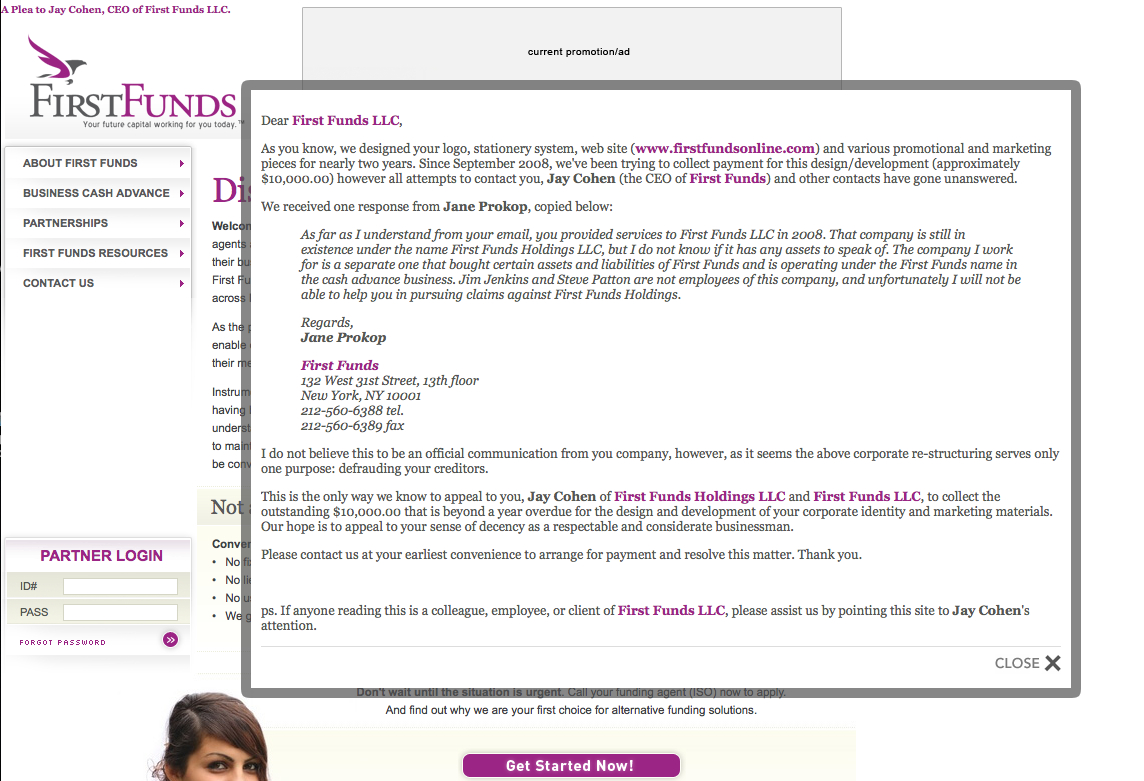
This is the site as it appears today on 8/31/2011. Apparently their web host/site designer has commandeered their site with a pop-up ad. It states:
“Dear First Funds LLC,
As you know, we designed your logo, stationery system, web site (www.firstfundsonline.com) and various promotional and marketing pieces for nearly two years. Since September 2008, we’ve been trying to collect payment for this design/development (approximately $10,000.00) however all attempts to contact you, Jay Cohen (the CEO of First Funds) and other contacts have gone unanswered.
We received one response from Jane Prokop, copied below:
As far as I understand from your email, you provided services to First Funds LLC in 2008. That company is still in existence under the name First Funds Holdings LLC, but I do not know if it has any assets to speak of. The company I work for is a separate one that bought certain assets and liabilities of First Funds and is operating under the First Funds name in the cash advance business. Jim Jenkins and Steve Patton are not employees of this company, and unfortunately I will not be able to help you in pursuing claims against First Funds Holdings.
Regards,
Jane ProkopFirst Funds
132 West 31st Street, 13th floor
New York, NY 10001
212-560-6388 tel.
212-560-6389 fax
I do not believe this to be an official communication from you company, however, as it seems the above corporate re-structuring serves only one purpose: defrauding your creditors.
This is the only way we know to appeal to you, Jay Cohen of First Funds Holdings LLC and First Funds LLC, to collect the outstanding $10,000.00 that is beyond a year overdue for the design and development of your corporate identity and marketing materials. Our hope is to appeal to your sense of decency as a respectable and considerate businessman.
Please contact us at your earliest convenience to arrange for payment and resolve this matter. Thank you.
ps. If anyone reading this is a colleague, employee, or client of First Funds LLC, please assist us by pointing this site to Jay Cohen‘s attention.”
——————–
While we’re not sure if this is the best way to get their attention or if this tactic is legal, we’re certain now that the one vendor you don’t want to upset is your web designer.
Embarrassing? You bet!
Merchant Cash Advance Industry is Waiting for its Big Moment
August 25, 2011Originally Posted 7/28/2011
According to an article in ISO&AGENT Magazine, the Merchant Cash Advance (MCA) industry has had significant success but “the companies that fund them acknowledge the cash-advance market is still waiting for its big moment.” This echoes our earlier opinion that a lack of collective marketing is keeping this financial tool from reaching its true potential.
How is it that in an ultra tight credit market that small businesses have not heard of MCA? With lax credit score standards, fast turnaround, minimal documentation, and a flexible method of repayment, it’s absurd that the industry has not reached so many that are looking to borrow. ISO & AGENT points to a negative image crisis and fingers the costs involved as a possible culprit.
The costs are a non-crisis. MCAs would be less expensive if they required collateral, perfect credit scores, fixed terms, ten years in business, and a 3 month underwriting process. If a small business meets those requirements and does not have a time sensitive opportunity they are looking to capitalize on, they should be going to their local bank. But most small business owners either do not meet that criteria or need the funds for a project they have going on today. Hence the product has to be more expensive for it to make sense for the firms providing the funds.
ISO&AGENT claims the industry has been compared to payday loans, an untrue characterization. In fact, that comparison has so rarely been made, that we can pinpoint the exact place they got that from. Inc.com published a very unflattering article on April 1, 2008 titled ‘Thanks, But No Thanks‘, in which they explain MCAs as “the business equivalent of a payday loan.” That was three and half a years ago! The article was not only biased and unfair, but was also written at a time when everything related to Wall Street, banks, or lending was being demonized as the nation sat on the verge of the Great Recession and economic collapse.
Still one can’t help but notice that buried deep within their criticism, is the answer to why MCAs are a tad bit more expensive:
The fact that collateral isn’t necessary is another important part of the MCA providers’ pitch. Entrepreneurs sometimes risk losing their homes if they can’t repay a bank loan, but they have no legal obligation to repay merchant cash advances if their companies fail, as long as they strictly follow the terms of the contract. They can’t encourage customers to pay in cash, for example, and they cannot switch credit card processors (typically, the MCA provider gets paid directly by the processor, rather than by the merchant). “If Diane’s Bistro goes out of business because Lauren’s Bar & Grill opens up across the street, we have absolutely no recourse to Diane, none whatsoever — as long as she follows the clearly defined covenants in our contracts,” says Glenn Goldman, AdvanceMe’s CEO.
And if you had any more reason to suspect MCAs are not as bad they tried to make it out to be, Inc.com published that article on April Fools Day. Case closed.
But there is indeed an image crisis and it’s that many businesses haven’t been exposed to the concept of MCA and thus cannot consider the pros and cons at all.
For instance: Most people can make the case for or against consumer payday loans. They’ve already got loads of information from the media, newspapers, banks, and lawmakers on which to base their argument. It’s become a well known household accepted form of financing. Whether or not payday loans can help the consumer is a separate debate.
That’s the difference. MCA is rarely spoken about by newspapers, banks, or lawmakers. Its presence in the media is limited and as a result we’re referring to stories published over three years ago. We have many friends employed as small business loan officers across the country and the only reason they’re aware of how MCAs work is because we told them. It’s embarrassing. And for an industry that funded over $500 Million last year alone, it really makes no sense.  We blamed antiquated marketing techniques: cold calling, junk mail, useless internet marketing, and spamming. The industry has gotten lazy and has a propensity to market their financing to small businesses that have already secured a MCA. This comes with bold promises of lower rates and other gimmicks. This inner competitiveness leads to both smaller margins and lower conversion rates. It does nothing to grow the industry as a whole.
That’s complemented by carpet bombing the public with an approach their customers learned to ignore a long time ago. Cold calls and junk mail. Really? Yes, really. There will always be a sliver of effectiveness from these methods and the firms that employ them will defend their success to the death. These methods may score some deals and perhaps even work well enough to grow a MCA firm, but it will not lead to the industry’s ‘big moment.’ Same goes for internet spam, poorly constructed articles that serve no purpose other than to boost some company’s SEO, and useless blogs kept by both respectable firms and no-name websites set up to harvest leads. Sure that’s the way of things on the internet these days but there isn’t anything beyond that. There are no mainstream media articles about MCA, forums for business owners where it is actively discussed, nor any public endorsements by anyone of high political or business stature.
Sounds like we have an image crisis on our hands. The Merchant Cash Advance Resource (the site you’re on right now) has been in existence for 1 year. In that time, we’ve made significant additions to the information that can be accessed here. We constantly receive emails from business owners and MCA brokers alike with the hope that we can provide them with an unbiased answer. And guess what? We do just that. By having no commercial affiliation, we give the best advice we can. The e-mail volume has gotten so heavy that our volunteer editors have trouble answering them all. But we try anyway.
And along the way we’ve managed to get some formal offers to convert this resource into a commercial site to generate sales leads. A six figure buyout offer here and there coupled with some lengthy, legalese filled non-disclosure agreements. We say ‘no’ every time. The Merchant Cash Advance Resource is designed to provide information, opinions, critiques, data, guides, and an independent ‘thumbs up’ to an industry that’s destined to do great things for small business.
Why do we spend the time, money, and effort to provide this service? We’re looking at the big picture of MCA. Big picture… Big moment…
And we’re on our way.
deBanked
https://debanked.com
Top 10 Merchant Cash Advance Funders for 2010
August 24, 2011
According to data compiled by infoUSA, this is a breakdown of marketshare by the top 10 funders:

Chart by:
Max Alewel
Senior Account Executive
Direct Toll Free: 1-866-322-3708
Fax: (402) 836-4914
max.alewel@infousa.com
credit.net
Relatively close to what our own analysis proved, the chart has some flaws:
- Advance Restaurant Finance is a licensed lender, not a provider of Merchant Cash Advance or purchaser of future credit card sales.
- We estimate there to be at least 37 active funding providers. A breakdown of marketshare between 10 of them doesn’t represent the share of the overall market, just between eachother.
- There are no quantifications, # of deals, dollar amounts etc.
We still appreciate Max’s work as it serves to complement and back up the claims we have made. If you still haven’t seen the data, check it out
Full 2010 Merchant Cash Advance Industry Statistics
1st Quarter 2011 Merchant Cash Advance Industry Preview
-The Merchant Cash Advance Resource