Articles by deBanked Staff

CFPB Reverses Course: Now Proposes to Remove Merchant Cash Advances from Section 1071 Rule
November 16, 2025The CFPB has come back with a new proposal on how to roll out its section 1071 rules. Inside the 198 pages, the agency opines at length on merchant cash advances and reverses its previous opinions. It now believes they should not be subject to the rules.
The CFPB believes that at the onset of data collection under section 1071 the rule should focus on core, generally applicable, lending products that are most likely to be foundational to small businesses’ formation and operation—loans, lines of credit, and credit cards—before determining whether to expand the scope of the rule to include more niche or specialty lending products. The CFPB therefore proposes to exclude MCAs, agricultural lending, and small dollar loans from the definition of covered credit transaction to better ensure the smooth operation of the initial period of data collection, while minimizing disruptions and regulatory complexity in the credit markets subject to section 1071.
Current § 1002.104(a) defines a “covered credit transaction” as “an extension of business credit that is not an excluded transaction under paragraph (b) of this section.” Section 1002.104(b)(1)-(6) enumerates six types of transactions that are excluded from covered credit extensions. The Bureau proposes adding MCAs to the list of excluded transactions in § 1002.104(b). Proposed § 1002.104(b)(7) would exclude MCAs, which it would define as an agreement under which a small business receives a lump-sum payment in exchange for the right to receive a percentage of the small business’s future sales or income up to a ceiling amount. Consistent with this proposed new exclusion, the CFPB proposes deleting several references to MCAs, and the related term sales-based financing, in commentary.
In the 2023 final rule, the CFPB explained its belief that the statutory term “credit” in ECOA is intentionally broad so as to include a wide variety of products without specifically identifying any particular product by name, such that all credit products should be included in the rule unless the CFPB specifically excluded them and concluded that “credit” encompasses MCAs. It further explained that MCAs should not be understood to constitute factoring within the meaning of the existing commentary to Regulation B subpart A or the definition in existing comment 104(b)-1, because factoring involves entities selling an existing legal right to payment from a third party, while no such contemporaneous right exists in an MCA. The CFPB also noted its understanding that, as a practical matter, MCAs are underwritten and function like a typical loan (i.e., underwriting of the recipient of the funds; repayment that functionally comes from the recipient’s own accounts rather than from a third party; repayment of the advance itself plus additional amounts akin to interest; and, at least for some subset of MCAs, repayment in regular intervals over a predictable period of time), although it also implicitly acknowledged practical differences between MCAs and conventional loans by including numerous provisions intended to capture MCA-specific data.
This proposal reconsiders the CFPB’s previous conclusions, as illustrated in existing comment 104(a)(1)-1, which does not exclude MCAs from the definition of “covered credit transactions” under § 1002.104(a), for several independent reasons. First, the CFPB believes that at the onset of the data collection under section 1071 the focus should be on core lenders and products before the CFPB considers expanding the scope of the rule. MCAs are structured differently from traditional lending products; traditional lending concepts like “interest rate” do not fit the way that MCAs are priced. As a result, it is not clear that data collection on MCA transactions under section 1071 would yield information that advances section 1071’s statutory purposes to the extent that some or many such transactions do not constitute credit. The CFPB believes it would advance the purposes of section 1071 at this time to exclude MCAs from the definition of covered credit transaction, and to focus on ensuring the smooth operation of data collection as to core lending products and providers most likely to be foundational to small businesses’ formation and operation.
Second, the CFPB believes it erred in prematurely determining that collection of data on MCA transactions would serve section 1071’s statutory purposes by concluding that all MCAs constitute credit. The 2023 final rule’s one-size-fits-all approach also does not take into account the varied terms and features of MCAs across the market that may be relevant to whether the products meet the definition of “credit” under ECOA, nor did it account for the fact that MCAs are relatively new products whose features and practices may be evolving, including in response to State regulation. Moreover, while some State courts have analyzed whether some MCAs meet State law definitions of “debt” or “credit,” there is a dearth of case law analyzing whether MCAs meet ECOA’s definition of “credit.”
Excluding MCAs from the definition of “covered credit transaction” would be consistent with the way the CFPB has already treated leases, which also present close questions as to whether they meet the definition of “credit” under ECOA. In the 2023 final rule’s analysis of leases, the CFPB acknowledged that some lease transactions could constitute “credit.” But rather than include all lease transactions in the 2023 final rule to ensure coverage of those leases that did actually constitute credit and credit disguised as leases, the CFPB determined that it would be able to monitor the market for such products without including them in the 2023 final rule. The CFPB proposes taking a similar approach to MCA transactions as it did to leases.
Further, the CFPB believes that the 2023 final rule’s coverage of MCAs does not take into account State law developments addressing sales-based financing. Several States have legislation and/or regulations in place addressing the MCA market and requiring providers to disclose terms such as the total cost of capital and the financing rate. Such laws provide key protections for users of MCAs and may shape MCA terms and practices in ways that bear on the question of whether they meet ECOA’s definition of “credit.” While the 2023 final rule referenced these pieces of State legislation, it did not consider the extent to which the evolving landscape under State law rendered premature a determination that including MCAs in the definition of “covered credit transaction” for purposes of mandating data collection furthered section 1071’s statutory purposes. The CFPB believes that it would be advantageous to observe how State laws address MCAs before the CFPB decides how, and whether, to collect data regarding MCAs pursuant to section 1071.
Finally, while the final rule cited concerns about high costs and predatory practices in the MCA market, those concerns may be addressed by Federal and State law enforcement agencies through their respective enforcement authorities.
The CFPB believes that taking into account the factors listed above, the relative novelty and evolving landscape of the MCA industry and the ongoing changes at the State level concerning the regulation of MCAs, that excluding MCA transactions from coverage under the rule at this time is necessary and appropriate to carry out the purposes of section 1071.
As explained above, MCAs differ in kind from traditional lending products, such that collecting data on MCA transactions under Section 1071 may not produce information that is comparable to data collected on other types of transactions. And because MCAs have not generally been regulated as credit, many smaller MCA providers may lack the infrastructure needed to manage compliance with regulatory requirements associated with making extensions of credit. Taken together, requiring MCAs to be reported could lead to data quality issues, which would not advance the purposes of section 1071.
The CFPB will continue to monitor developments in the markets for MCAs and other sales-based financing to determine whether over time a subset might be appropriately included in the definition of “covered credit transaction” for purposes of data collection.
The CFPB seeks comment on this proposed revision to the rule. It also seeks comment on topics including, but not limited to, the extent to which MCAs differ from or resemble traditional lending products; the diversity of MCA terms and practices and how they impact whether MCAs, or a subset of MCAs, meet the definition of “credit” under ECOA; whether certain types of MCAs are more or less appropriate for exclusion; and suggestions for how the 2023 final rule could be modified with respect to MCAs if the CFPB ultimately does not exclude them. The CFPB further seeks comment on alternative definitions to the one proposed in
§ 1002.104(b)(7).
Square Activates Paying With Dollars Over Bitcoin Lightning Networks Rails
November 16, 2025Square is rolling out Bitcoin acceptance in every state across the US except New York and with that the prospect of skipping merchant processing fees if their customers pay with Bitcoin. Square is taking direct aim at the card payment networks and their bank partners, eliminating chargeback risk, and bypassing their fees. The twist is that customers need not even have Bitcoin and the merchants need not know much about Bitcoin. Instead, Cash App customers that have a cash balance in their accounts can simply pay a Square merchant with dollars using Bitcoin’s Lightning Network rails.
Customers that do in fact have Bitcoin can also pay a Square merchant using Cash App or any other Lightning Network compatible wallet such as Coinbase and also spare the merchant from a transaction fee. Block, Square’s parent company, is hoping that Bitcoin payments take off.
“It’s time,” tweeted Block CEO Jack Dorsey, “the independent and free currency is here.”
Block is going all-in on Bitcoin since Dorsey, a long-time advocate, financier, and evangelist for Bitcoin, is trying to shift the narrative of Bitcoin’s use-case in the public sphere back to everyday money and away from its current status as a Wall Street investment or digital gold. (The editor of deBanked has long claimed that Jack Dorsey is probably Satoshi Nakamoto, Bitcoin’s pseudonymous founder). Block has even replaced its existing peer-to-peer Cash App network with the Bitcoin Lightning Network. That means Cash App users accustomed to using a $cashtag can now send/receive payments outside the Cash App network.
Square will also be enabling stablecoin payments via the Solana blockchain starting in early 2026 and will explore integrations with other blockchains but will remain Bitcoin-centric and dominant.
it’s time.
the independent and free currency is here. https://t.co/tWDksqldWY
— jack (@jack) November 10, 2025
Square did their part, now let’s do ours. For bitcoin to become everyday money, merchants need to accept it. But first, they’ll need a reason to. We've put together the resources to help anyone make the case that only bitcoin can defeat credit card fees: https://t.co/fYkCARD5MD pic.twitter.com/1QO9KVyEuj
— Spiral (@spiralbtc) November 12, 2025
This means:
– For @CashApp customer: no taxable event, no decrease in bitcoin stack
– For @Square merchants: no fees, no chargebacks
– For the world: no middleman, just pure open networkFeels like the future.
— Miles 🌞 (@milessuter) November 12, 2025
POV: you pay for your coffee with bitcoin ☕ pic.twitter.com/4DCq7fxeSf
— Square (@Square) November 12, 2025
somewhat poetic we happened to launch dollars on lightning today and also the last penny ever minted was today
something in there
— OBJ (@owenbjennings) November 13, 2025
B2B Finance Expo 2025 Recap
November 12, 2025B2B Finance Expo 2025 was a tremendous success! This conference featured a larger number of attendees, exhibitors, and speakers from across the spectrum of commercial finance and small business lending than the previous inaugural year.
B2B FINANCE EXPO 2025 PHOTOS HERE
VIDEO INTERVIEWS FROM THE RED CARPET HERE
If you want a copy of your interview video file, email events@debanked.com.
To learn more about the Small Business Finance Association, contact Stephen Denis or visit: https://sbfassociation.org
A special shout out to the Diamond and Platinum Sponsors: Rapid Finance, Kapitus, Bitty, and Ocrolus.
Also a shout out to Nexi (WiFi Sponsor), AMA Recovery Group (Breakfast Sponsor), Shoreham Bank (Lanyard Sponsor), and Vox Funding (Key Card Sponsor).
Lightspeed Commerce: ‘MCAs a Super Popular Upsell’
November 10, 2025Lightspeed, the point-of-sale an e-commerce platform, has experienced tremendous success with its MCA product. More than $107M of MCAs currently sit on their balance sheet. The company does not sell the receivables to third parties.
“We are using [Lightpeed] Capital to upsell and cross-sell across the base and in the rest of the world portfolio, Capital is one of the products that’s super popular in the upsell to the merchant base,” said Lightspeed President JD Saint-Martin in the company’s Fiscal Q2 2026 earnings call.
Outside of a potential stock buyback, the company’s largest use of cash going forward will be growing its MCA business, the company stated. Experience with this product has also made their underwriting more efficient and they’ve managed to reduce their average payback period to seven months. Revenue on MCAs year-over-year grew by 32%.
Lightspeed’s MCA business also expanded to Switzerland this quarter, the company revealed.
NerdWallet: Organic Search Result Leads for SMB Financing Still Down, LLM-Generated Leads Converting Better
November 7, 2025This quarter, NerdWallet repeated that its SMB financing deal flow continues to lag significantly below last year’s levels because of changes in organic search. Similarly, the company reiterated that the conversion rate of leads coming from LLMs has looked very promising. During the Q3 earnings call, analysts finally asked if LLM traffic meant ChatGPT.
“I’d say the primary driver to think about is actually AI overviews within Google Search,” said NerdWallet CEO Tim Chen. “So because search is becoming more useful, people are searching a lot more. And so we are seeing traffic come through from AI overviews. ChatGPT and Gemini are also driving an increase there. So those are kind of the 2 major drivers in terms of the LLM traffic. When people come through that way, they’re really high intent typically, they’re really held in on finding something in a marketplace, for example. So I think that’s what’s driving some of the higher transaction rates there.”
Though, LLM conversions are promising, they are currently not enough to replace the organic search conversions they were previously generating. CFO John Lee said they expect a continued degradation in SMB in Q4.
Square Loans: Also Repeat Originations Performance Quarter over Quarter
November 7, 2025Square Loans put up $1.7B in originations in Q3 2025. That’s “up” from $1.68B in the prior quarter. In context this is not an unusual lull in growth as Square Loans originations from Q2 to Q3 in 2024 actually dipped by 4%.
Square also put in the footnotes of its earnings that it actually recast its quarterly origination figures going back to Q3 2024 because they had introduced a new short term loan product that was not previously reported in included figures.
Square Loans is the largest online small business lender that deBanked tracks volume for.
Square Loans is a subsidiary of Block so its commercial lending program rarely warrants discussion on its earnings calls since the focus is on payments, Square, and Cash App.
The editor of deBanked has previously theorized that Block CEO Jack Dorsey is the pseudonymous creator of Bitcoin but that has not been proven. Block reported $1.96B in Bitcoin revenue in Q3 but the margins on this are extremely slim as it represents Block acquiring Bitcoin on the open market and selling it to buyers on Cash App.
Shopify Capital: Repeat Originations Performance Quarter over Quarter
November 4, 2025 Shopify Capital originated ~$1B in business loans and merchant cash advances in Q3, the same as the previous quarter. The total for the first nine months of 2025 now sits at ~$2.8B, which means they will surpass 2024’s total of $3B. deBanked has been tracking originations of more than a dozen of the largest online small business lenders since 2014.
Shopify Capital is not limited to the US and in Q3 it added Ireland and Spain to the list of countries it funds in.
Technically speaking, “Certain loans and merchant cash advances are facilitated by the Company and originated by a bank partner, from whom the Company then purchases the loans and merchant cash advances obtaining all rights, title and interest or discount,” the company explains in its SEC documents.
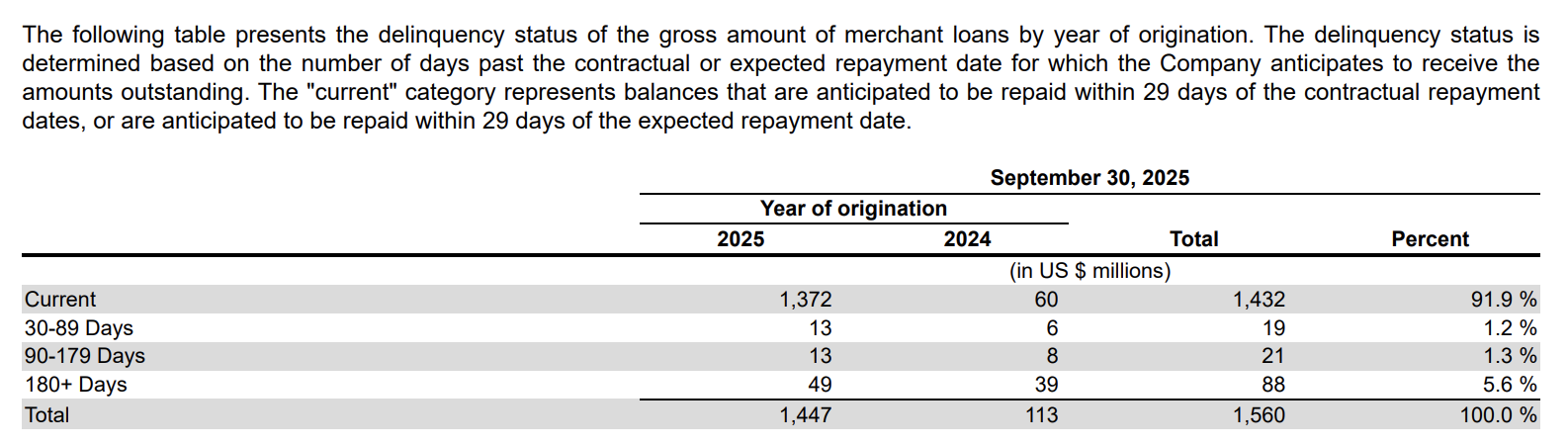
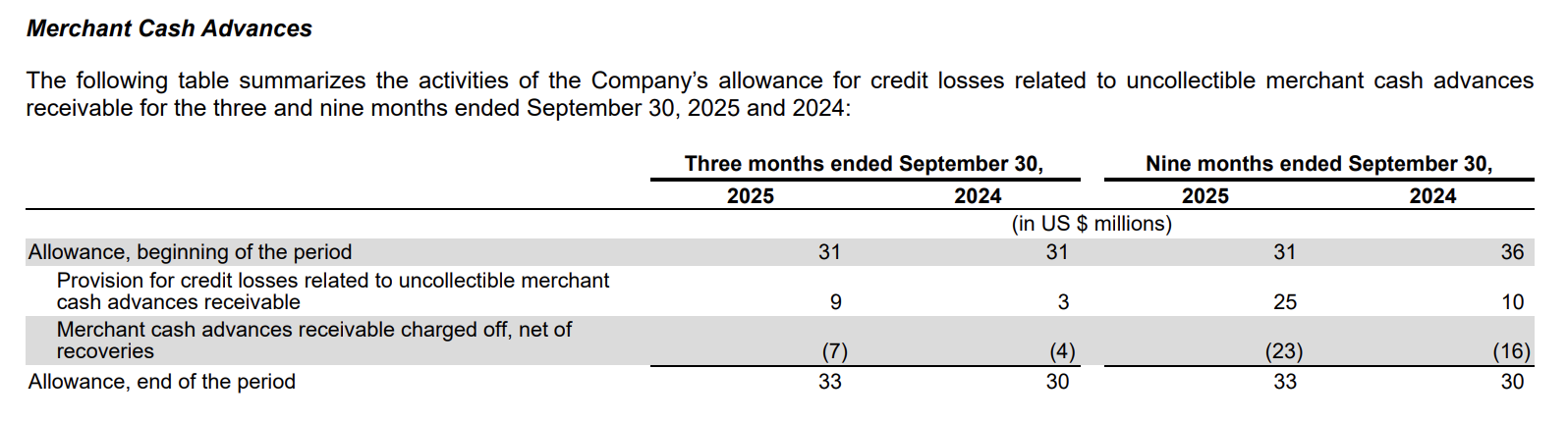
A snapshot of payment status from their Q3 report:
PayPal: Business Loan and Working Capital Originations of $600M in Q3
November 3, 2025PayPal originated approximately $600M in business loans and working capital loans in the third quarter. A financial institution makes the loans to their clients and PayPal purchases the receivables and services the portfolio. Under this basis the company has purchased $1.6B worth of receivables for the first nine months of 2025.
“The allowance for credit losses at September 30, 2025 for our merchant receivable portfolio was $163 million, an increase from $113 million at December 31, 2024,” PayPal stated in its earnings report. “The increase in allowance for credit losses was related to a decline in credit quality of merchant loans outstanding primarily from modifications in acceptable risk parameters in 2024, which included broadened eligibility. In the second quarter of 2025, we updated our expected credit loss model for all portfolios to utilize multiple economic scenarios rather than the single scenario previously utilized. These changes did not have a material impact on our allowance for credit losses in the period.”