
You Underwrite Merchants. Your Credit Line Underwrites You.
Mendy Reich, CPA, is Principal of River Edge Advisors, a Cedarhurst, NY-based accounting and fractional CFO firm serving clients nationwide and internationally. His CPA-led team of 75 keeps the books for more than 40 MCA funders and lenders, including deal-level portfolio reporting, remittance reconciliation, syndicator balances, and borrowing-base reporting. The firm also works in the capital markets space, making introductions and helping clients obtain debt or capital.
What lenders and participants look for when the funder is the one raising capital.
Every MCA funder knows how to read a merchant’s bank statements. Stacked positions, thin days, revenue that only exists on paper – you can spot them in minutes.
When you go to raise a credit facility or bring on participants, the roles reverse. Now a capital provider is reading your books, and many of them read them the way you read a merchant’s statements. What is in the file shapes the conversation: how much diligence it takes, what questions come back, and what the lender is willing to paper. Terms themselves are always the lender’s call, set in the facility documents – but the reporting you bring to the table is the part you control.
Capital providers do not underwrite your story. They underwrite your reporting.
And the tests are the same tests. The red flags in a merchant’s file have direct equivalents in a funder’s, and a diligence team can spot them just as quickly. Our team keeps the books for more than 40 MCA funders and lenders. These are four places a funder’s own reporting can undermine its own raise – with a hypothetical illustration of what the other side of the table is looking at.
The number that doesn’t tie
When a merchant’s deposits do not match the application, you do not assume the business is growing. You assume the file is unreliable, and everything else in it gets discounted.
A funder who can quote origination volume but cannot produce collections by funding vintage can get read the same way. The performance question is not how much you funded last quarter; it is how each vintage is collecting against plan. “We funded $2.4M in Q2” is a volume statement. “Our Q1 vintage collected $940K against $1.10M expected – 85.5% of plan” – hypothetical numbers – is a performance statement, and it is the one the lender’s model needs. If the collections data is not readily available, diligence can slow while someone reconstructs it – and a reconstructed number tends to face harder questions than one produced on demand.
The number that improved on its own
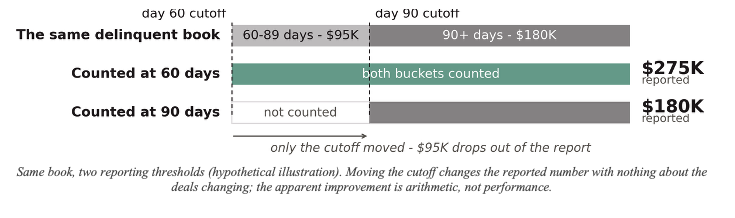
When a merchant’s revenue jumps the month before underwriting, you ask what changed. When a funder’s reported defaults fall after a policy change, a lender may ask the same question.
Nothing about the book improved; the ruler moved. A reported default figure that falls by a third because the definition changed should be expected to surface in diligence – rolled and rewritten deals, aging buckets, all of it – and a quiet shift discovered there costs more credibility than a conservative number stated up front. The defense is boring: a written default-recognition policy appropriate to the applicable accounting requirements and your agreements, applied the same way every month, with any change documented and explained before someone asks.
The headline that isn’t the real number
A merchant can state $80K a month in revenue; you care what actually hits the account. A facility can quote an 80% advance rate; the lender cares what the rate applies to.
Watch what eligibility does to a $10.0M book in a hypothetical example: remove $600K of deals past 90 days, $450K of concentration above a 10% single-merchant cap ($1.45M sits with one merchant; only $1.0M counts), and $300K in defaults – three non-overlapping buckets – and $8.65M remains eligible. At an 80% advance rate that is $6.92M of gross capacity, before any existing draws or other reserves the agreement subtracts. The headline was 80% of a $10M book; the gross borrowing capacity, before any draws or other reserves, comes to about 69% of it.
That gap is why lenders live in the eligibility definitions, and why the practical standard is reproducibility: an eligibility report with written rules that ties back to the general ledger every month. A spreadsheet only one person can rebuild draws scrutiny simply because it cannot be verified.
Other people’s money
A stacked position is an obligation the application did not mention. Unreconciled syndicator and participant balances read the same way from the outside: money collected but not yet remitted, open questions about splits, old deals never trued up. If you syndicate, these balances are part of how outsiders read your operation. Regular reconciliation on a cadence matched to your activity and reporting obligations, and quick resolution of breaks, keeps them from surfacing for the first time in someone else’s diligence file.
The bottom line
The disciplines behind all four are unglamorous: remittance reconciliation that ties collected-by-vintage to the bank; a written default policy applied consistently; a borrowing-base report with documented rules that ties to the ledger; syndicator balances reconciled on a regular cadence – monthly is a workable starting point; origination and collections reported as separate metrics, because blended numbers invite questions; and a monthly package prepared or reviewed by a CPA firm familiar with MCA reporting, so the predictable diligence questions are answered before they are asked.
None of this guarantees an approval, an advance rate, or any particular covenant – every lender underwrites differently, and the agreement governs. What reporting discipline does is remove avoidable friction. And when the reporting holds up, the raise itself is still a sales process – it helps to have people who know the capital markets side, making introductions and helping funders get debt or capital in place. Treat your own reporting with the same skepticism you bring to a merchant’s statements, and you will know what the other side of the table is looking at.
Numbers in the worked examples are hypothetical illustrations created to explain the concepts.
Last modified: October 30, 2026Mendy Reich, CPA, is Principal of River Edge Advisors, a Cedarhurst, NY-based accounting and fractional CFO firm serving clients nationwide and internationally. His CPA-led team of 75 keeps the books for more than 40 MCA funders and lenders, including deal-level portfolio reporting, remittance reconciliation, syndicator balances, and borrowing-base reporting. The firm also works in the capital markets space, making introductions and helping clients obtain debt or capital.