
Bluevine CEO on Being Acquired by a Bank: “You’re seeing a lot of fintechs becoming banks right now.”
Valley National Bancorp is acquiring Bluevine for $340M in a 75% cash, 25% stock transaction.
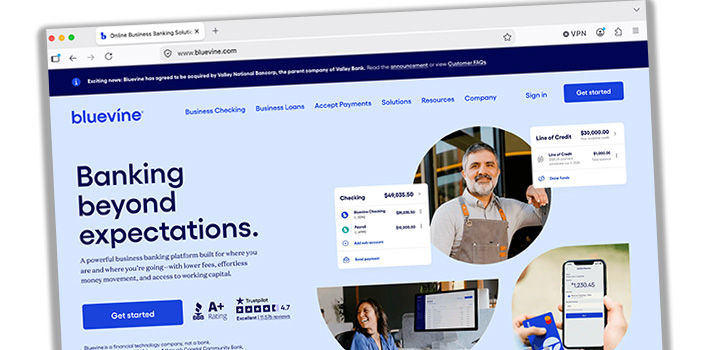 During a company conference call discussing the announcement, Valley CFO Travis Lan said that “the transaction does not require traditional bank regulatory or shareholder approval and is expected to close early in the first quarter of 2027.”
Veterans of the fintech industry may recall Bluevine’s early days doing invoice factoring and lines of credit, but the company has long since pivoted primarily toward small business banking. And that’s what interested Valley, according to the bank’s chief executives, particularly the deposits.
“[Bluevine has] about $130 million of on-balance sheet loans today,” said CFO Lan. “However, they have a variety of forward flow agreements, and they sell a lot of their production for a gain. We assume that remains fairly constant. So the growth in on-balance sheet loans is fairly modest. We’ll continue to sell some of the production into the forward flow agreements that are in place today. So that will support fee income. The risk-adjusted returns on the loans have been very strong historically, but this is certainly a deposit play, not on-balance sheet loan play.”
Bluevine, for example, has 175,000 small business banking customers while Valley only had 9,000. The impact to Valley is a 20x increase in its small business customer base. Valley said that it does not really intend to ramp up its small business loan originations as a result, however.
“While the [Bluevine] loans are attractive from a risk-adjusted return perspective, I mean, obviously, we have our credit appetite that will continue to drive the majority of the loans that we would on balance sheet across the franchise,” said Lan. “So as we’ve talked about historically, loan growth is not a problem for Valley. It’s funding that loan growth. And so while the loans that will come from Bluevine is modest in size and we’re willing to continue, it will not become an outsized part of the portfolio in aggregate.”
The economics of Bluevine loans were offered later in the call:
“The average FICO on [Bluevine] loans is around 720,” said Lan. “So it’s fairly high quality. The loss rates, as you’d imagine, for small business are somewhat higher than what we’re used to, but the portfolio is very small. And the loss rates have improved actually in the last couple of years. So they have, I think, average annual losses are running kind of low to mid-single digits. They have an 11% allowance against it today. We’ll add to that allowance at acquisition, and that’s kind of the approach that we’ll preserve going forward.”
Analysts wondered why Bluevine chose to sell.
“You’re seeing a lot of fintechs becoming banks right now,” said Bluevine CEO Eyal Lifshitz, who will become Head of Small Business Banking at Valley as a result of the deal. “It makes a lot of sense, both the economics, the regulatory certainty, just the ability to control your destiny, the infrastructure and so on. And so there’s different paths to get there, de novo, acquire a bank, and get acquired by a bank. And so for us, when we looked at the options in front of us, this felt like for us, the best option to accelerate our vision of building our small business franchise.”
Three years ago, Bluevine was mulling over an IPO, according to an interview with Axios. At the time, it quoted Lifshitz as saying the company was not profitable but that it could become so.
“When you look at our scale and the pace of growth, and as we approach going public, I think we would be in a position where we could become profitable,” it quotes him as saying. It further said that the company’s valuation was less than a billion dollars at the time.
The vast majority of Bluevine small business banking customers today are not signing up to borrow. They’re signing up for the easy process and user experience of business banking. Their KYC process is much more cost-effective than Valley’s and their use of AI superior.
“When Bluevine does its enhanced due diligence on some of their AML and KYC clients, they do at a cost of about $20. It cost us about $500,” said Valley CEO Ira Robbins. “80% of the clients that reach out to their customer care center at Bluevine are resolved by AI agents. To put that into perspective, that’s around 2% at Valley.”
In an interview Lifshitz did with deBanked in 2017, the interviewer made a remark about the Bluevine vision: “It sounds like the beginnings of a bank.”
Last modified: September 29, 2026